Description
Quick-Reference Overview Matrix
For efficient laboratory evaluation, the matrix below consolidates the core analytical, storage, and cross-reference parameters of GHK-Cu 100mg.
| Core Parameter | Technical Summary & Quick Data | Internal Cross-Reference |
|---|---|---|
| Purity & Matrix Yield | ≥ 98% HPLC Certified Matrix Massive 100mg volume, sterile filtered, displaying the uniform blue crystalline hue indicative of true copper-chelate coordination. | View High-Purity Series → |
| Primary Target Path | Extracellular Matrix (ECM) Synthesis: Promotes direct fibroblast activation rows, driving targeted upregulation of collagen, elastin, and proteoglycan structural paths. | Anti-Aging Series → |
| Storage Protocol | Lyophilized Powder: -20°C to -80°C (Up to 24 months). Store in dark settings. Reconstituted Layer: 2°C to 8°C (Exhaust the fluid layer within 10–14 days max). Avoid persistent UV light exposure. | Buy Reconstitution Diluents → |
What Is GHK-Cu?
What Is GHK-Cu?
GHK-Cu (Glycyl-L-Histidyl-L-Lysine Copper) is an advanced, naturally occurring copper-binding peptide complex classified as a powerful tissue remodeling factor. Functioning as an active cellular signal, the GHK peptide molecule features an exceptionally high binding affinity for copper ions, forming a highly stable and authentic chelate structure. Inside analytical laboratory models, this specific coordination setup enables the peptide to transport essential copper micro-elements directly into cellular systems. This process initiates a cascade of genetic updates that stimulate fibroblasts, regulate tissue recovery signaling fields, and support the natural replacement of damaged skin matrix frameworks.
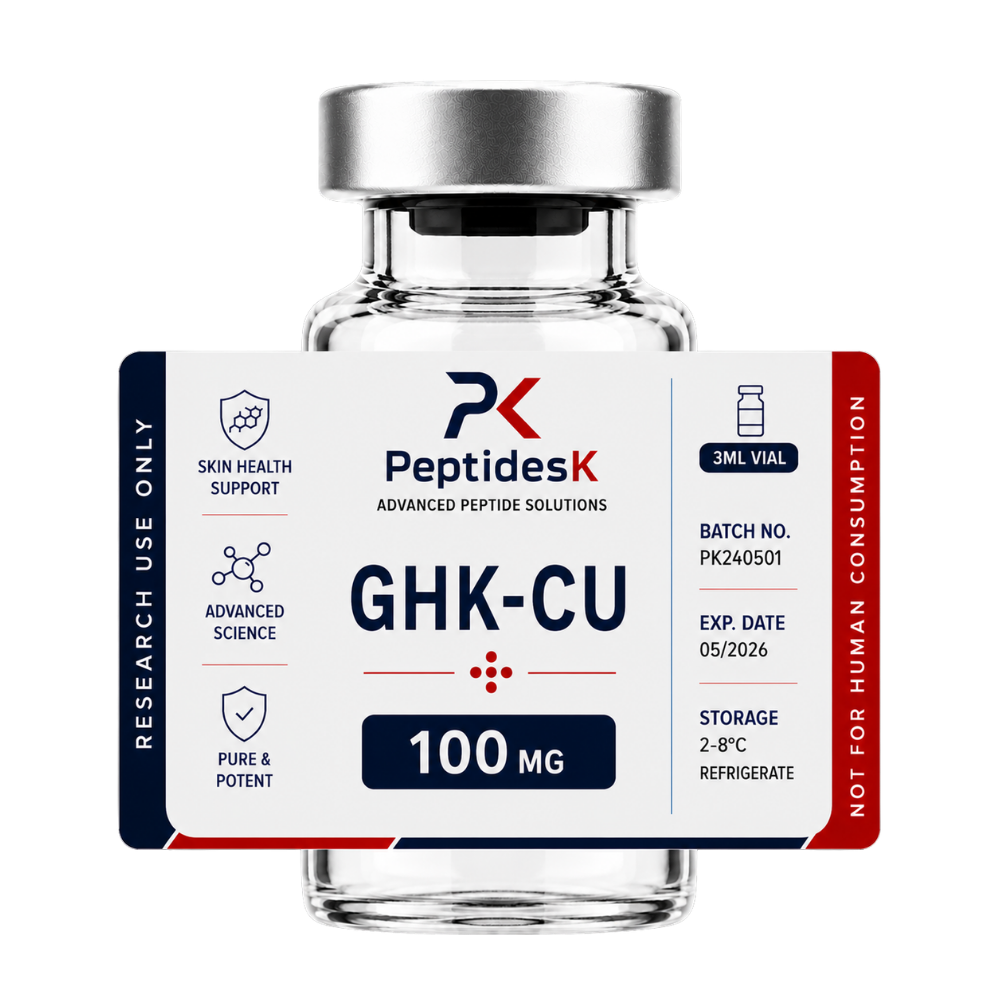
GHK-Cu 100mg Laboratory Standard
Our GHK-Cu 100mg formulation focuses purely on structural skin matrix and mechanical tissue scaffolding. It provides an impressive, large-scale material yield developed explicitly for high-throughput multi-well layouts, automated testing plates, and long-term cell row mapping studies. Packed under absolute vacuum criteria inside sterile glass vials, the dense 100mg freeze-dried powder remains perfectly protected against breakdown and environmental stress throughout its storage lifecycle.
| Technical Parameter | Specification Level |
|---|---|
| Active Mass Payload | 100mg per Vial (Pure Freeze-Dried Powder) |
| Chemical Classification | Copper-Coordinated Tripeptide Chaperone Complex |
| Matrix Purity Level | ≥ 98.0% (HPLC Certified & Sequence Verified) |
| Physical Presentation | Uniform, deep blue-tinted freeze-dried solid cake (Authentic copper-chelate indicators) |
| Primary Research Focus | Fibroblast Activation Kinetics, Extracellular Matrix Collagen (Type I, III, IV) Deposition, Skin Matrix Balancing Assays |
Regulatory Compliance Notice: This product is synthesized, distributed, and intended solely for laboratory research and development purposes. It is strictly not for human therapeutic use, clinical trials, or cosmetic applications. Lot analytics are documented systematically.
How GHK-Cu Works (Skin Matrix & Tissue Repair Mechanisms)
How GHK-Cu Works (Skin Matrix & Tissue Repair Mechanisms)
In analytical matrix biology, advanced cell studies, and gene expression publications, GHK-Cu is evaluated extensively across multilateral structural pathways. Investigators utilize this molecule to analyze:
- Active Cell Growth Kinetics: Mapping real-time acceleration curves in tissue fibroblast growth and overall cell attachment tracking rows post-exposure.
- Collagen & Elastin Production: Quantifying the increase in structural skin proteins, monitoring the production of natural cellular components which control fine scaffolding layout.
- Skin Matrix Balance Systems: Studying how the compound balances natural enzymes alongside protective links to track optimal, smooth tissue alignment parameters.
GHK-Cu Structural Mechanism of Action
GHK-Cu coordinates tissue environments by delivering a specialized copper-transport signaling loop directly across target cell domains:
- Safe Copper Binding: Upon introducing the solution, the peptide binds smoothly with local copper ions, preventing loose atoms from prompting destructive oxidation stress reactions.
- Gene Pathway Activation: The complex interacts with cell-surface networks, upregulating core genes linked directly to collagen synthesis paths and localized cellular defense lines.
- Flawless Matrix Remodeling: Directs target tissue layers to increase the production of Type I, III, and IV collagen strands while balancing breakdown pathways, driving an immaculate rebuilding loop.
Operational Summary: Core Benefits vs. Laboratory Constraints
A straightforward overview of the high-yield testing advantages and exact handling rules to maintain peak peptide stability during laboratory rows.
| Observed Research Values | Technical Assay Constraints |
|---|---|
| • Flawless Scaffolding Control: Masters fibroblast-to-collagen synthesis tracks natively, providing a gold-standard reference model for extracellular matrix remodeling. | • Light Sensitivity Infiltration: The chemical balance of copper-chelate structures can face slow breakdown if exposed to bright, persistent UV light rays during testing arrays. |
| • Massive 100mg Fluid Stock Capacity: Ideal for expansive automated testing plates, preventing data variance issues linked to swapping between separate lot vials. | • Liquid Solution Stability Limits: In fluid phases, copper molecules sitting near peptide connections can accelerate breakdown if the mixed solution is kept beyond 2 weeks. |
Peptide Comparison Matrix
Peptide Comparison Matrix
| Research Compound | Operational Engine | Core Analytical Focus | Target Nodes | Molar Status |
|---|---|---|---|---|
| GHK-Cu 100mg (This Product) | Copper-Chelate Complex | Fibroblast replication, collagen type I/III/IV deposition, and smooth matrix remodeling. | Skin Matrix | Tripeptide |
| BPC-157 10mg | VEGFR2 Activation | Systemic angiogenetic speed, tissue repair pathways, and tendon healing models. | VEGFR2 / EGR-1 | Pentadecapeptide |
| TB-500 10mg | Actin Sequestration | Cellular migration tracking, wound space infiltration, and flexible locomotion assays. | G-Actin / MMPs | Peptide Fragment |
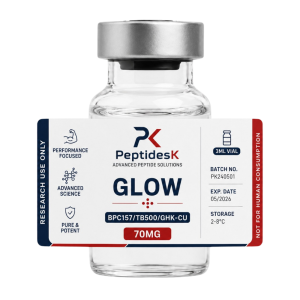
| GLOW 70MG Blend | Triple Synced Matrix | Overlapping collagen synthesis, rapid actin cell movement, and vascular recovery loops. | GHK / BPC / TB | Mixed Blend |
| Explore advanced formulations & single lots: | Peptide Blends → All Compounds → | |||
Laboratory Climate & Handling Standards
Laboratory Climate & Handling Standards
To safely insulate the copper-chelate balance from photolytic oxidation and protect your high-yield mass from early hydrolysis, implement rigid handling controls:
- DEEP FREEZE Lyophilized Powder: Lock instantly inside sub-zero laboratory storage running strictly at -20°C or optimal -80°C. Preserves complete amino chain sequence layout for up to 24 months.
- LIGHT ISOLATION UV Shielding: Authentic GHK-Cu is sensitive to intense light exposures. Keep the glass vials stored inside dark boxes, opaque foil covers, or closed climate containers.
- LIQUID PHASE WINDOW Solubilized Matrix: Store strictly under refrigeration between 2°C and 8°C. Reconstituted fluid phases are sensitive to copper-peptidyl bond stress; exhaust the fluid layer completely within 10 to 14 days max. Never freeze fluid mixtures.
Reconstitution Protocol
- Allow the blue 100mg GHK-Cu vial to naturally reach room temperature equilibrium before opening its vacuum seal.
- Cleanse the upper rubber septum top using a fresh isopropyl alcohol wipe.
- Slowly inject 2ml to 5ml of sterile bacteriostatic water down the internal glass envelope wall, letting the fluid cascade gently to minimize structural sequence shock paths.
- Do not shake or vortex. Mechanical friction can degrade long-term fluid stability. Gently rotate the vial horizontally in circular patterns until the blue powder fully dissolves into a pristine, crystal-clear ocean-blue liquid layer.

There are no reviews yet.