
Description
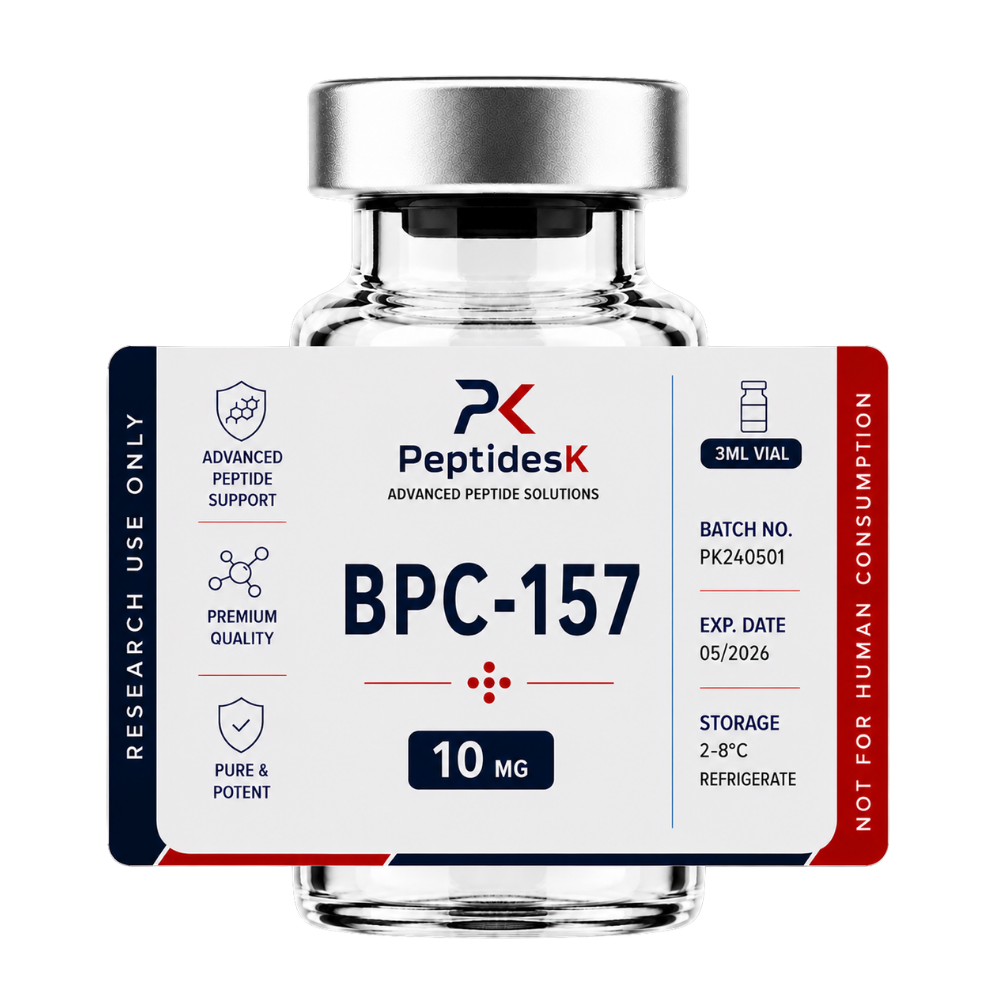
BPC-157 10mg Core Metrics
Technical specification parameters optimized for integrating high-purity BPC-157 into focused cell assay rows.
| Research Parameter | Assay Benchmark Profile | Internal Catalog Link |
|---|---|---|
| Sequence Blueprint | H-Gly-Glu-Pro-Pro-Pro-Gly-Lys-Pro-Ala-Asp-Asp-Ala-Gly-Leu-Val-OH | High-Purity Series → |
| Purity Baseline | ≥ 98.0% via High-Performance HPLC | Tissue Repair Series → |
What is BPC-157 Peptide?
What is BPC-157 Peptide?
BPC-157 (Body Protection Compound-157) is a refined synthetic pentadecapeptide consisting of a 15-amino acid sequence layout. Originally modeled after a protective regulatory protein found naturally inside human gastric juice, BPC-157 is widely recognized for its high molecular stability. Unlike standard growth factors that break down rapidly when exposed to environmental enzymes, BPC-157 maintains a highly resilient structure. In laboratory cell cultures and tissue models, it acts as an active promoter of vascular repair and cell growth pathways.
BPC-157 Peptide Quick Specifications
| Technical Property | Laboratory Standard Specifications |
|---|---|
| Chemical Structure | Synthetic Pentadecapeptide (15 Amino Acids) |
| Molecular Formula | C62H98N16O22 |
| Purity Baseline | ≥ 98.0% Pure Certified via HPLC Testing |
| Product Appearance | Sterile filtered, white uniform lyophilized powder cake |
| Primary Research Focus | VEGFR2 pathway activation, endothelial cell growth, and tissue modeling assays |
How Does BPC-157 Work in Laboratory Assays?
BPC-157 operates by directly interacting with the vascular endothelial growth factor receptor 2 (VEGFR2) activation pathways across sample cell membranes. This specific binding bypasses standard cellular blockades to jumpstart downstream signaling lines, prompting the upregulation of early growth response gene frameworks. As a result, researchers can observe real-time acceleration curves in microvascular cell growth and granulation tissue stabilization natively within their in vitro culture setups.
BPC-157 Research Applications
BPC-157 Research Applications
In analytical matrix biology and advanced cell modeling publications, standalone BPC-157 is widely tracked for its distinct angiogenetic and tissue recovery properties. Researchers utilize this synthetic peptide to observe cell line acceleration, cell movement, and growth factor receptor updates under controlled laboratory environments. Its exceptional structural stability allows the compound to maintain integrity across diverse test environments, making it an ideal reference standard for consistent profiling assays.
BPC-157 Core Pathways & Action Matrix
The table below consolidates the primary cellular pathways, biological markers, and research objectives tracked during BPC-157 laboratory testing lines:
| Target Pathway | Observed Cellular Action | Primary Research Goal |
|---|---|---|
| Vascular Signaling | Interacts selectively with vascular endothelial growth receptors to stimulate early blood vessel development loops. | Tracking microvascular density and collateral vessel multiplication. |
| Growth Gene Activation | Triggers the upregulation of Early Growth Response gene frameworks within target cell cultures. | Mapping downstream cytokine production and matrix modeling cues. |
| Cell Migration Kinetics | Accelerates the growth, multiplication, and migration velocity of functional recovery cells and fibroblasts. | Studying extracellular matrix deposition and structural tissue modeling. |
| Nitric Oxide Modulation | Balances endothelial and inducible nitric oxide synthesis pathways naturally during stress phases. | Investigating localized blood-flow stabilization parameters. |
Step-by-Step Mechanism of Action
When BPC-157 is introduced to the sample research media, it coordinates biological responses through a highly targeted, multi-stage interaction loop:
- Receptor Alignment: The peptide sequence aligns smoothly with specialized growth receptors on cell membranes without triggering surface stress anomalies.
- Intracellular Communication: This clean binding bypasses standard cellular blocks, forcing an immediate internal signaling and phosphorylation wave.
- Transcription Updates: The signal reaches the nuclear core, prompting direct transcription updates that accelerate localized growth factor receptor generation.
- Scaffolding Stabilization: Endothelial cells initiate capillary row elongation and anchor tightly onto the surrounding layers, establishing a balanced tissue recovery matrix.
How Does BPC-157 Compare to Other Research Peptides?
How Does BPC-157 Compare to Other Research Peptides?
To assist in protocol coordination, it is essential to differentiate the angiogenetic and vascular focus of BPC-157 10mg from alternative tissue repair and structural peptides available in our collection. While BPC-157 directly targets blood vessel development and endothelial pathways, other peptides operate through distinct molecular engines such as cellular migration or extracellular matrix scaffolding. Understanding these baseline differences allows for more precise laboratory assay designs.
Peptide Quick Comparison Matrix
The comparative table below outlines the core differences in research focus, mechanism of action, and primary target nodes across our high-purity laboratory peptide catalog:
| Research Peptide | Mechanism of Action | Primary Laboratory Focus | Target Nodes | Peptide Structure |
|---|---|---|---|---|
| BPC-157 10mg (This Product) | VEGFR2 Pathway Activation | Accelerating capillary growth, angiogenesis speed, and localized tendon/ligament repair models. | VEGFR2 / EGR-1 | Pentadecapeptide (15-AA) |
| ARA 290 | Innate Repair Agonism | Neuropathic tissue shielding, localized vascular protection, and anti-inflammatory loops. | IRR Receptor | 11-AA Peptide |
| GHK-Cu 100mg | Copper Chelation Chaperone | Upregulating collagen type I/III/IV deposition, fibroblast replication curves, and scarless matrix modeling. | ECM Scaffolding | Tripeptide (3-AA) |
| Epithalon 10mg | TERT Gene Promoter | Telomere extension mapping, chromatin epigenetic unfolding, and cellular lifespan tracking. | Nuclear DNA / TERT | Tetrapeptide (4-AA) |
| Explore advanced formulations & single lots: | Peptide Blends → All Compounds → | |||
Synergistic Research Application Notice
In advanced tissue regeneration protocols, researchers frequently study BPC-157 in combination with alternative compounds to observe cumulative outcomes. For example, the pre-mixed Wolverine Blend (BPC-157 + TB-500) is highly valued in pilot remediation assays to track how blood vessel speed and cell locomotion work together. Similarly, combining BPC-157 with GHK-Cu allows for the simultaneous observation of capillary elongation and structural extracellular matrix overhaul. Standalone formulations provide the flexibility needed to create individual concentration curves for precise baseline control setups.
How to Store BPC-157 Lyophilized Powder & Liquid Solutions
How to Store BPC-157 Lyophilized Powder & Liquid Solutions
To keep your high-purity BPC-157 peptide stable and prevent the amino acid chains from unfolding prematurely, you must follow strict temperature and environment parameters. Proper handling ensures that your laboratory assay baselines remain consistent and free from degradation artifacts over time.
- FREEZER (-20°C) Lyophilized Peptide Powder: Store the dry crystalline powder inside a laboratory freezer at -20°C to -80°C for long-term storage. This fully seals the peptide configuration against degradation loops for up to 24 months.
- ROOM TEMP (25°C) Shipping & Transit Window: In its dry, vacuum-desiccated solid cake state, BPC-157 is highly resilient. It can easily endure ambient transport fluctuations up to 25°C for a maximum of 3 weeks. Always return the vials to deep-freeze storage upon delivery.
- REFRIGERATOR (2°C – 8°C) Reconstituted Liquid Phase: Once mixed into a liquid form, the solution must be stored strictly under refrigeration between 2°C and 8°C. Reconstituted fluid phases face natural structural decay; completely exhaust the active liquid within 10 to 14 days maximum. Never freeze a peptide after it has been liquified.
Step-by-Step BPC-157 Reconstitution Guide
Because structural peptide bonds are sensitive to rapid physical shock, follow this precise laboratory protocol to dissolve your 10mg BPC-157 powder cake into a stable liquid layer:
- Temperature Adjusting: Allow the 10mg BPC-157 vial to naturally reach ambient room temperature equilibrium before removing the plastic security cap. This step blocks condensation moisture from contaminating the dry cake.
- Sanitizing the Septum: Thoroughly clean the upper rubber entry core septum using a fresh, high-grade isopropyl alcohol sterile wipe.
- Gentle Liquid Cascade: Draw your laboratory diluent (such as sterile bacteriostatic water) and slowly inject 1ml to 2ml down the internal glass envelope wall. Let the fluid cascade gently down the glass rather than spraying it directly at the powder to avoid structural kinetic shock paths.
- Zero Aggressive Agitation: Do not shake, vibrate, or vortex the vial. Mechanical friction shears peptide chains easily. Instead, gently roll and rotate the vial horizontally in circular, concentric movements until the white solid cake fully transitions into a pristine, crystal-clear transparent liquid layer.

There are no reviews yet.