
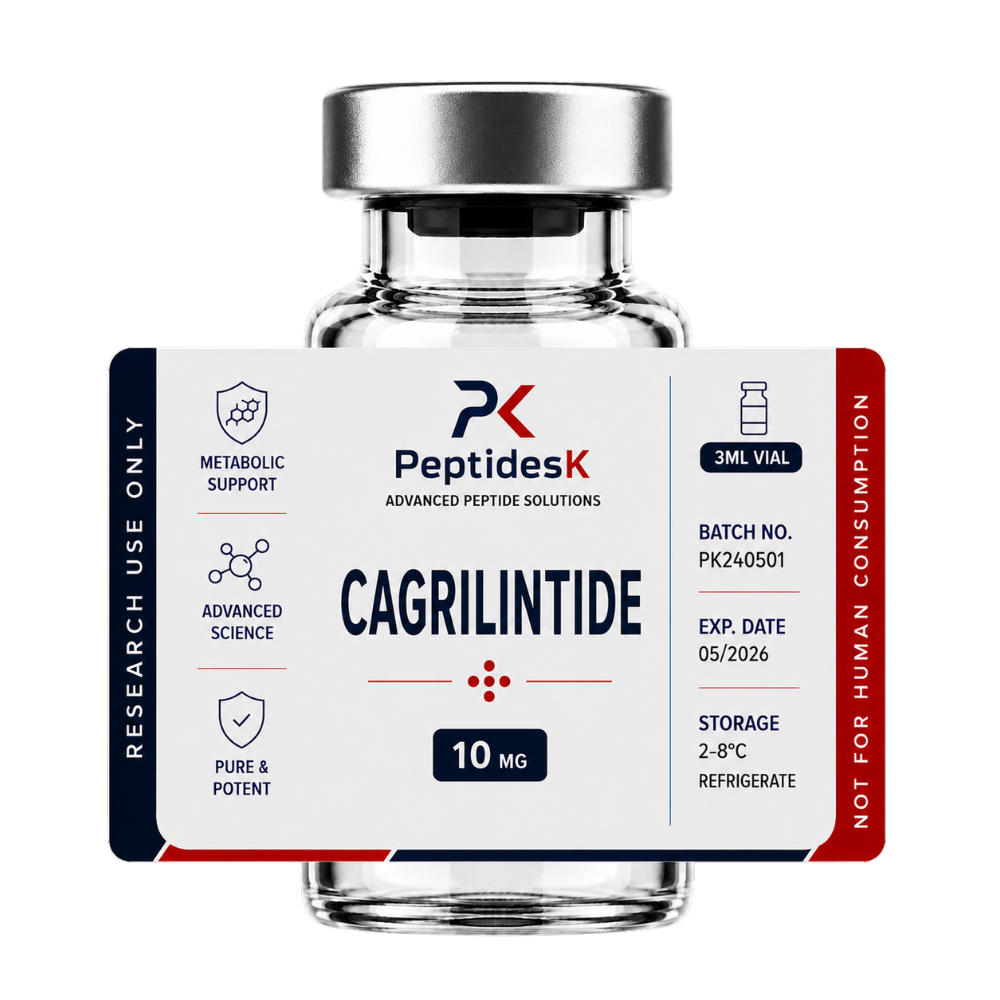
Description
Operational Parameters & Core Metrics
The table below provides analytical benchmark profiles optimized for integrating Cagrilintide 10mg into comparative metabolic research rows.
| Operational Domain | Assay Specification Data | Internal Catalog Link |
|---|---|---|
| Pathway Activation | Non-Selective Amylin Agonism: Binds dualistically to CTR-RAMP complexes to investigate hindbrain satiation signaling loops independent of central hunger structures. | Metabolic Series → |
| Purity Verification | ≥ 98% via SEC-HPLC Vacuum lyophilized to lock the acylated peptide backbone structure against storage mutations. | High-Purity Series → |
| Storage Boundaries | Freeze-Dried Cake: 24 Months (-20°C to -80°C). Solubilized State: Store at 2°C to 8°C. Must completely exhaust within 10 to 14 days maximum. | Get Lab Diluents → |
What is Cagrilintide?
What is Cagrilintide?
Cagrilintide represents a highly sophisticated milestone in contemporary metabolic research, operating as a potent long-acting analog of endogenous amylin. Naturally produced amylin is co-secreted with insulin by pancreatic cells to help manage postprandial glucose levels, but its native form suffers from rapid structural breakdown. Cagrilintide overrides these technical limitations through a unique acylation strategy and optimized amino acid modifications. By attaching a specialized fatty acid chain, the molecule displays exceptional resistance against breakdown and exhibits high binding dynamics. This results in a dramatically extended active window inside cell tracking media, enabling investigators to observe neuro-endocrine homeostatic paths without the erratic data caused by quick compound decay.
Cagrilintide 10mg Laboratory Standard
Our 10mg Cagrilintide presentation is precision-formulated for intermediate cell validation lines, metabolic synergy calibration rows, and automated saturation curves. Vacuum-desiccated and packed inside high-resistance glass vials, the structural configuration of this acylated peptide is deeply insulated from ambient moisture infiltration, sequence breakdown, and thermal stress throughout its storage lifecycle.
| Technical Attribute | Specification Framework |
|---|---|
| Active Mass Payload | 10mg per Vial (Pure Freeze-Dried Powder) |
| Chemical Structural Class | Acylated Long-Acting Amylin Receptor Agonist |
| Purity Threshold | ≥ 98.0% (HPLC Certified & Quality Verified) |
| Physical Form | Sterile filtered, white uniform freeze-dried crystalline solid cake |
| Primary Research Focus | Amylin Receptor Activation Kinetics, Postprandial Glucagon Suppression, Gastric Motility Assays, Combined Incretin Synergy Interaction Models |
Regulatory Compliance Notice: This product is synthesized, distributed, and intended solely for laboratory research and development purposes. It is strictly not for human therapeutic use, clinical obesity trials, or consumer lifestyle use. Analytical logs are maintained per batch.
How Cagrilintide Works ( Metabolic Mechanisms)
How Cagrilintide Works ( Metabolic Mechanisms)
In analytical endocrinology, advanced metabolic studies, and neuro-circuitry tracking publications, Cagrilintide is evaluated heavily for its distinct homeostatic pathways. Investigators utilize this molecule to analyze:
- Active Satiety Signaling Kinetics: Mapping how the compound acts on specialized brain stem regions within hindbrain matrices to track neuro-signaling hunger vectors.
- Gastric Emptying Deceleration: Measuring real-time delay curves in nutrient transit velocities to establish metabolic digestion baselines in research models.
- Glucagon Secretion Balancing Profiles: Tracing the natural management of cell secretory outputs under conditions of high nutrient exposure curves.
Cagrilintide Mechanism of Action
Cagrilintide coordinates advanced biological responses by utilizing a direct, multi-component binding engine:
- Core Receptor Alignment: Docks with high affinity across the core Calcitonin Receptor (CTR) backbones.
- Complex Transformation: Simultaneously engages one of three Receptor Activity-Modifying Proteins (RAMP1, RAMP2, or RAMP3), transforming the complex into a highly responsive, functional amylin receptor sub-type.
- Glucose Pace Management: This dualistic binding initiates downstream energy pathways and cyclic AMP (cAMP) flux loops, projecting central homeostatic markers that manage glucose entry velocity independent of standard pathways.
Operational Summary: Core Benefits vs. Laboratory Constraints
A straightforward overview of the 10mg metabolic testing advantages and exact handling rules to maintain peak peptide stability during laboratory rows.
| Observed Research Values | Technical Assay Constraints |
|---|---|
| • Resilient Lipophilic Tail: The acylated structural modification prevents immediate plasma clearance loops, offering an extended window for automated tracking layouts. | • Target Structure Dependency: Because actions depend on CTR-RAMP interaction profiles, isolated tissue setups lacking correct RAMP expression layouts can yield limited tracking data. |
| • Precision 10mg Calibration Volume: Provides an ideal mass profile for intermediate screening rows, preventing target saturated data errors. | • Liquid Solution Viscosity Shifts: The acylated lipophilic chain can alter molecular surface interactions in dense liquid solutions; careful reconstitution parameters must be applied. |
Peptide Comparison Matrix
Peptide Comparison Matrix
| Research Compound | Operational Engine | Core Analytical Focus | Target Nodes | Molecular Status |
|---|---|---|---|---|
| Cagrilintide 10mg (This Product) | Non-Selective AMYR Agonism | CTR-RAMP co-activation, hindbrain satiety loops, and postprandial glucagon control. | AMYR Complex | Acylated Peptide |
| Semaglutide | GLP-1R Selective Agonism | Incretin pathway regulation, glucose-dependent insulin tracking, and satiety curve shifts. | GLP-1 Receptor | Modified Peptide |
| Tirzepatide | Dual GIP/GLP-1 Agonism | Synergistic insulin secretion updates, metabolic rate acceleration, and fatty acid clearance assays. | GIPR / GLP-1R | Acylated Dimer |
| Orforglipron | Non-Peptide GLP-1R Agonism | Oral-route metabolic modeling, stable cyclic AMP tracking, and gastrointestinal transit velocity curves. | GLP-1R (Oral) | Small Molecule |
| Explore advanced formulations: | Peptide Blends → All Compounds → | |||
Storage & Reconstitution Guidelines
Storage & Reconstitution Guidelines
To safely isolate the acylated sequence maps from mechanical deformation and shield the peptide backbone from premature hydrolysis loops, implement strict handling parameters:
- DEEP FREEZE Lyophilized Solid: Lock inside sub-zero laboratory storage running strictly at -20°C or optimal -80°C. Preserves peptide integrity for up to 24 months.
- TRANSIT BUFFER Vacuum Desiccation: Dry crystalline states withstand typical transport fluctuations up to 25°C for 3 weeks max. Transfer to deep freezers post-arrival.
- LIQUID PHASE LIMIT Solubilized State: Store strictly in refrigeration between 2°C and 8°C. Reconstituted solutions gradually lose baseline efficiency in fluids; exhaust the mixed layer within 10–14 days maximum. Never freeze fluid mixtures.
Reconstitution Protocol
- Allow the 10mg Cagrilintide vial to naturally reach room temperature equilibrium before opening its vacuum seal.
- Cleanse the upper rubber septum top using a fresh isopropyl alcohol wipe.
- Slowly inject 1ml to 2ml of sterile bacteriostatic water down the internal glass envelope wall, letting the fluid cascade gently to minimize structural sequence shock paths.
- Do not shake or vortex. Acylated structures can form unwanted foaming aggregation if agitated heavily. Gently rotate the vial horizontally in circular patterns until the white solid powder fully transitions into a pristine, clear liquid layer.

There are no reviews yet.