
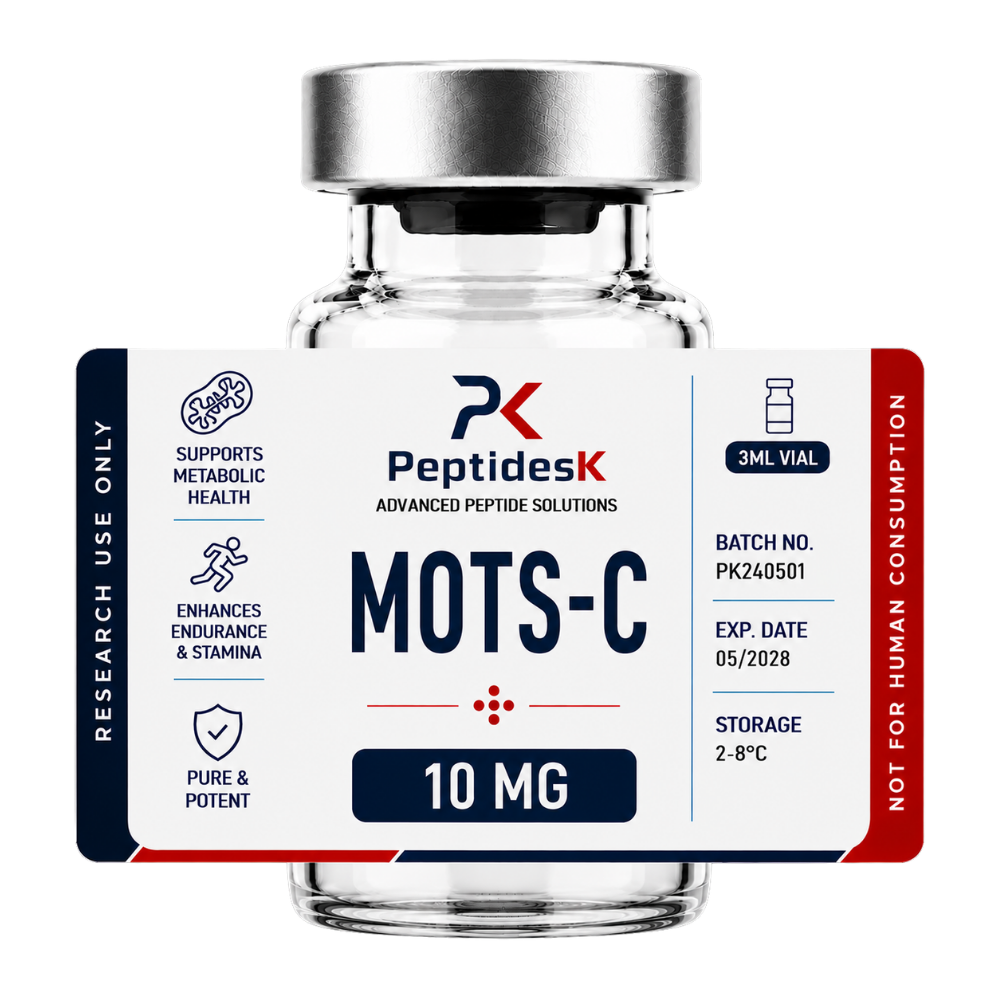
Description
Analytical & Operational Blueprint
The blueprint matrix below provides a consolidated reference for integrating MOTS-c 10mg into automated multi-well screening protocols.
| Structural Dimension | Laboratory Benchmark Data | Catalog Routing |
|---|---|---|
| Sequence & Target | 16-Amino Acid Loop: Tracks downstream cellular longevity mechanisms, metabolic homeostasis and the suppression of senescence profiles via autonomous AICAR induction pathways. | Explore Anti-Aging Series → |
| Purity Verification | ≥ 98% via MS Analysis Desiccated to block amino backbone shifts during microfluidic tracking. | High-Purity Vault → |
| Solution Lifecycle | Freeze-Dried: 24 Months (-20°C). Reconstituted: 10–14 Days (2°C to 8°C). Avoid intense kinetic mixing. | Get Diluents → |
What is MOTS-c?
What is MOTS-c?
MOTS-c represents a fascinating paradigm shift in cellular biology, being an active signaling agent transcribed directly from the mitochondrial 12S rRNA locus rather than the nuclear engine. This autonomous origin allows the 16-amino acid compound to function as an adaptive metabolic messenger. When target cells register structural stress or raw nutrient depletion, MOTS-c initiates a critical retrograde migration path directly into the nucleus, binding with distinct transcription nodes to reset cellular longevity parameters. Modern investigators utilize this compound to analyze advanced glucose handling mechanisms and skeletal tissue adaptivity metrics without requiring external physical stress elements.
MOTS-c 10mg Assay Design
Our MOTS-c 10mg formulation delivers pristine chemical clarity engineered for microfluidic tracking and localized biochemical mapping. Every vial is insulated under deep vacuum criteria to stabilize the linear peptide configuration against ambient shipping environments, securing flawless single-batch parameters across delicate experimental setups.
| Technical Feature | Specification Level |
|---|---|
| Molecular Mass | 2174.6 g/mol |
| Amino Acid Blueprint | MRWQEMGYIFLPRKPR |
| Empirical Formula | C101H152N28O22S2 |
| Purity Baseline | ≥ 98.0% via HPLC Integration |
| Primary Target Path | AMPK Pathway Induction, GLUT4 Translocation Dynamics, Fatty Acid β-Oxidation Profiling |
Core Operational Mechanisms of MOTS-c
Core Operational Mechanisms of MOTS-c
In analytical bioenergetics literature, MOTS-c is observed to orchestrate a rapid, receptor-independent metabolic reprogramming cluster. When introduced into evaluated cell populations, its signaling focus split into parallel homeostatic pathways:
- The AICAR Accumulation Axis: The peptide drives a deliberate shift in purine metabolic pathways, fostering a calculated accumulation of cellular AICAR (5-aminoimidazole-4-carboxamide ribonucleotide).
- Natively Prompted AMPK Activation: Rising AICAR values directly prompt the activation of AMP-activated protein kinase (AMPK) networks, bypassing traditional systemic hormonal paths.
- GLUT4 Translocation: Active AMPK states coordinate the immediate migration of GLUT4 transport proteins directly to the plasma membrane layer, optimizing cellular glucose clearance kinetics.
Analytical Summary: Benefits vs. System Limitations
| Observed Research Values | Technical Assay Constraints |
|---|---|
| • Non-Nuclear Metabolic Tracing: Offers an exclusive look into mitochondrial retrograde control arrays, isolating mitochondrial-driven feedback lines from nuclear genome variables. | • Rapid Proteolytic Cleavage: Lacking heavy cyclic structures or protective N-terminal modifications, the 16-amino acid sequence requires careful handling in serum-free media. |
| • Targeted Insulin Study: Enables deep mapping of non-insulin dependent glucose clearance paths inside isolated skeletal tissue structures. | • Media pH Sensitivity: Minor variations in assay buffer acidity can alter the peptide’s spatial solubility, risking localized crystal aggregation noise. |
Peptide Comparison Matrix
Peptide Comparison Matrix
To support advanced experimental setups, the matrix below details the physiological and operational contrasts between MOTS-c 10mg and alternative metabolic or bioenergetic lines in our collection:
| Research Compound | Operational Engine | Core Analytical Focus | Target Nodes | Molecular Base |
|---|---|---|---|---|
| MOTS-c 10mg(This Product) | Mito-Retrograde Signal | AMPK pathways, non-insulin glucose clearance, metabolic aging models. | AICAR / AMPK | Linear Peptide |
| SLU-PP-332 5mg | Nuclear Pan-Agonism | Oxidative fiber transitions, mitochondrial replication, fat mass modulation. | ERRα / β / γ | Non-Steroidal |
| NAD+ 500mg | Ubiquitous Coenzyme | Electron transport efficiency, Sirtuin deacetylation, DNA PARP tracking. | SIRT / PARP | Dinucleotide |
Laboratory Climate & Handling Standards
Laboratory Climate & Handling Standards
To safely shield the un-linked 16-amino acid sequence from structural degradation and avoid non-enzymatic breakdown vectors, maintain strict climate control boundaries:
- DEEP FREEZE Lyophilized Solid: Lock inside laboratory freezers running at -20°C or -80°C. Secures structural sequence baseline metrics for up to 24 months.
- TRANSIT WINDOW Vacuum Desiccation: The dry solid safely resists ambient shipment paths up to 25°C for 3 weeks max. Transfer to cold storage instantly post-delivery.
- LIQUID PHASE Solubilized State: Store strictly in refrigeration between 2°C and 8°C. Exhaust the testing solution fully within 10 to 14 days maximum. Never freeze mixed fluids.
Reconstitution Protocol
- Allow the 10mg MOTS-c vial to reach ambient room balance naturally inside a clean laboratory envelope before opening its muzzled seal.
- Meticulously swab the upper rubber core interface with a fresh isopropyl wipe.
- Slowly inject 1ml or 2ml of sterile bacteriostatic water, running the stream down the internal glass barrier to isolate the linear chain from kinetic shock.
- Do not shake or vortex. Gently rotate the vial horizontally in circular patterns until the dry powder transitions completely into a clear liquid layer.
There are no reviews yet.