
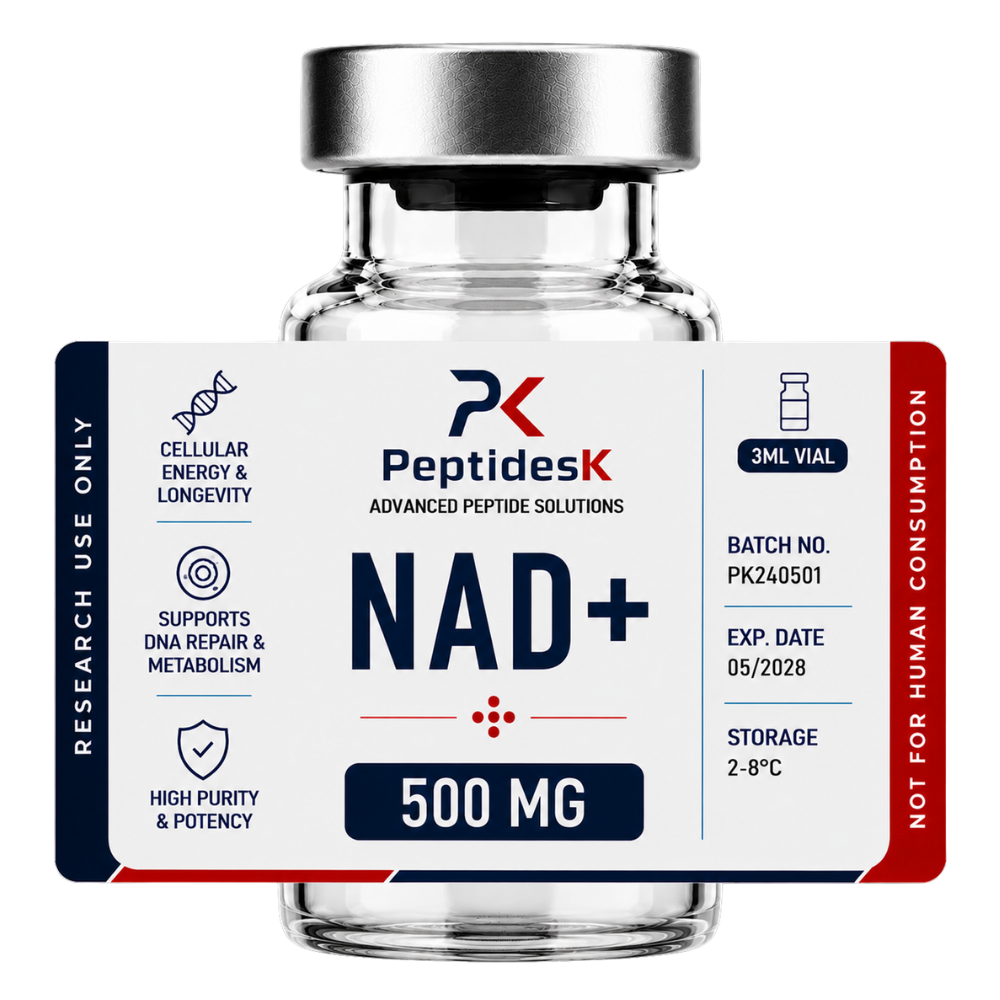
Description
Quick-Reference Overview Matrix
For efficient laboratory evaluation, the matrix below consolidates the core analytical, storage, and cross-reference parameters of NAD+ 500mg.
| Core Parameter | Technical Summary & Quick Data | Internal Cross-Reference |
|---|---|---|
| Purity & Yield | ≥ 98% HPLC Certified High-yield 500mg sterile filtered, vacuum-desiccated lyophilized cake optimized for high-throughput profiling. | View High-Purity Series → |
| Primary Target Path | Mitochondrial Respiratory Chain: Serves as an essential coenzyme for redox reactions in glycolysis and the citric acid cycle, facilitating ATP synthesis regulation. | Cellular Longevity Series → |
| Storage Protocol | Lyophilized: -20°C to -80°C (Up to 24 months). Reconstituted: 2°C to 8°C (Strictly use within 7–10 days due to coenzyme decay). | Buy Reconstitution Diluents → |
| Synergistic Assays | Frequently evaluated alongside mitokondri hedefli alternatif peptidler like SS-31 to cross-examine amplified inner-membrane protective cascades. | Pair with SS-31 50mg → |
What Is NAD+?
What Is NAD+?
NAD+ (Nicotinamide Adenine Dinucleotide) is an essential, ubiquitous cellular coenzyme found in all living cells, structured as a dinucleotide bound via phosphate groups. It functions as a foundational metabolic link, alternating between its oxidized (NAD+) and reduced (NADH) states to drive vital biological electron transport dynamics. Beyond its classical role in ATP generation, NAD+ is an obligatory substrate for non-redox signaling enzymes, including sirtuins (SIRT1-7 deacetylases), cyclic ADP-ribose polymerases (PARPs) and CD38/157 ectoenzymes. In analytical laboratory setups, it is crucial for tracking cellular senescence parameters and bioenergetic adaptations.
NAD+ 500mg Overview
Our NAD+ 500mg formulation yields a high-concentration, sterile-filtered lyophilized solid engineered specifically for large-scale microfluidic row screening and high-throughput enzymatic kinetics. Vacuum-sealed to optimize long-term chemical preservation, the powder formulation eliminates the high degradation risks typical of raw aqueous dinucleotides.
| Parameter | Specification |
|---|---|
| Product Format | 500mg Vial (Lyophilized Powder) |
| Chemical Structure | Nicotinamide-adenine dinucleotide (Oxidized internal complex form) |
| Molecular Formula | C21H27N7O14P2 |
| Molecular Weight | 663.4 g/mol |
| Purity Level | ≥ 98% (HPLC Monitored) |
| Physical Appearance | Sterile filtered, off-white to white uniform powder freeze-dried cake |
| Core Research Focus | Sirtuin Deacetylation Pathways, PARP-Mediated Genomic Stabilization, Mitochondrial ATP Synthesis Flux |
Regulatory Compliance Notice: This product is synthesized, distributed, and intended solely for laboratory research and development purposes. It is strictly not for human therapeutic use, clinical trials, or agricultural applications. Batch-specific Certificates of Analysis (CoA) are maintained systematically.
Research Applications of NAD+ Coenzyme
Research Applications of NAD+ Coenzyme
In mitochondrial biology, cellular longevity mapping, and metabolic decay publications, NAD+ is evaluated extensively across micro-environmental tracking loops. Researchers utilize this compound to analyze:
- Sirtuin-Driven Epigenetic Adaptation: Studying the dependency of SIRT1 and SIRT3 enzymes on baseline NAD+ concentrations to map downstream histones deacetylation and mitochondrial volume replication.
- Genomic Maintenance Assays: Investigating how PARP1 enzymes consume NAD+ substrate supplies to facilitate DNA single-strand fracture repairs during induced radiation stress.
- Oxidative Phosphorylation Flux: Mapping the rate of conversion from NAD+ to NADH within tissue cell matrices to monitor localized metabolic health variations.
NAD+ Mechanism of Action
The metabolic and functional activity of NAD+ branches into parallel catalytic and consumption pathways:
- Redox Catalyst Path: Acts as an electron acceptor during glycolysis and the Krebs cycle, receiving hydride ions to convert into NADH, which then delivers electrons directly to Complex I of the Electron Transport Chain.
- Substrate Cleavage Consumption: Serves as a vital degradation substrate for Sirtuins; the enzyme cleaves the nicotinamide moiety away to couple target protein deacetylation with the generation of O-acetyl-ADP-ribose.
- PARP Coordination: Breaks down NAD+ to construct branched poly(ADP-ribose) polymers on target proteins, signaling cellular repair machinery to gather at DNA fracture sites.
Research Overview: Benefits vs. Technical Risks
| Observed Research Benefits | Technical Risks & Limitations |
|---|---|
| • Master Metabolic Key: Provides a direct, comprehensive baseline overview of both mitochondrial bioenergetic pathways and nuclear epigenetic signaling fields simultaneously. | • Rapid Hydrolysis In Solution: Once dissolved in water phases, the dinucleotide pyrophosphate bond degrades rapidly unless maintained under sub-zero or chilled conditions. |
| • High Concentration Yield: The dense 500mg vial payload permits multi-well dilutions, securing flawless consistency across identical testing rows. | • Feedback Inhibition In Vitro: High concentration accumulations can lead to nicotinamide byproduct accumulation, which can act as a natural inhibitor against Sirtuin targets if left unbuffered. |
Peptide Comparison Matrix
Peptide Comparison Matrix
To optimize assay configurations, the framework below differentiates NAD+ 500mg from alternative cofactors and mitochondria-targeted research lines in our catalog:
| Peptide Compound | Primary Mechanism | Core Research Focus | Target Receptors | Molecular Status |
|---|---|---|---|---|
| NAD+ 500mg(This Product) | Cellular Coenzyme | Sirtuin activation substrate, redox electron pairing, DNA PARP tracking. | SIRT / PARP Enz. | 663.4 g/mol Dinucleotide |
| SS-31 50mg | Cardiolipin Targeting | Inner membrane architectural stability, ROS suppression loops. | Cardiolipin Lipids | 639.8 g/mol Peptide |
| Epitalon 50mg | Telomerase Inducer | Telomere elongation tracking, cellular lifespan modulation models. | Epigenetic DNA | 390.4 g/mol Peptide |
Storage & Handling Instructions
Storage & Handling Instructions
NAD+ is a highly hygroscopic and chemically reactive coenzyme. To ensure the dinucleotide pyrophosphate bonds do not undergo non-enzymatic cleavage pathways, carefully implement these climate parameters:
- LONG-TERM Lyophilized Cake: Must be deep-frozen instantly at -20°C or optimal -80°C. Preserves complete nucleotide integrity for up to 24 months.
- SHORT-TERM Logistics Window: The dry vacuum cake resists ambient delivery shifts up to 25°C for 2 weeks max. Place inside sub-zero environments post-arrival.
- POST-RECONSTITUTION Liquid Phase Matrix: Keep chilled between 2°C and 8°C. Reconstituted solutions are highly fragile; exhaust the fluid completely within 7 to 10 days max. Never freeze fluid mixtures.
Reconstitution Guidelines
- Allow the 500mg NAD+ vial to reach room balance equilibrium inside a low-humidity lab zone before unsealing.
- Meticulously sanitize the rubber injection stopper top using an isopropyl alcohol wipe.
- Slowly slide 2ml to 5ml of sterile bacteriostatic water or your target assay buffer down the interior glass envelope.
- Do not agitate or shake. Swirl slowly in horizontal circles until the dense crystalline cake is fully dissolved into a transparent fluid layer.


There are no reviews yet.