
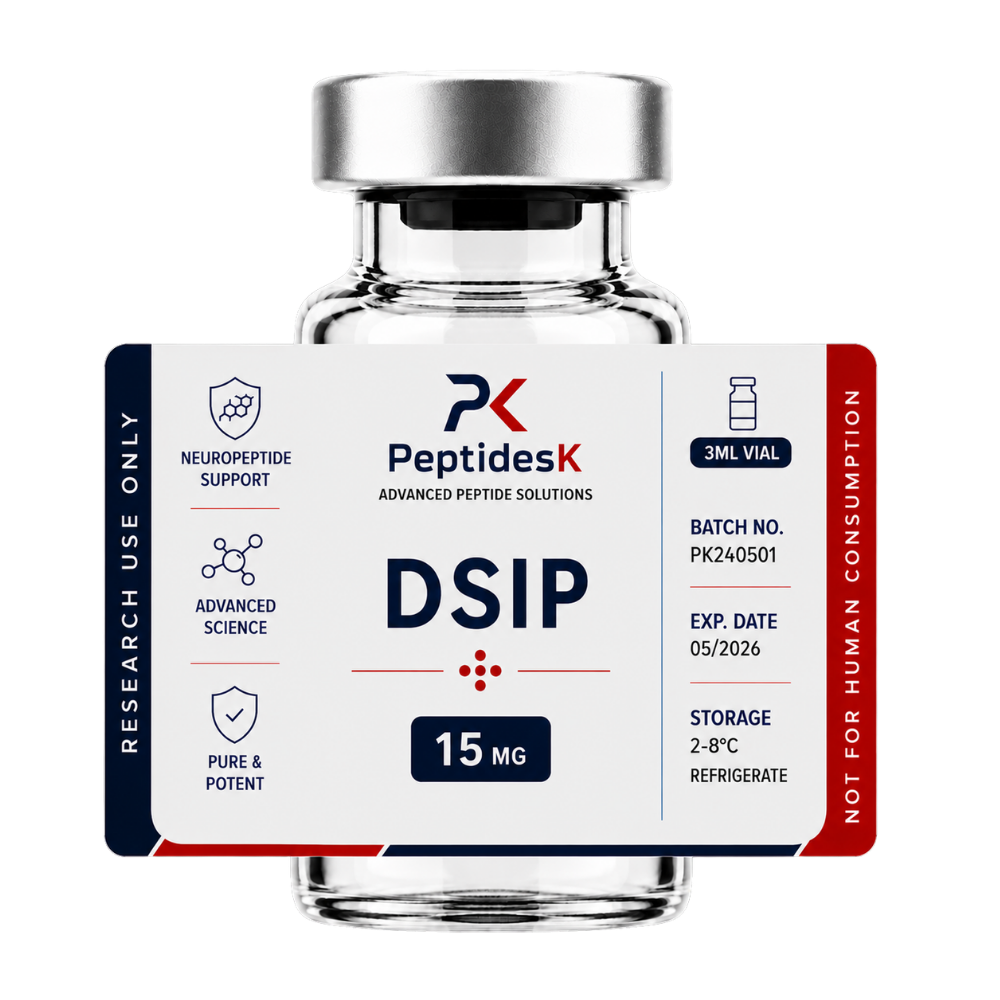
Description
Quick-Reference Overview Matrix
For efficient laboratory evaluation, the matrix below consolidates the core analytical, storage, and cross-reference parameters of DSIP 15mg.
| Core Parameter | Technical Summary & Quick Data | Internal Cross-Reference |
|---|---|---|
| Purity & Assay Yield | ≥ 98% HPLC Certified Matrix 15mg payload, sterile filtered, vacuum-desiccated lyophilized solid cake optimized for consistent neuronal culture mapping. | View High-Purity Series → |
| Primary Target Path | Neuromodulatory Homeostasis: Interacts with central neurotransmitter receptor clusters to track slow-wave delta rhythm modulations and antioxidant enzyme flux. | Neurological Research Series → |
| Storage Protocol | Lyophilized Powder: -20°C to -80°C (Up to 24 months). Reconstituted Fluid: 2°C to 8°C (Must use within 10–14 days). Avoid persistent room temperature exposures. | Buy Reconstitution Diluents → |
What Is DSIP?
What Is DSIP?
DSIP (Delta Sleep-Inducing Peptide) is a highly purified synthetic peptide consisting of a specialized nine-amino acid chain layout. Originally isolated from natural slow-wave sleep cycles, DSIP operates as a gentle cellular and neuromodulatory helper. Unlike standard sedatives or chemical sleep compounds that bind directly to aggressive pathways to force cellular shutdown, DSIP exhibits a natural regulatory action loop. In advanced cell line tracking, it is evaluated extensively for its capacity to stabilize natural circadian biorhythms, balance stress-induced free radical loops, and support internal antioxidant defense parameters under conditions of extreme metabolic stress.
DSIP 15mg Laboratory Standard
While standard metabolic series track general active receptors, the DSIP 15mg configuration is built purely to study central homeostatic balance and neuronal cellular adaptation. The 15mg mass profile provides an excellent middle-ground layout, enabling multiple precise titration series across single-plate cell matrices without risking the fluid waste commonly linked to larger bulk packages. Vacuum-desiccated inside heavy-duty glass vials, the nonapeptide framework remains perfectly protected against air exposure, structural stress, and sequence breakdown throughout its storage lifecycle.
| Technical Feature | Specification Level |
|---|---|
| Active Mass Payload | 15mg per Vial (Pure Freeze-Dried Powder) |
| Molecular Sequence | H-Trp-Ala-Gly-Gly-Asp-Ala-Ser-Gly-Glu-OH |
| Purity Baseline | ≥ 98.0% (HPLC Certified & Quality Verified) |
| Physical Form | Sterile filtered, white uniform freeze-dried crystalline solid cake |
| Primary Research Focus | Circadian Rhythm Studies, Deep Slow-Wave Sleep Brain Wave Modeling, Natural Stress Hormone Regulation Assays |
Regulatory Compliance Notice: This product is synthesized, distributed, and intended solely for laboratory research and development purposes. It is strictly not for human therapeutic use, clinical insomnia treatments, or lifestyle biohacking injection protocols. Analytical documentation is logged systematically per lot.
How DSIP Works (Sleep Regulation & Stress Mechanisms)
How DSIP Works (Sleep Regulation & Stress Mechanisms)
In analytical neuroscience, neuroendocrinology, and molecular biorhythm literature, DSIP is evaluated extensively across overlapping regulatory pathways. Investigators utilize this molecule to analyze:
- Circadian Clock Gene Modulations: Mapping downstream shifts in natural internal biological clock expressions inside specialized cell structures.
- Natural Stress Response Damping: Tracking how the compound limits the overproduction of core stress hormones and chemical response models.
- Oxidative Radical Defense: Investigating the structural upregulation of natural cellular protection enzymes inside neural tissues under free radical strain curves.
How DSIP Works (Mechanism of Action)
DSIP coordinates physiological markers by acting as an efficient indirect neuromodulator upon introduction to target media:
- Cellular Signaling Adjustment: Interacts selectively with central membrane tracking setups, altering communication rates via natural protein kinase pathways.
- Neural Protection Loops: This binding action helps balance receptor sensitivity, shielding target neuronal networks from chemical stress and excitotoxicity errors.
- Biorhythm Balance: Simultaneously directs transcription adjustments that balance peripheral active fluxes (including serotonin and melatonin pathways), establishing a stable homeostatic baseline.
Operational Summary: Core Benefits vs. Laboratory Constraints
A straightforward overview of the 15mg homeostatic balancing advantages and exact handling rules to maintain peak peptide stability during laboratory rows.
| Observed Research Values | Technical Assay Constraints |
|---|---|
| • Modulatory Regulatory Profile: Stabilizes cell lines without causing full receptor down-regulation or sudden rebound spikes common to traditional neuro-reagents. | • High Receptor Sensitivity: Because it operates via subtle downstream modulation loops, capturing its full impact requires highly sensitive transcriptomic or analytical equipment. |
| • Balanced 15mg Volume Calibration: Provides the perfect material footprint required for focused single-plate affinity screenings while minimizing post-assay waste risks. | • Fast Fluid Phase Degradation: Once solubilized, the active peptide sequence layout can face fast enzymatic or thermal breakdown if kept outside refrigeration bounds. |
Peptide Comparison Matrix
Peptide Comparison Matrix
To support advanced experimental configurations, the comparative grid below separates the neuromodulatory focus of DSIP 15mg from alternative pineal and longevity tracking agents available in our catalog:
| Research Compound | Operational Engine | Core Analytical Focus | Target Nodes | Molecular Status |
|---|---|---|---|---|
| DSIP 15mg (This Product) | Neuromodulatory Chaperone | Delta-wave slow rhythm tracking, stress response damping, and oxidative pathway shielding. | Biorhythm / CRH | 9-AA Nonapeptide |
| Epithalon 10mg | TERT Enzyme Promoter | Telomere extension indexing, chromatin structure remodeling, and cell longevity calibrations. | Nuclear DNA / TERT | 4-AA Tetrapeptide |
| MOTS-c 10mg | Mito-Signaling Loop | Mitochondrial energy output tracking, non-insulin glucose clearings, and exercise mimetic assays. | AMPK Pathways | Linear 16-AA |
| Explore advanced formulations & single lots: | Peptide Blends → All Compounds → | |||
Storage & Reconstitution Guidelines
Storage & Reconstitution Guidelines
To safely shield the nonapeptide sequence folding from mechanical shear and protect your active material from premature hydrolysis paths, enforce strict climate profiles:
- DEEP FREEZE Lyophilized Solid Cake: Lock inside sub-zero freezer arrays operating strictly at -20°C or optimal -80°C. Safeguards spatial peptide metrics against structural decay for up to 24 months.
- SHIPPING TRANSIT Vacuum Integrity: Resilient in freeze-dried cake form. Endures typical ambient shipping transport environments up to 25°C for 3 weeks max. Transfer to deep-freeze post-delivery.
- LIQUID PHASE LIMIT Solubilized State: Store strictly in refrigeration between 2°C and 8°C. Reconstituted solutions face quick progressive decay; exhaust the active fluid layer completely within 10–14 days maximum. Never freeze fluid mixtures.
Reconstitution Protocol
- Allow the 15mg DSIP vial to naturally adjust to ambient room temperature before removing its security vacuum seal.
- Cleanse the top rubber entry septum thoroughly using a high-grade isopropyl alcohol wipe.
- Slowly slide 1ml to 2ml of sterile bacteriostatic water down the interior glass envelope to minimize structural kinetic shock paths along the nonapeptide layout.
- Do not shake or vortex. Aggressive agitation shears peptide sequences. Gently swirl the vial horizontally in circular patterns until the white solid powder fully dissolves into a clear liquid layer.


There are no reviews yet.