
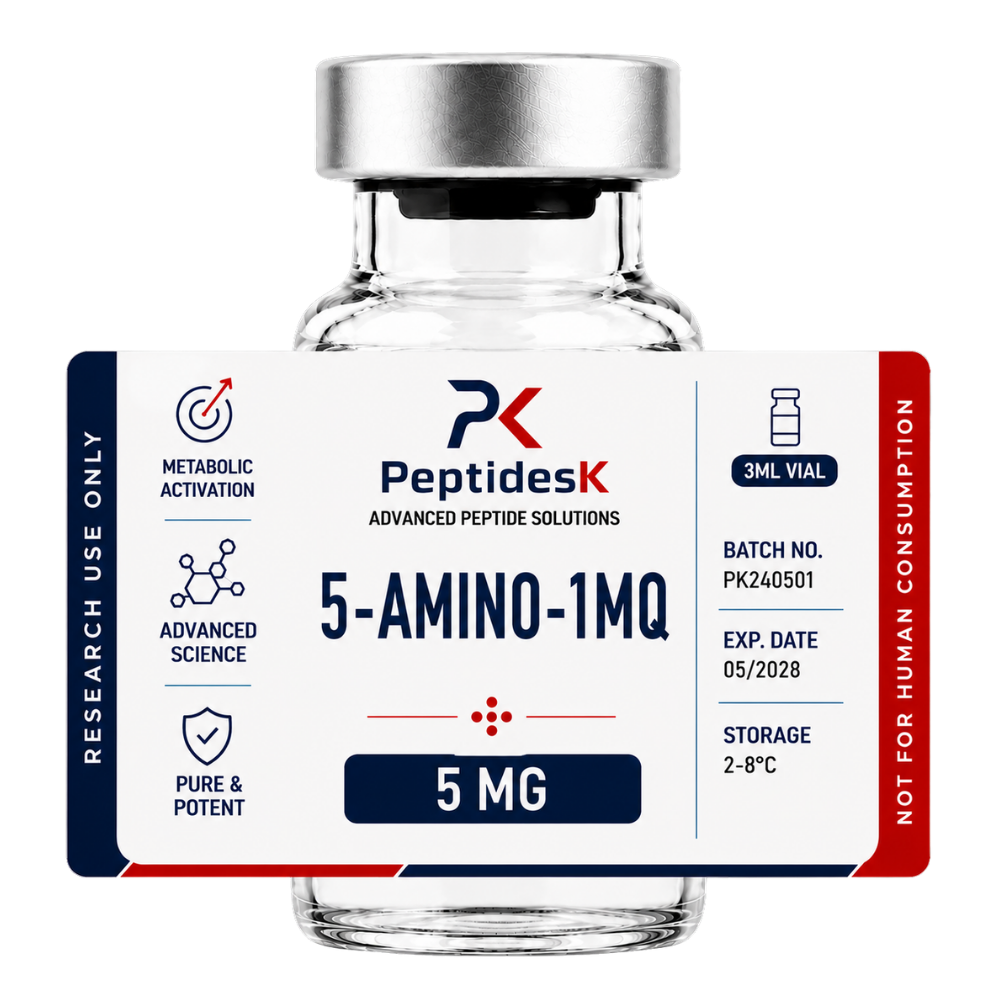
Description
5-Amino-1MQ 5mg Core Specifications
Deep technical specification parameters optimized for integrating 5mg 5-Amino-1MQ into focused, multi-well laboratory screening protocols.
| Research Parameter | Assay Benchmark Profile | Internal Catalog Link |
|---|---|---|
| Chemical Structural Class | 5-Amino-1-methylquinolin-1-ium (Aminoquinoline Derivative Small Molecule) | High-Purity Series → |
| Molecular Weight | 159.2 Da (Ultra-low mass, cell-permeable non-peptide architecture) | |
| Purity Baseline | ≥ 98.0% via High-Performance SEC-HPLC | Metabolic Series → |
| Assay Target | Selective Intracellular Nicotinamide N-Methyltransferase (NNMT) Inhibition |
What is 5-Amino-1MQ & How Does it Work?
What is 5-Amino-1MQ & How Does it Work?
5-Amino-1MQ (5-Amino-1-methylquinolinium) is an advanced, cell-permeable small molecule derivative engineered to operate as a potent, highly selective inhibitor of Nicotinamide N-methyltransferase (NNMT). NNMT is a critical cytosolic enzyme highly expressed in fat tissue that acts as a primary sensor and regulator of cellular energy balance by methylating nicotinamide. Unlike broad-spectrum metabolic modulators, 5-Amino-1MQ targets this specific enzymatic point to reduce fat accumulation and optimize basal cellular breathing dynamics. In modern laboratory lines, this 5mg format serves as an ideal micro-scale reference standard for studying lipogenesis deceleration, mapping intracellular NAD+ salvage conservation, and tracking adipocyte volume reductions without wasting large volume resources.
5-Amino-1MQ 5mg Quick Specifications
| Technical Property | Laboratory Standard Specifications |
|---|---|
| Chemical Composition | Cell-Permeable Small Molecule Aminoquinoline Salt |
| Active Core Payload | 5mg Purified Crystalline Powder / Vial (Micro-Scale Calibration Setup) |
| Purity Baseline | ≥ 98.0% Pure Certified via HPLC Testing Assays |
| Primary Research Focus | Direct cytosolic NNMT inactivation, intracellular NAD+ level optimization, and sirtuin pathway conservation |
How Does 5-Amino-1MQ Work in Laboratory Assays?
5-Amino-1MQ operates by directly diffusing across the lipid bilayer of target cell matrices to bind competitively into the active site of cytosolic Nicotinamide N-methyltransferase (NNMT). By blocking this enzyme, the compound stops the methylation of nicotinamide into 1-methylnicotinamide, which would otherwise exhaust raw materials needed for energy pathways. This blocking action prevents the depletion of S-adenosylmethionine (SAM) and redirects free nicotinamide back into the NAD+ salvage pathway, elevating internal NAD+ levels to trigger sirtuin (SIRT1) transcription and accelerate cellular lipid clearance loops natively.
5-Amino-1MQ Applications & Action Mechanisms
5-Amino-1MQ Applications & Action Mechanisms
In analytical biochemistry, obesity models, and metabolic transcriptomic profiling publications, 5-Amino-1MQ is monitored extensively for its capability to reverse metabolic slowdowns and lower overall lipid storage profiles in treated cultures. Investigators utilize this 5mg presentation format to build exact concentration pilot boards and track the expression changes of genes linked to fat accumulation and mitochondrial biogenesis under controlled conditions. This micro-scale configuration is highly favored for focused sample testing rows, allowing researchers to explore single-well thresholds while completely avoiding material surplus footprints.
5-Amino-1MQ Core Pathways & Action Matrix
| Target Pathway | Observed Cellular Action | Primary Research Goal |
|---|---|---|
| NNMT Enzyme Blocking | Inactivates cytosolic Nicotinamide N-methyltransferase to halt 1-methylnicotinamide accumulation. | Quantifying lipogenesis drop curves in fat cell lines. |
| NAD+ Conservation | Redirects nicotinamide parameters back into the NAD+ salvage pathway loop to optimize raw fuel pools. | Measuring internal ATP output changes in aging models. |
| SIRT1 Pathway Sync | Elevates available NAD+ coenzymes to trigger downstream sirtuin-dependent metabolic speed adjustments. | Tracking high-yield cellular energy kinetics under stress. |
Step-by-Step Mechanism of Action
When 5-Amino-1MQ is introduced to the target sample research media, it manages structural cellular adaptations through a highly standardized sequence path:
- Cytosolic Membrane Diffusion: The low-molecular-weight small molecule shifts smoothly across lipid membranes without requiring receptor links.
- Catalytic Core Binding: Competitive docking takes place directly in the active binding cleft of the intracellular NNMT structural complex.
- Salvage Pathway Diversion: Reverses nicotinamide exhaustion paths, allowing free nicotinamide to convert into active internal NAD+ pools.
- Lipid Clear Accumulation: Prompts the cell matrix to upregulate fatty acid oxidation lines, forcing an optimized shrinkage in adipocyte volume layers.
How Does 5-Amino-1MQ Compare to Other Compounds?
How Does 5-Amino-1MQ Compare to Other Compounds?
To assist in protocol coordination, it is essential to differentiate the non-peptide enzymatic blocking focus of 5-Amino-1MQ 5mg from alternative triple-receptor incretin mimetics, selective lipolytic fragments, or global cell coenzymes available in our collection. While alternative options investigate extracellular peptide receptor docking or direct beta-3 adrenergic activation, 5-Amino-1MQ acts as an isolated intracellular enzyme modifier. Understanding these baseline differences allows for more precise laboratory assay designs.
Peptide & Small Molecule Quick Comparison Matrix
The comparative table below outlines the core differences in research focus, mechanism of action, and primary target nodes across our high-purity laboratory catalog:
| Research Compound | Mechanism of Action | Primary Laboratory Focus | Target Nodes | Compound Class |
|---|---|---|---|---|
| 5-Amino-1MQ 5mg(This Product) | Selective NNMT Inhibition | Intracellular NAD+ salvage up-regulation, adipocyte lipogenesis blocking, and sirtuin pathway tracking. | Cytosolic NNMT | Small Molecule |
| Retatrutide 10mg | Triple Incretin Agonism | GCGR, GIPR, and GLP-1R sync profiling, multi-pathway surface loop saturation, and intensive lipids oxidation. | GIPR/GLP-1R/GCGR | Modified Peptide |
| HGH Fragment | Selective Beta-3 Agonism | Isolated fat tissue breakdown mapping, growth-independent lipid clearance, and non-glycemic metabolic tracking. | Beta-3 Adrenergic | Truncated Peptide |
| NAD+ 1000mg | Sirtuin Enzyme Substrate | Mitochondrial respiration mapping, direct sirtuin deacetylation substrate fuel, and cellular energy restoration. | SIRT1-7 / Mitochondria | Purified Coenzyme |
Synergistic Research Application Notice
In analytical metabolic lines, investigators frequently cross-examine small molecule NNMT inhibitors alongside downstream direct coenzymes like NAD+ to track the cumulative efficiency changes in sirtuin expression pathways. This micro 5mg format delivers great calibration accuracy, allowing researchers to run exact pilot trials without lot variance disruptions. While alternative catalog rows explore extracellular surface docks via incretins or lipolytic growth fragments, standalone 5-Amino-1MQ remains the absolute benchmark for direct cytosolic enzyme modification analysis.
Storage & Reconstitution Guidelines
Storage & Reconstitution Guidelines
To keep your high-purity 5-Amino-1MQ compound stable and prevent structural modification or degradation of its methylquinolinium ring, you must follow strict temperature parameters. Proper handling ensures that your laboratory assay baselines remain fully consistent and free from analytical artifacts over time.
-
FREEZER (-20°C)
Lyophilized Powder Base: Store the dry crystalline powder vial inside a laboratory freezer at -20°C to -80°C for long-term storage. This fully seals the small molecule configuration against degradation loops for up to 24 months. -
ROOM TEMP (25°C)
Shipping & Transit Window: In its dry, moisture-desiccated state, 5-Amino-1MQ is exceptionally stable. It can easily endure ambient transport fluctuations up to 25°C for a maximum of 4 weeks. Always return the vials to deep-freeze storage upon delivery. -
REFRIGERATOR (2°C – 8°C)
Reconstituted Liquid Phase: Once mixed into a liquid form using an appropriate solvent matrix (such as sterile bacteriostatic water or a mild DMSO dilution), the solution must be stored strictly under refrigeration between 2°C and 8°C. Reconstituted small molecule liquid phases are more resilient than long peptide chains, but it is highly recommended to exhaust the active liquid within 21 days maximum. Never freeze a compound solution after it has been liquified.
Step-by-Step 5-Amino-1MQ Reconstitution Guide
Because small molecule crystals require precise dissolving vectors to ensure absolute solution homogeneity without forming precipitate artifacts, follow this exact sequence path:
- Temperature Adjusting: Allow the 5mg 5-Amino-1MQ vial to naturally reach ambient room temperature equilibrium before removing the plastic security cap. This step blocks condensation moisture from contaminating the dry cake.
- Sanitizing the Septum: Thoroughly clean the upper rubber entry core septum using a fresh, high-grade isopropyl alcohol sterile wipe.
- Gentle Liquid Cascade: Draw your laboratory diluent (such as sterile bacteriostatic water) and slowly inject 1ml down the internal glass envelope wall. Let the fluid cascade gently down the glass rather than spraying it directly at the powder to avoid structural kinetic shock paths.
- Zero Aggressive Agitation: Do not shake, vibrate, or vortex the vial. While non-peptide architectures resist mechanical shearing better than long chains, gentle handling ensures pristine dissolution. Roll and rotate the vial horizontally in circular, concentric movements until the white solid cake fully transitions into a pristine, crystal-clear transparent liquid layer.
There are no reviews yet.