
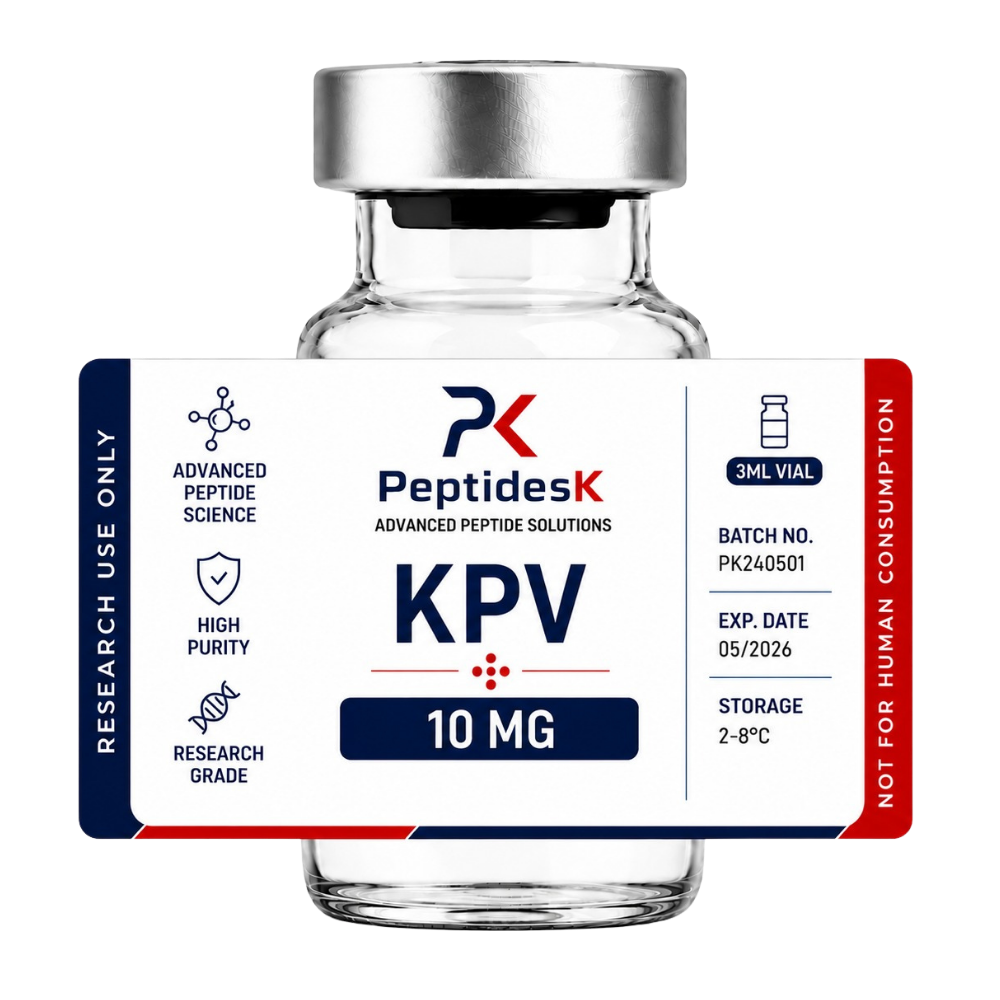
Description
KPV 10mg Core Specifications
Deep technical specification parameters optimized for integrating 10mg KPV into focused, multi-well laboratory screening protocols.
| Research Parameter | Assay Benchmark Profile | Internal Catalog Link |
|---|---|---|
| Sequence Blueprint | Lys-Pro-Val (C-Terminal Core Fragment of alpha-Melanocyte Stimulating Hormone) | High-Purity Series → |
| Molecular Weight | 356.5 Da (Ultra-short, highly stable tripeptide structure) | |
| Purity Baseline | ≥ 98.0% via High-Performance SEC-HPLC | Anti-Aging Compounds → |
| Assay Target | Intracellular NF-kB Inhibition & Epithelial Junction Stabilization |
What is KPV Peptide & How Does it Work?
What is KPV Peptide & How Does it Work?
KPV is a highly purified synthetic tripeptide consisting of the amino acid sequence Lysine-Proline-Valine. This specific sequence represents the exact C-terminal fragment of the endogenous alpha-melanocyte-stimulating hormone (alpha-MSH). While it retains the potent anti-inflammatory properties of the parent molecule, KPV possesses a distinct structural layout that prevents it from binding to classic melanocortin receptors responsible for pigment changes. Because of its ultra-short 3-amino-acid composition, it easily penetrates cell membranes and exhibits remarkable stability against enzymatic breakdown. In modern biology research, this 10mg format serves as an ideal reference standard for exploring tissue recovery, epithelial barrier stabilization, and localized immune response trends over extended testing phases without facing cross-reactivity noise.
KPV 10mg Quick Specifications
| Technical Property | Laboratory Standard Specifications |
|---|---|
| Chemical Structure | Linear Tripeptide Structure (Lys-Pro-Val Sequence Architecture) |
| Active Core Payload | 10mg Purified Crystalline Powder / Vial (Focused Titration Setup) |
| Purity Baseline | ≥ 98.0% Pure Certified via HPLC Testing Rows |
| Primary Research Focus | Intracellular NF-kB down-regulation, tight junction preservation, and antimicrobial tracking |
How Does KPV Work in Laboratory Assays?
KPV operates primarily by passing inside the cell matrix to block the translocation of Nuclear Factor Kappa B (NF-kB), which is the primary pathway driving cellular inflammatory responses. By suppressing this specific transcription factor, KPV shuts down the downstream output of pro-inflammatory cytokines such as IL-1, IL-6, and TNF-alpha. Concurrently, it interacts with cellular transporter networks to stabilize tight junction proteins, enabling researchers to measure the preservation of tissue integrity across inflamed epidermal or mucosal cell barriers natively.
KPV Research Applications & Action Mechanisms
KPV Research Applications & Action Mechanisms
In analytical immunology, gastroenterology, and wound-healing publications, KPV is heavily tracked for its role in regulating cell defense mechanisms and preventing tissue scarring. Investigators utilize this stable 10mg presentation format to build exact concentration parameters and observe the up-regulation of collagen organizing lines in tissue culture matrices. This focused setup is highly favored for multi-well plate configurations, allowing researchers to explore localized cell repair thresholds while keeping material waste to a minimum.
KPV Core Pathways & Action Matrix
| Target Pathway | Observed Cellular Action | Primary Research Goal |
|---|---|---|
| NF-kB Suppression | Enters cells directly to inhibit the pathway transcription engine responsible for inflammatory loops. | Quantifying cytokine drop curves in inflamed tissue models. |
| Barrier Repair | Stabilizes tight junction architecture near cell boundaries to limit cellular leaking. | Measuring gut and skin epithelial restoration speeds. |
| Antimicrobial Loop | Disrupts cell membrane patterns of targeting pathogens natively due to its structural charge lines. | Tracking pathogen survival values without using antibiotics. |
Step-by-Step Mechanism of Action
When KPV is introduced into target inflamed cellular media, it coordinates deep tissue adaptations through a highly standardized path:
- Cellular Entry: The ultra-short linear tripeptide shifts smoothly across target cell boundaries without requiring complex receptor docks.
- Transcription Blocking: Targets the intracellular cytoplasm layer to fully block the activation paths of the NF-kB structural complex.
- Cytokine Down-Regulation: Halts the transcription process of inflammatory signaling vectors, immediately lowering the expression of tissue-destroying elements.
- Junction Fortification: Prompts cell borders to rebuild and align structural proteins, securing a tight, uniform cellular shield layout.
How Does KPV Compare to Other Peptides?
How Does KPV Compare to Other Peptides?
To assist in protocol coordination, it is essential to differentiate the non-hormonal anti-inflammatory focus of KPV 10mg from alternative pigmentation promoting variants, selective lipolytic fragments, or longevity gene promoters available in our collection. While alternative options investigate skin tone adjustments, adipose tissue reduction, or cell life extension loops, KPV targets localized cellular boundary repair exclusively. Understanding these baseline differences allows for more precise laboratory assay designs.
Peptide Quick Comparison Matrix
The comparative table below outlines the core differences in research focus, mechanism of action, and primary target nodes across our high-purity laboratory catalog:
| Research Peptide | Mechanism of Action | Primary Laboratory Focus | Target Nodes | Peptide Structure |
|---|---|---|---|---|
| KPV 10mg(This Product) | Intracellular NF-kB Inhibition | Epithelial barrier repair mapping, anti-inflammatory cell loops, and tissue stabilization. | Intracellular Cytoplasm | Tripeptide (3-AA) |
| Melanotan 1 10mg | Selective MC1R Agonism | Dark pigment synthesis induction, light exposure skin cell survival mapping, and photoprotection. | MC1 Receptor | Linear Core (13-AA) |
| HGH Fragment | Lipolytic Pathway Trigger | Adipose tissue reduction mapping, isolated fat burning markers, and growth-independent research. | Beta-3 Adrenergic | 176-191 Segment |
| Epithalon 10mg | TERT Gene Promoter | Telomere extension mapping, chromatin epigenetic unfolding, and cellular lifespan tracking. | Nuclear DNA / TERT | Tetrapeptide (4-AA) |
Synergistic Research Application Notice
In analytical tissue biology lines, investigators frequently study KPV derived tripeptides in parallel with full length melanocortin structures like Melanotan 1 to analyze the structural divergence of anti-inflammatory properties from active skin tanning pathways. The stable 10mg format provides excellent concentration accuracy, allowing researchers to run exact pilot trials without lot variance disruptions. While alternative catalog rows look into cell life expansion parameters or fat clearing tracks, standalone KPV provides a clean reference for isolated tissue boundary repair analysis.
There are no reviews yet.