
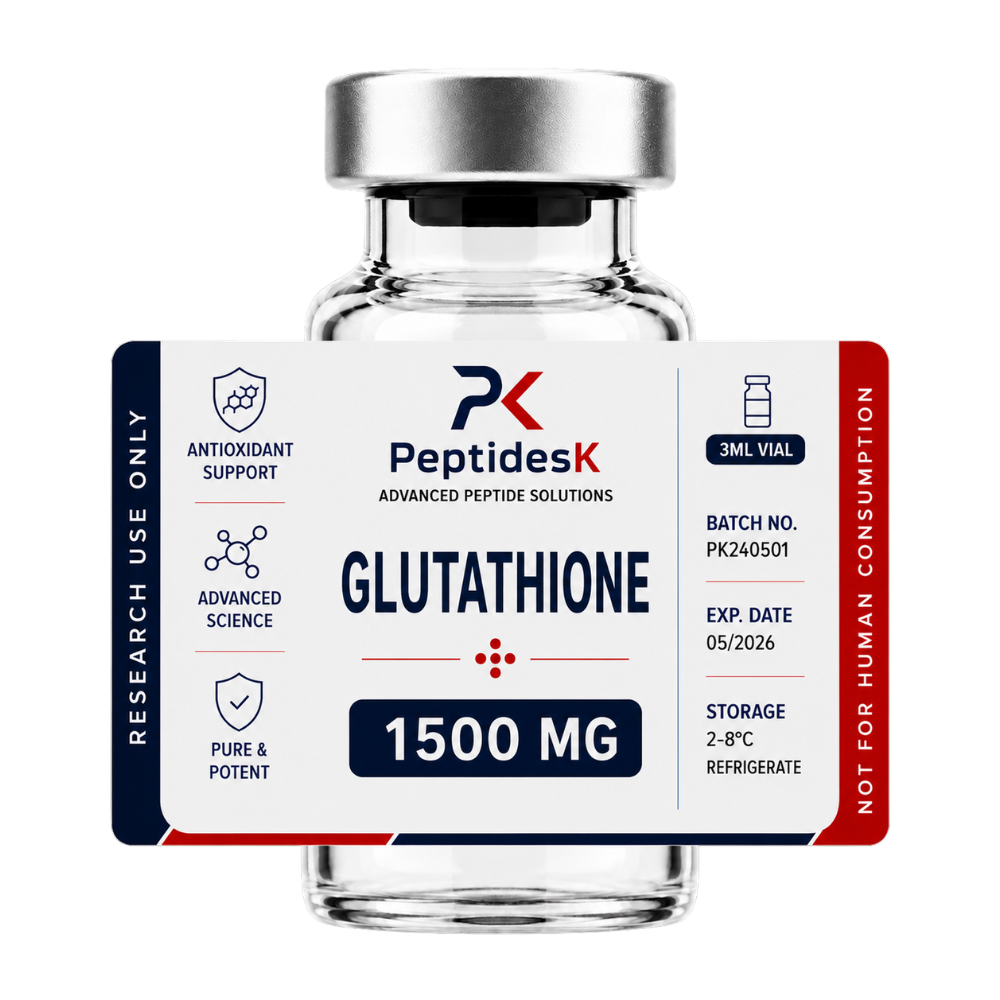
Description
Quick-Reference Overview Matrix
For efficient protocol deployment, the matrix below consolidates the core analytical and handling parameters of Glutathione 1500mg.
| Core Parameter | Technical Summary & Quick Data | Internal Cross-Reference |
|---|---|---|
| Purity & Assay Yield | ≥ 98% HPLC Certified Massive 1500mg payload, sterile filtered, vacuum-desiccated crystalline solid engineered for consistent multi-well rows. | View High-Purity Series → |
| Primary Target Path | Hücresel Redoks Homeostazı: Serves as a direct sulfhydryl cofactor to reduce oxidative radicals, preventing lipid peroxidation and stabilizing inner mitochondrial wall integrity. | Cellular Longevity Series → |
| Storage Protocol | Lyophilized Powder: -20°C to -80°C (Up to 24 months). Reconstituted Liquid: 2°C to 8°C (Must use within 7 days due to quick auto-oxidation into GSSG form in liquid phases). | Buy Reconstitution Diluents → |
| Synergistic Assays | Frequently co-evaluated alongside cellular energy coenzymes like NAD+ or SS-31 to cross-examine amplified mitochondrial protection networks. | Pair with NAD+ 500mg → |
What Is Glutathione?
What Is Glutathione?
Glutathione (GSH) is a foundational, naturally occurring antioxidant structure composed of three essential amino acids: L-glutamate, L-cysteine, and glycine. Thanks to its unique structural binding, this compound is highly resistant to being quickly broken down by ordinary cellular enzymes. Glutathione features an active sulfur (thiol) group, making it an excellent target for binding and neutralizing free radicals. In laboratory profiling assays, Glutathione balances the cell’s internal antioxidant environment, transitioning smoothly between its active reduced state (GSH) and inactive state to help researchers track cellular survival and longevity boundaries.
Glutathione 1500mg Laboratory Standard
Our Glutathione 1500mg formulation delivers a highly concentrated, pure crystalline solid engineered specifically for steady institutional testing and long-term research models. Vacuum-sealed to ensure maximum stability, the dense 1500mg payload allows investigators to create substantial test dilutions while maintaining absolute, single-batch consistency across all plates.
| Technical Parameter | Specification Standard |
|---|---|
| Total Payload Mass | 1500mg per Vial (Pure Lyophilized Powder) |
| Molecular Weight | 307.3 g/mol |
| Amino Acid Structure | γ-Glu-Cys-Gly |
| Purity Baseline | ≥ 98.0% (HPLC Certified & Quality Verified) |
| Primary Research Focus | Cellular Antioxidant Balance, Free Radical Neutralization, Detoxification Pathway Tracking |
Regulatory Compliance Notice: This product is synthesized, distributed, and intended solely for laboratory research and development purposes. It is strictly not for human therapeutic use, clinical diagnostics, or cosmetic skin-lightening workflows. Analytical records are logged systematically per batch.
Primary Laboratory Uses of Glutathione 1500mg
Primary Laboratory Uses of Glutathione 1500mg
In mitochondrial bioenergetics, toxicology screening, and cellular longevity publications, Glutathione 1500mg serves as an indispensable master research tool. Investigators utilize this compound to analyze:
- Oxidative Stress Shielding: Studying how active Glutathione pools protect cellular DNA and lipids from severe free radical damage and oxidative injuries.
- Cellular Detoxification Pathways: Investigating how cells utilize specific enzymes to bind, neutralize, and clear heavy metals or environmental toxins in tissue cultures.
- Cellular Death Resistance: Monitoring primary enzyme activities to map how low Glutathione levels trigger iron-dependent cell breakdown and rapid cellular aging models.
How Glutathione Works (Mechanism of Action)
Glutathione balances vital metabolic parameters by operating as an essential biological protector and core enzyme helper:
- Direct Radical Neutralization: The active sulfur group (-SH) on the molecule safely neutralizes unstable Reactive Oxygen Species (ROS), turning harmful particles into harmless water layers.
- Enzymatic Protection: Acts as a mandatory fuel source for protective enzymes (GPx) to break down hazardous cell toxins while transitioning into a temporary connected structure.
- Continuous Energy Recycling: Under normal balance, the cell utilizes helper enzymes to instantly convert used Glutathione back into its active, protective form, creating a non-stop cell defense loop.
Research Overview: Core Values vs. Laboratory Constraints
A quick guide to the primary test benefits and technical storage rules to track when maintaining high-purity Glutathione solutions.
| Observed Research Values | Technical Assay Constraints |
|---|---|
| • Universal Antioxidant Control: Delivers a reliable, comprehensive baseline tool to manage and track cellular stress levels across almost all tissue culture models. | • Rapid Liquid Solution Decay: Once mixed with liquid, the active solution is highly sensitive to air contact, turning from active to inactive forms within a few days if not stored correctly. |
| • Excellent Molecule Lifespan: The unique internal chemical bonds naturally block common degrading enzymes, guaranteeing a highly stable life inside cell testing environments. | • Cell Membrane Absorption Rules: Raw, intact Glutathione requires specific cellular enzyme breakdown to be fully integrated across membrane matrices, requiring precise measurement tracking. |
Peptide Comparison Matrix
Peptide Comparison Matrix
To optimize experimental configurations, the matrix below contrast Glutathione 1500mg from alternative bioenergetic and cellular longevity research items in our collection:
| Research Compound | Operational Engine | Core Analytical Focus | Target Nodes | Molecular Base |
|---|---|---|---|---|
| Glutathione 1500mg(This Product) | Direct Thiol Redoks Core | ROS chemical sacrifice, GPx enzyme tracking, phase II detoksifikasyon. | GPX4 / GST Nodes | 307.3 g/mol Tripeptide |
| NAD+ 500mg | Ubiquitous Coenzyme | Electron transport efficiency, sirtuin deacetylation, DNA repair tracks. | SIRT / PARP Enz. | 663.4 g/mol Dinucleotide |
| SS-31 50mg | Cardiolipin Targeting | Inner mitochondrial wall architecture, metabolic ROS suppression loops. | Cardiolipin Lipids | 639.8 g/mol Tetrapeptide |
Laboratory Climate & Handling Standards
Laboratory Climate & Handling Standards
Glutathione is a highly active, hygroscopic reaktif. To guarantee the sulfhydryl bonds do not face premature atmospheric conversion into the inactive GSSG dimer state, meticulously manage storage conditions:
- DEEP FREEZE Lyophilized Solid: Lock inside laboratory freezers running at -20°C or optimal -80°C. Preserves complete structural chemical integrity for up to 24 months.
- TRANSIT WINDOW Vacuum Desiccation: Highly stable in dry vacuum form. Can endure ambient shipping transport configurations up to 25°C for 3 weeks max. Transfer to freezers instantly post-arrival.
- LIQUID PHASE Solubilized Matrix: Store inside refrigeration between 2°C and 8°C. Reconstituted liquid phases face fast oxidation; exhaust the fluid layer completely within 5 to 7 days maximum. Never freeze mixed fluids.
Reconstitution Protocol
- Allow the dense 1500mg Glutathione vial to reach room temperature equilibrium inside a low-humidity lab zone before breaking its seal.
- Cleanse the top rubber core entry septum thoroughly using a fresh isopropyl alcohol wipe.
- Slowly slide 3ml to 5ml of sterile bacteriostatic water down the interior glass envelope to minimize kinetic impact pathways.
- Do not shake or vortex. Mechanical agitation accelerates oxidation with dissolved oxygen molecules. Gently roll the vial horizontally in concentric circles until the white powder transitions fully into a clear fluid layer.

There are no reviews yet.