
Description
Quick-Reference Overview Matrix
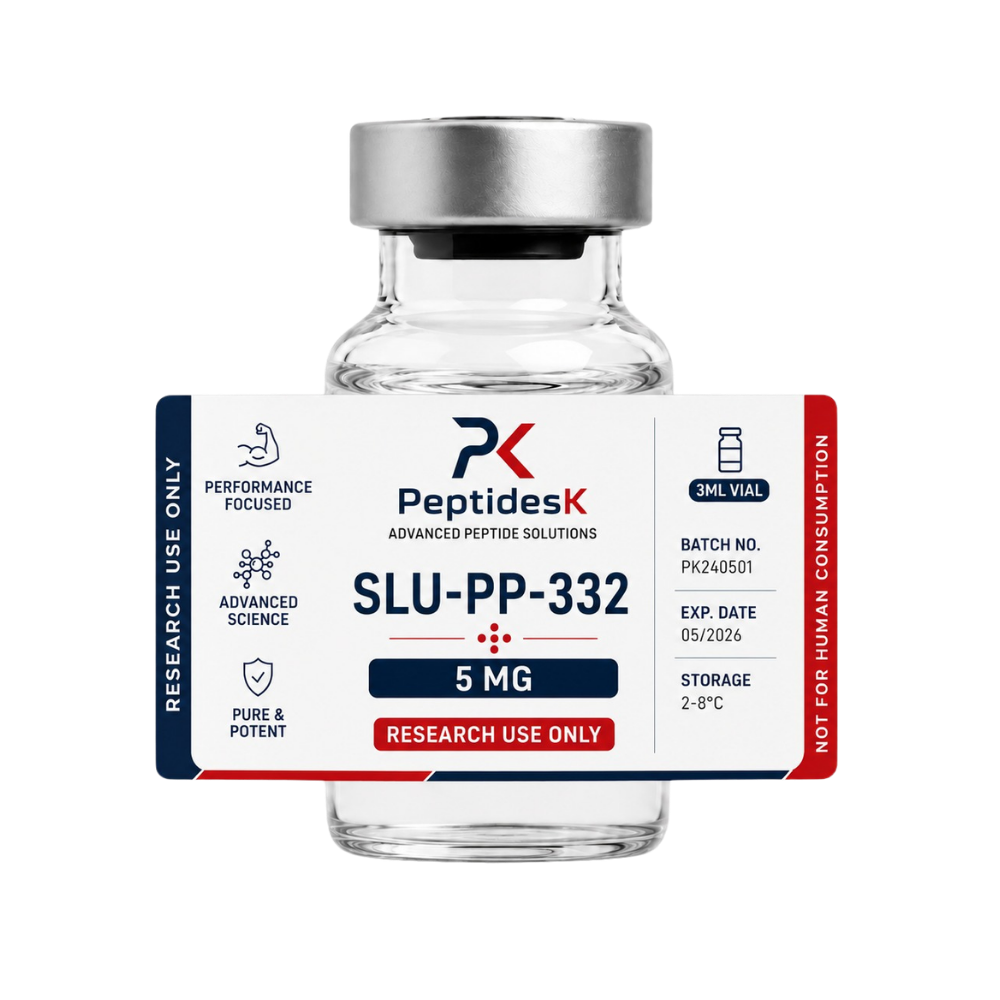
For efficient laboratory evaluation, the matrix below consolidates the core analytical, storage, and cross-reference parameters of SLU-PP-332 5mg.
| Core Parameter | Technical Summary & Quick Data | Internal Cross-Reference |
|---|---|---|
| Purity & Grade | ≥ 98% HPLC Certified Sterile filtered, vacuum-sealed lyophilized formulation optimized for metabolic tracking assays. | View High-Purity Series → |
| Primary Target Path | ERR Pan-Agonism: Activates Estrogen-Related Receptors to stimulate oxidative muscle fiber transitions and enhanced fatty acid lipolysis. | Metabolic Research Series → |
| Storage Protocol | Lyophilized: -20°C to -80°C (Up to 24 months). Reconstituted: 2°C to 8°C (Must use within 10–14 days). | Buy Reconstitution Diluents → |
| Synergistic Assays | Frequently co-evaluated with other bioenergetic or fat-loss modulators like SR-9009 or Cardarine alternatives for metabolic research models. | Explore Tissue Repair Series → |
What Is SLU-PP-332?
What Is SLU-PP-332?
SLU-PP-332 is a highly innovative, non-steroidal synthetic compound that acts as a potent pan-agonist for the Estrogen-Related Receptors (ERRs), specifically targeting the ERRα, ERRβ and ERRγ nuclear receptor isoforms. In structural biological models, it acts as a robust exercise mimetic by directly inducing genetic transcriptions usually triggered by intensive endurance training. It is heavily utilized in contemporary laboratory setups to explore treatments for metabolic syndrome, muscle atrophy models, and advanced lipid oxidative pathways.
SLU-PP-332 5mg Overview
Our SLU-PP-332 5mg formulation is manufactured to elite analytical research standards, ensuring complete structural definition and zero baseline contamination during cellular screenings. Each vial is freeze-dried (lyophilized) and vacuum-sealed, keeping the active compound fully isolated from kinetic and environmental stress variables.
| Parameter | Specification |
|---|---|
| Product Format | 5mg Vial (Lyophilized Powder) |
| Chemical Name | N-(5-(trifluoromethyl)pyridin-2-yl)-2-(3-(trifluoromethyl)phenyl)acetamide derivative |
| Molecular Formula | C16H11F6N3O2 (Core complex variant) |
| Molecular Weight | 407.3 g/mol |
| Purity Level | ≥ 98% (HPLC Monitored) |
| Physical Appearance | Sterile filtered, off-white to white lyophilized solid |
| Core Research Focus | ERRα/β/γ Transcription, Mitochondrial Volume Density, Skeletal Muscle Oxidative Capacity |
Regulatory Compliance Notice: This product is synthesized, distributed, and intended solely for laboratory research and development purposes. It is strictly not for human therapeutic use, clinical trials, or agricultural applications. Analytical verification sheets (HPLC/MS) arelogged systematically per batch.
Research Applications of SLU-PP-332
Research Applications of SLU-PP-332
In analytical endocrinology and metabolic disease publications, SLU-PP-332 is evaluated extensively across performance-simulation and energetic expenditure assays. Researchers utilize this compound to analyze:
- Skeletal Muscle Remodeling: Studying how active pan-agonism promotes a structural shift from glycolytic (Type II) toward oxidative (Type I) muscle fiber profiles in vivo.
- Mitokondriyal Volume Regulation: Investigating the upregulation of genes connected to mitochondrial replication, augmenting overall cellular respiratory velocity.
- Obesity Resistance Models: Tracking metabolic rate changes and fat mass accumulation ratios during targeted lipid saturation diets in laboratory animal subjects.
SLU-PP-332 Mechanism of Action
SLU-PP-332 functions by serving as a high-affinity ligand that binds simultaneously to **ERRα, ERRβ, and ERRγ** orphan nuclear receptors, mimicking the downstream genetic signals typically triggered by PGC-1α activation during exercise:
- Upon receptor docking, it activates the transcription of specific gene arrays controlling fatty acid oxidation (such as Cpt1b) and mitochondrial structural enhancement.
- Upregulates the expression of **Skeletal Muscle Pyruvate Dehydrogenase Kinase 4 (Pdk4)**, driving cellular networks to prioritize lipid burning over carbohydrate consumption.
- This metabolic modification leads to high physical fatigue resistance and lowered systemic lipid levels within evaluated cellular and physiological lineages.
Research Overview: Benefits vs. Technical Risks
| Observed Research Benefits | Technical Risks & Limitations |
|---|---|
| • Complete ERR Coverage: Simulates global exercise adaptations more effectively than single-isoform agonists by hitting all three ERR pathways (α, β, γ). | • Substrate Solubility Limits: Being non-steroidal, raw molecular reconstitution requires precise lab diluents to prevent sudden precipitation out of liquid phases. |
| • High Genetic Potency: Triggers measurable changes in metabolic biomarkers at lower micro-concentrations inside muscle tissue assays. | • Cellular Adaptability Noise: Prolonged receptor saturation in long assays can cause secondary gene adaptations that alter original baseline controls. |
Peptide Comparison Matrix
Peptide Comparison Matrix
To assist in experimental optimization, the table below differentiates SLU-PP-332 5mg from other metabolic regulatory and energetic pathway research compounds available in our catalog:
| Peptide Compound | Primary Mechanism | Core Research Focus | Target Receptors | Molecular Weight |
|---|---|---|---|---|
| SLU-PP-332 5mg(This Product) | ERR Pan-Agonism | Exercise simulation, mitochondrial replication, lipid breakdown upregulation. | ERRα / β / γ | 407.3 g/mol |
| MOTS-c 10mg | Mito-Signaling | Insulin response mapping, baseline glucose tracking assays. | AMPK Pathways | 2174.6 g/mol |
| Tesamorelin 10mg | GHRH Analogue | Visceral adipose tissue breakdown, endogenous growth hormone tracking. | GHRH Receptor | 5135.9 g/mol |
Storage & Handling Instructions
Storage & Handling Instructions
To avoid crystal lattice structural faults and keep the pan-agonist compound safe from early degradation pathways, apply the following climate protocols:
- LONG-TERM Lyophilized State: Store inside calibrated laboratory freezing units at -20°C or -80°C. Stable for up to 24 months.
- SHORT-TERM Logistics Cushion: The dry formulation is resilient during active transport up to 25°C for 3 weeks max. Deep-freeze post-delivery.
- POST-RECONSTITUTION Solubilized State: Store strictly in refrigeration between 2°C and 8°C. Exhaust the testing solution within 10–14 days. Do not re-freeze mixed liquid.
Reconstitution Guidelines
- Allow the SLU-PP-332 vial to naturally settle to room temperature equilibrium before removing its seal.
- Wipe the core rubber injection stopper thoroughly with an isopropyl sterile swab.
- Slowly introduce your lab diluent (such as sterile bacteriostatic water or target assay buffering liquids) against the interior glass structure.
- Do not shake. Gently swirl the vial horizontally in small concentric pathways until the 5mg cake dissolves completely into a clear, residue-free fluid layer.

There are no reviews yet.