
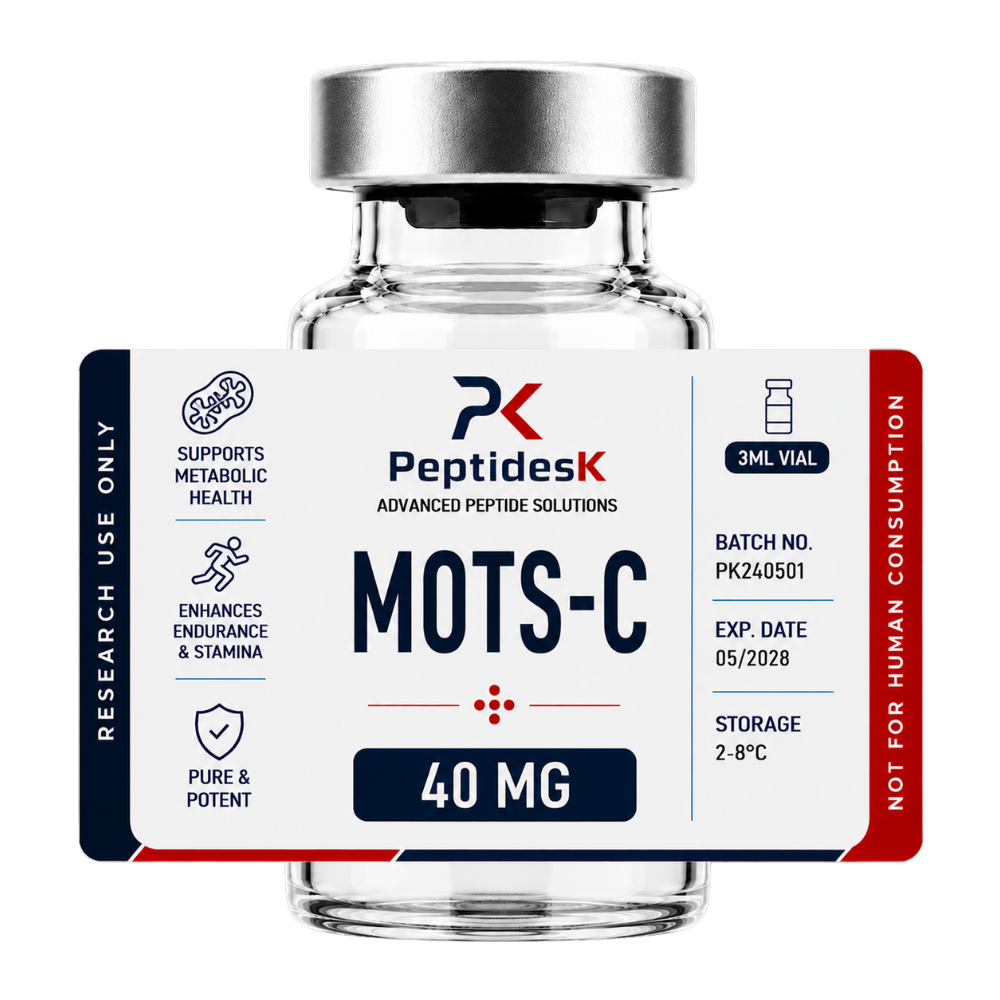
Description
Quick-Reference Overview Matrix
For efficient laboratory evaluation, the matrix below consolidates the core analytical, storage, and cross-reference parameters of MOTS-c 40mg.
| Core Parameter | Technical Summary & Quick Data | Internal Cross-Reference |
|---|---|---|
| Purity & Yield | ≥ 98% HPLC Certified High-yield 40mg sterile filtered, vacuum-desiccated lyophilized cake engineered for multi-well metabolic tracking. | View High-Purity Series → |
| Primary Target Path | AMPK / AICAR Cascade: Translocates to the nucleus under metabolic stress to promote AICAR accumulation and modulate adaptive mitochondrial expression pathways. | Explore Anti-Aging Series → |
| Storage Protocol | Lyophilized: -20°C to -80°C (Up to 24 months). Reconstituted: 2°C to 8°C (Must use within 10–14 days). | Buy Reconstitution Diluents → |
| Synergistic Assays | Frequently co-evaluated alongside nuclear receptor agonists like SLU-PP-332 to model amplified, non-linear endurance and lipolytic cellular circuits. | Pair with SLU-PP-332 → |
What Is MOTS-c?
What Is MOTS-c?
MOTS-c (Mitochondrial Open Reading Frame of the 12S rRNA Type-c) is a structurally unique, naturally occurring 16-amino acid peptide encoded within the mitochondrial genome rather than nuclear DNA. Serving as a primary mitochondrial-derived signaling molecule, it functions as a central regulator of systemic metabolic homeostasis. Under conditions of metabolic or cellular stress, MOTS-c rapidly translocates from the mitochondria to the nucleus, where it binds directly to regulatory gene prompts to control adaptive transcriptions. In contemporary laboratory models, it is vital for investigating type 2 diabetes vectors, obesity resistance kinetics, and mitochondrial bioenergetics.
MOTS-c 40mg Overview
Our MOTS-c 40mg formulation offers an exceptional analytical purity profile, designed strictly for high-throughput screening and long-term diagnostic protocols. Providing a dense 40mg payload per vial allows researchers to secure ample material yield for deep cellular dilutions while preserving absolute chemical layout consistency across identical assay lines.
| Parameter | Specification |
|---|---|
| Product Format | 40mg Vial (Lyophilized Powder) |
| Sequence | Met-Arg-Trp-Gln-Glu-Met-Gly-Tyr-Ile-Phe-Leu-Pro-Arg-Lys-Pro-Arg |
| Molecular Formula | C101H152N28O22S2 |
| Molecular Weight | 2174.6 g/mol |
| Purity Level | ≥ 98% (HPLC Monitored) |
| Physical Appearance | Sterile filtered, uniform white lyophilized cake powder |
| Core Research Focus | AMPK Pathway Activation, GLUT4 Translocation tracking, Glucose Clearance Kinetics, Mitochondrial Retrograde Signaling |
Regulatory Compliance Notice: This product is synthesized, distributed, and intended solely for laboratory research and development purposes. It is strictly not for human therapeutic use, clinical trials, or agricultural applications. Analytical data records are logged per batch.
Research Applications of MOTS-c Peptide
Research Applications of MOTS-c Peptide
In global endocrinology, muscle physiology, and cellular senescence publications, MOTS-c is evaluated heavily across performance-simulation and metabolic adaptivity loops. Researchers utilize this compound to analyze:
- Skeletal Muscle Glucose Transport: Studying how the compound stimulates glucose clearance into Type I and Type II muscle tissues independent of insulin pathways.
- Mitochondrial Biogenesis: Investigating the upregulation of transcription factors connected to mitochondrial density, augmenting overall baseline oxygen consumption.
- Fatty Acid Beta-Oxidation: Tracking shifts in fat metabolism trends and overall adipose layout modulation during high-lipid tissue culture assays.
MOTS-c Mechanism of Action
MOTS-c functions as a crucial metabolic link, working across both mitochondrial and nuclear genetic cellular spaces:
- Upon exposure to low-nutrient stress, it leaves the mitochondria and targets the nucleus to induce broad retrograde signaling cascades.
- Activates **AMP-activated protein kinase (AMPK)** pathways via an intensive cellular accumulation of the purine nucleotide intermediate AICAR.
- AMPK activation causes the swift translocation of **GLUT4 transporters** to the cell surface, directly driving high-velocity glucose uptake into tested tissue lineages.
Research Overview: Benefits vs. Technical Risks
| Observed Research Benefits | Technical Risks & Limitations |
|---|---|
| • Master Exercise Simulator: Successfully tracks complex physiological endurance adaptions inside skeletal tissue rows without requiring direct physical workload variables. | • Kinetic Sequence Fragility: Lacking standard cyclic linkages, the unconstitutional linear 16-amino acid backbone can degrade rapidly if stored poorly. |
| • Massive 40mg Capacity: The deep payload provides a robust supply limit, allowing researchers to run large-scale comparative dilution groups. | • Media pH Sensitivity: Slight pH variances inside target cell cultures can cause early structural aggregation, shifting baseline data visibility. |
Peptide Comparison Matrix
Peptide Comparison Matrix
To assist in experimental protocol coordination, the matrix below differentiates MOTS-c 40mg from alternative metabolic regulatory and energetic pathway research compounds available in our catalog:
| Peptide Compound | Primary Mechanism | Core Research Focus | Target Receptors | Molecular Status |
|---|---|---|---|---|
| MOTS-c 40mg(This Product) | Mito-Signaling Matrix | Insulin response tracking, baseline glucose clearing, exercise simulation assays. | AMPK Pathways | 2174.6 g/mol Linear Chain |
| SLU-PP-332 5mg | ERR Pan-Agonism | Mitochondrial replication tracking, oxidative fiber shifts, fat loss modeling. | ERRα / β / γ | 407.3 g/mol Non-Steroidal |
| Tesamorelin 10mg | GHRH Analogue | Visceral adipose matrix breakdown, endogenous growth factor monitoring. | GHRH Receptor | 5135.9 g/mol Stabilized |
Storage & Handling Instructions
Storage & Handling Instructions
Because the linear chain layout of MOTS-c lacks structural cross-links, it is highly prone to denaturation if subjected to poor climate controls. Adhere closely to these laboratory rules:
- LONG-TERM Lyophilized State: Store immediately inside deep freezing systems calibrated at -20°C or optimal -80°C. Stable for up to 24 months.
- SHORT-TERM Transit Stability: The desiccated vacuum solid can survive transport fluctuations up to 25°C for 3 weeks max. Deep-freeze post-delivery.
- POST-RECONSTITUTION Solubilized Matrix: Keep refrigerated strictly between 2°C and 8°C. Exhaust the testing solution layer within 10–14 days max. Never freeze fluid mixtures.
Reconstitution Guidelines
- Allow the massive 40mg vial to naturally adjust to ambient room temperature before opening its seal.
- Cleanse the top rubber injection septum with a high-grade isopropyl alcohol swab.
- Slowly slide 2ml to 4ml of sterile bacteriostatic water down the inside glass envelope to block mechanical chain stress.
- Do not shake. Gently swirl the vial horizontally in concentric circles until the dense 40mg cake fully dissolves into a clear, residue-free fluid layer.

There are no reviews yet.