Description
Quick-Reference Overview Matrix
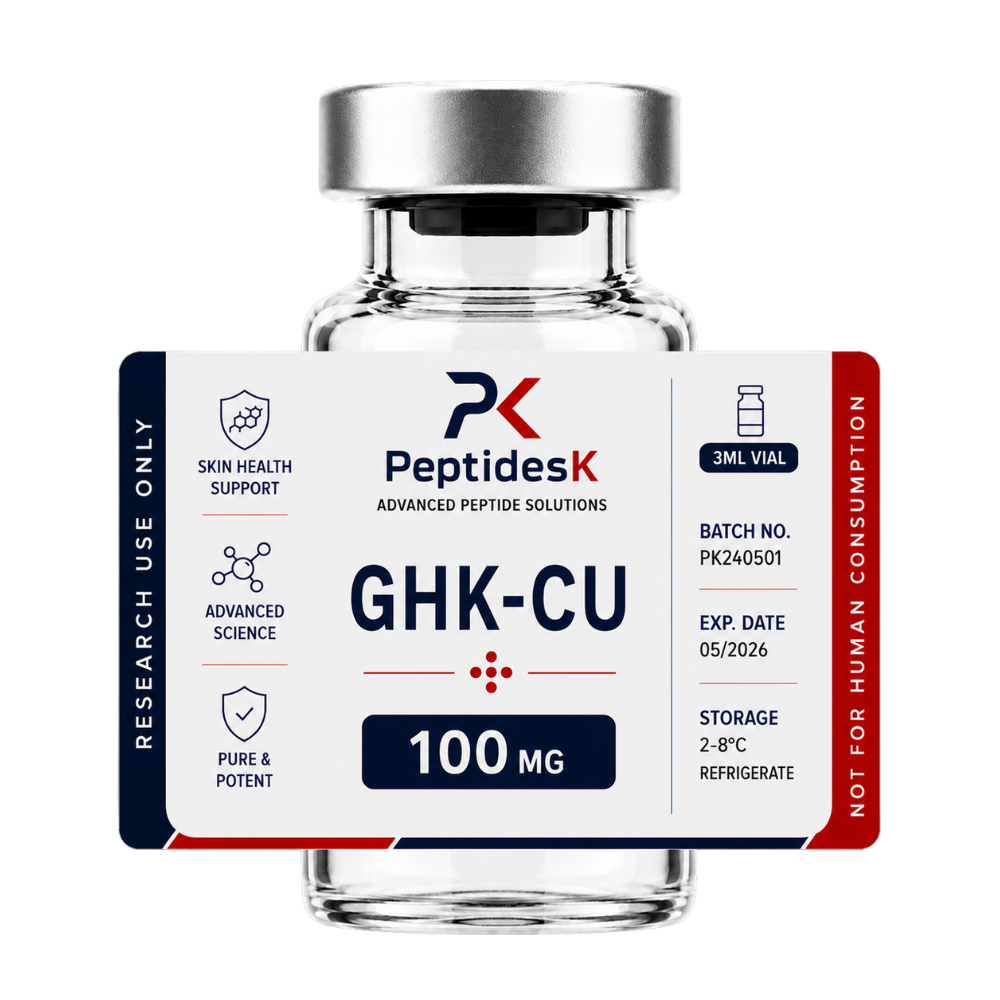
For efficient laboratory evaluation, the matrix below consolidates the core analytical, storage, and cross-reference parameters of GHK-Cu 100mg.
| Core Parameter | Technical Summary & Quick Data | Internal Cross-Reference |
|---|---|---|
| Purity & Matrix Yield | ≥ 98% HPLC Certified Matrix Massive 100mg volume, sterile filtered, displaying the uniform blue crystalline hue indicative of true copper-chelate coordination. | View High-Purity Series → |
| Primary Target Path | Extracellular Matrix (ECM) Synthesis: Promotes direct fibroblast activation rows, driving targeted upregulation of collagen, elastin, and proteoglycan structural paths. | Anti-Aging Series → |
| Storage Protocol | Lyophilized Powder: -20°C to -80°C (Up to 24 months). Store in dark settings. Reconstituted Layer: 2°C to 8°C (Exhaust the fluid layer within 10–14 days max). Avoid persistent UV light exposure. | Buy Reconstitution Diluents → |
What Is GHK-Cu 100mg and How Does It Work?
GHK-Cu 100mg (scientifically known as Copper tripeptide-1) is a naturally occurring human plasma complex composed of the tripeptide glycyl-L-histidyl-L-lysine bound to a copper(II) ion. Classed as a foundational GHK-Cu metallopeptide, it acts as a powerful signal molecule that regulates gene expression for tissue remodeling, anti-inflammatory response, and cellular repair.In analytical biochemistry and dermatology, our GHK-Cu 100mg peptide presentation serves as a premier reference standard. Supplying a high-yield 100mg lyophilized vial provides laboratories with optimal material capacity for high-concentration titration series, cell culture trials, and extended tissue studies without batch-to-batch variation. To review batch testing details and third-party lab documentation, visit peptidesk.com.| Parameter | Specification Standard |
|---|---|
| Product Format | 100mg Purified Lyophilized Powder / Vial |
| Purity Baseline | ≥ 98.0% Certified Purity |
| Peptide Sequence | Gly-His-Lys (Cu2+ Complex) |
| GHK-Cu Molecular Weight | 404.93 g/mol (Bound Salt Form) |
| Physical Appearance | Sterile filtered, distinct deep blue crystalline cake |
Is GHK-Cu a Copper Peptide?
Yes, GHK-Cu is one of the most thoroughly studied and widely recognized copper peptides in biological research. It is a naturally occurring human plasma complex formed when the tripeptide glycyl-L-histidyl-L-lysine binds directly to a bio-available copper(II) ion.
In cellular repair and skin remodeling studies, this copper binding allows the compound to act as a powerful signal peptide, delivering copper directly into cells to activate key antioxidant enzymes like superoxide dismutase and stimulate collagen building pathways.
What Is the Difference Between GHK and GHK-Cu?
The primary difference between plain GHK and GHK-Cu is the presence of the active copper ion. While both share the same underlying amino acid chain, their biological properties and appearance differ significantly:
| Feature | GHK (Unbound Tripeptide) | GHK-Cu (Copper-Bound Complex) |
|---|---|---|
| Molecular Structure | Glycyl-L-histidyl-L-lysine amino acid sequence without a bound metal ion. | GHK tripeptide chelated with a copper(II) ion ($Cu^{2+}$). |
| Biological Activity | Exhibits baseline cellular signaling but cannot directly supply copper to enzymes. | Delivers copper directly to tissue cells, boosting collagen, elastin, and antioxidant defense. |
| Physical Appearance | White to off-white freeze-dried powder. | Characteristic deep blue cake due to copper coordination bonds. |
How Does GHK-Cu Affect Collagen Production and Extracellular Matrix Remodeling?
In cellular repair studies, GHK-Cu tripeptide acts as a master regulator of tissue regeneration. Rather than simply boosting collagen indiscriminately, it organizes and optimizes how cells rebuild structural frameworks:- Fibroblast Activation: Stimulates dermal fibroblasts to produce fresh Collagen Type I and Type III, alongside glycosaminoglycans like hyaluronic acid.
- Matrix Metalloproteinase Balance: Regulates MMP enzymes and their inhibitors (TIMPs), removing damaged collagen fibers while promoting smooth, healthy tissue growth.
- Skin and Tissue Elasticity: Re-establishes healthy elastin networks to restore firmness and structural resilience in damaged dermal tissue layers.
What Is GHK-Cu Used for in Research? How Does It Support Skin and Tissue Models?
The GHK-Cu research peptide is extensively featured across multiple scientific disciplines due to its broad gene-modulating capabilities:1. Dermal Rejuvenation & Anti-Aging
Researchers examine how GHK-Cu increases skin thickness, tightens loose tissue, smooths fine lines, and protects skin cells from photo-damage.
2. Wound Repair & Tissue Recovery
Evaluates how the complex accelerates epithelial closure, promotes micro-vessel growth (angiogenesis), and reduces scar formation during tissue healing.
3. Antioxidant & Anti-Inflammatory Defense
Studies track the downregulation of inflammatory cytokines (such as TNF-alpha and IL-6) while boosting internal antioxidant enzyme production.
Is GHK-Cu Used in Hair Follicle and Hair Growth Research?
Yes, copper peptide hair research represents one of the fastest-growing application areas for GHK-Cu. Studies demonstrate that copper tripeptides play a direct role in supporting hair follicle viability and scalp tissue health:- Follicle Size Expansion: GHK-Cu helps enlarge miniaturized hair follicles, encouraging fine or thinning hair shafts to transition into thicker, terminal strands.
- Anagen Phase Extension: Prolongs the active growing (anagen) phase of the hair growth cycle while delaying the resting (telogen) phase.
- Scalp Microvascular Support: Promotes localized blood vessel formation around hair bulbs, delivering essential nutrients and oxygen required for active growth.
What Is Copper Peptide GHK-Cu Used for Overall?
In summary, GHK-Cu copper tripeptide is a multi-functional research tool utilized whenever cellular regeneration, collagen rebuilding, wound healing, or hair follicle stimulation is evaluated. Its ability to resetting thousands of human genes to a healthier, younger state makes it a cornerstone compound in modern age-reversal and tissue repair science.Storage and Handling Guidelines
How to Store Your Vial
- Unopened Freeze-Dried Powder: Keep dry powder vials in a laboratory freezer at -20°C to -80°C for long-term stability up to 24 months. Keep protected from direct light.
- During Transit: Sealed freeze-dried vials remain stable at room temperatures up to 25°C for up to 3 weeks.
- Reconstituted Liquid Phase: Once mixed with bacteriostatic water, store in the refrigerator between 2°C and 8°C and use within 10 to 14 days. Avoid refreezing.
Step-by-Step Reconstitution Steps
- Allow the 100mg vial to reach ambient room temperature naturally before opening the cap to eliminate condensation moisture inside the glass.
- Sanitize the rubber entry stopper with a fresh isopropyl alcohol wipe.
- Slowly introduce 2ml to 3ml of sterile bacteriostatic water down the inside glass wall of the vial.
- Do not shake. Gently swirl horizontally in small circles until the blue cake completely dissolves into a clear blue liquid.
Where Can I Buy GHK-Cu 100mg for Research?
When looking where to buy GHK-Cu online or comparing competitive GHK-Cu 100mg price levels, selecting a reliable vendor with verified analytical quality is critical. Low-grade copper peptides with improper copper coordination can result in unbound salts that disrupt cell culture assays.Every lot of our GHK-Cu 100mg USA stock undergoes independent HPLC testing to guarantee high purity and correct peptide-copper bonding. If you want to buy GHK-Cu 100mg with fast domestic shipping across the USA, check our GHK-Cu 100mg stock directly on peptidesk.com.Quality Verification: View our latest purity charts and lab testing documents directly on our PeptidesK Third-Party Lab Testing Page.
Shop by Research Goals
Explore our catalog of analytical-grade compounds grouped by research category:
| Category | Primary Research Focus |
|---|---|
| Anti-Aging & Longevity Peptides → | Cellular renewal, skin remodeling, collagen renewal, and anti-senescence research. |
| Recovery & Healing Peptides → | Soft tissue repair, extracellular matrix remodeling, and wound closure. |
| Fat Loss & Metabolic Peptides → | Incretin mimetics, lipolysis acceleration, and metabolic flexibility profiling. |
| Focus & Cognitive Peptides → | Nootropic signaling, neuroprotection, and synaptic plasticity assays. |
| Muscle Growth & Building Peptides → | Anabolic signaling, GH secretagogues, and protein synthesis acceleration. |


There are no reviews yet.