
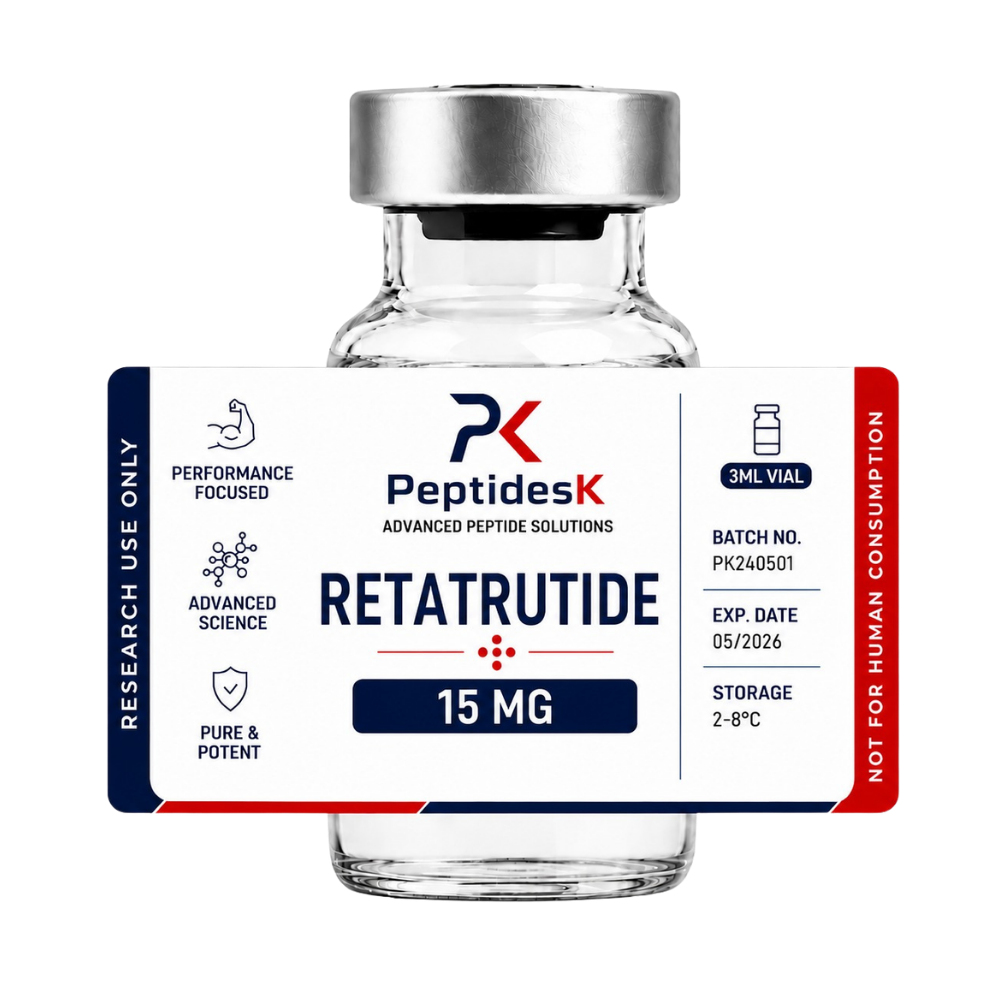
Description
Retatrutide 15mg Core Specifications
Deep technical specification parameters optimized for integrating 15mg Retatrutide into focused, multi-well laboratory screening protocols.
| Research Parameter | Assay Benchmark Profile | Internal Catalog Link |
|---|---|---|
| Sequence Blueprint | Modified 39 Amino Acid Peptide Complex (GIP / GLP-1 / Glucagon Tri-Agonist Base) | High-Purity Series → |
| Molecular Weight | 4731.4 Da (Stabilized with a customized C20 fatty diacid chain modification) | |
| Purity Baseline | ≥ 98.0% via High-Performance HPLC Testing | Metabolic Series → |
| Assay Target | Concurrent GIPR, GLP-1R, and GCGR Multi-Pathway Saturation Loops |
What is Retatrutide Peptide & How Does it Work?
What is Retatrutide Peptide & How Does it Work?
Retatrutide is an advanced synthetic polypeptide designed to operate as a potent triple agonist targeting three vital metabolic receptors: Glucose-Dependent Insulinotropic Polypeptide (GIP), Glucagon-Like Peptide-1 (GLP-1), and Glucagon (GCG). By integrating these three independent paths into a single 39 amino acid backbone, Retatrutide yields an exceptional degree of fat clearing and metabolic pathway management. Its structure features a unique C20 lipophilic fatty acid chain modification that extends its tracking half-life and insulates the peptide against early enzyme breakdown. In modern laboratory lines, this 15mg format serves as a stable reference standard for monitoring adipocyte cellular adaptations, lipid oxidation speed, and multi-receptor metabolic flux without wasting large volume resources.
Retatrutide 15mg Quick Specifications
| Technical Property | Laboratory Standard Specifications |
|---|---|
| Chemical Structure | Acylated 39-AA Peptide Chain (Triple-Incretin Agonist Base) |
| Active Core Payload | 15mg Purified Crystalline Powder / Vial (Controlled Titration Setup) |
| Purity Baseline | ≥ 98.0% Pure Certified via HPLC Assays |
| Primary Research Focus | Simultaneous GIPR/GLP-1R/GCGR activation, mitochondrial energy kinetics, and fat cell oxidation |
How Does Retatrutide Work in Laboratory Assays?
Retatrutide operates by concurrently docking into GIP, GLP-1, and glucagon receptor backbones on the surface of target cells, generating a powerful internal signaling loop. The structural GIPR and GLP-1R interaction loops drive adenylate cyclase activation to raise cyclic AMP (cAMP) levels, balancing insulin management and gastric delay velocity. Concurrently, its distinct glucagon receptor recruitment natively stimulates lipolysis mechanisms, signaling the cell matrix to directly increase lipids oxidation pathways. This combined, multi-pathway configuration allows investigators to analyze intensive metabolic expenditure metrics, completely free from unguided background data noise.
Retatrutide Research Applications
Retatrutide Research Applications
In analytical metabolic endocrinology and transcriptomic profiling publications, Retatrutide is tracked extensively for its role in accelerating lipid clearance speed and expanding cellular energy expenditure pathways. Investigators utilize this 15mg presentation to map steady titration rows and monitor the deceleration of tissue fat accumulation markers under controlled conditions. This controlled mass format is highly favored for focused sample testing lines, allowing researchers to explore multi-well calibrations entirely from a uniform production lot while avoiding early material exhaustion.
Retatrutide Core Pathways & Action Matrix
| Target Pathway | Observed Cellular Action | Primary Research Goal |
|---|---|---|
| Triple Receptor Sync | Co-activates GIP, GLP-1, and GCG pathways to maximize downstream internal cyclic AMP flux. | Quantifying multi-receptor incretin and glucagon synergy. |
| Lipid Oxidation | Recruits glucagon pathways to directly accelerate fatty acid breakdown inside adipocyte rows. | Measuring the deceleration speed of new tissue fat accumulation. |
| Energy Kinetics | Forces cells to prioritize burning stored lipid parameters, enhancing baseline cellular metabolic rates. | Mapping high-yield non-shivering heat generation curves natively. |
Step-by-Step Mechanism of Action
When Retatrutide is introduced to the target sample research media, it manages structural metabolic changes through a highly standardized sequence path:
- Structural Stabilization: The acylated C20 diacid tail chain links with available media proteins, delaying plasma clearance loops cleanly.
- Triple Site Alignment: Docks smoothly and concurrently across active GIPR, GLP-1R, and GCGR cell surface receptors at the exact same moment.
- cAMP Wave Amplification: Initiates a robust internal kinase phosphorylation cascade, multiplying intracellular cyclic AMP accumulation layers.
- Metabolic Equilibrium: The cell lines demonstrate an optimized shift in fatty acid oxidation speed and a drop in overall glucose fluctuation while cellular profiles remain stable.
How Does Retatrutide Compare to Other Peptides?
How Does Retatrutide Compare to Other Peptides?
To assist in protocol coordination, it is essential to differentiate the advanced triple-agonist focus of Retatrutide 15mg from alternative selective single-receptor compounds, dual-incretin architectures, or oral non-peptide small molecules available in our collection. While alternative compounds monitor single hunger region vectors or dual pathways exclusively, Retatrutide recruits the glucagon pathway to optimize direct lipids oxidation. Understanding these baseline differences allows for more precise laboratory assay designs.
Peptide Quick Comparison Matrix
The comparative table below outlines the core differences in research focus, mechanism of action, and primary target nodes across our high-purity laboratory catalog:
| Research Peptide | Mechanism of Action | Primary Laboratory Focus | Target Nodes | Peptide Structure |
|---|---|---|---|---|
| Retatrutide 15mg(This Product) | Triple Receptor Agonism | GCGR, GIPR, and GLP-1R sync profiling, intensive lipids oxidation, and high energy expenditure tracking. | GIP/GLP-1/GCG | Modified Peptide (39-AA) |
| Tirzepatide 30mg | Dual GIP/GLP-1 Agonism | Synergistic insulin secretion updates, metabolic rate acceleration, and fatty acid clearance assays. | GIPR / GLP-1R | Acylated Dimer (39-AA) |
| Semaglutide 10mg | Selective GLP-1R Agonism | Incretin pathway regulation, glucose-dependent insulin tracking, and selective satiety curve shifts. | GLP-1 Receptor | Acylated Linear (31-AA) |
| Orforglipron 6mg | Non-Peptide GLP-1R Agonism | Oral-route metabolic modeling, stable cyclic AMP tracking, and gastrointestinal transit curves. | GLP-1R (Oral) | Small Molecule |
Synergistic Research Application Notice
In broad endocrine lines, investigators frequently cross-examine triple receptor mimetics alongside selective single-receptor compounds like Semaglutide to map baseline metabolic differences. The 15mg format provides excellent material availability, allowing researchers to run continuous automated titration rows without lot variance disruptions. While our oral capsule lines offer gut-enzyme bypass advantages, standalone Retatrutide remains the absolute standard for multi-pathway injectable cell line analysis.
How to Store Retatrutide Lyophilized Powder & Liquid Solutions
How to Store Retatrutide Lyophilized Powder & Liquid Solutions
To keep your high-purity Retatrutide peptide stable and prevent its delicate 39 amino acid acylated chain from breaking down early, you must follow strict temperature parameters. Proper handling ensures that your laboratory assay baselines remain fully consistent and free from structural degradation artifacts over time.
- FREEZER (-20°C)
Lyophilized Peptide Powder: Store the dry crystalline powder vial inside a laboratory freezer at -20°C to -80°C for long-term storage. This fully seals the peptide configuration against sequence decay for up to 24 months. - ROOM TEMP (25°C)
Shipping & Transit Window: In its dry, vacuum-desiccated solid state, Retatrutide is highly resilient. It can easily endure ambient transport fluctuations up to 25°C for a maximum of 3 weeks. Always return the vials to deep-freeze storage upon delivery. - REFRIGERATOR (2°C – 8°C)
Reconstituted Liquid Phase: Once mixed into a liquid form, the solution must be stored strictly under refrigeration between 2°C and 8°C. Reconstituted fluid phases face natural structural decay; completely exhaust the active liquid within 10 to 14 days maximum. Never freeze a peptide after it has been liquified.
Step-by-Step Retatrutide Reconstitution Guide
Because long-chain peptide matrices are highly sensitive to sudden physical pressure shifts, follow this precise protocol to dissolve your 15mg Retatrutide powder cake into a stable fluid layer:
- Temperature Adjusting: Allow the 15mg Retatrutide vial to naturally reach ambient room temperature equilibrium before removing the plastic security cap. This step blocks condensation moisture from contaminating the dry cake.
- Sanitizing the Septum: Thoroughly clean the upper rubber entry core septum using a fresh, high-grade isopropyl alcohol sterile wipe.
- Gentle Liquid Cascade: Draw your laboratory diluent (such as sterile bacteriostatic water) and slowly inject 1ml down the internal glass envelope wall. Let the fluid cascade gently down the glass rather than spraying it directly at the powder to avoid structural kinetic shock paths.
- Zero Aggressive Agitation: Do not shake, vibrate, or vortex the vial. Mechanical friction shears acylated structures easily. Instead, gently roll and rotate the vial horizontally in circular, concentric movements until the white solid cake fully transitions into a pristine, crystal-clear transparent liquid layer.


There are no reviews yet.