
Description
Quick-Reference Overview Matrix
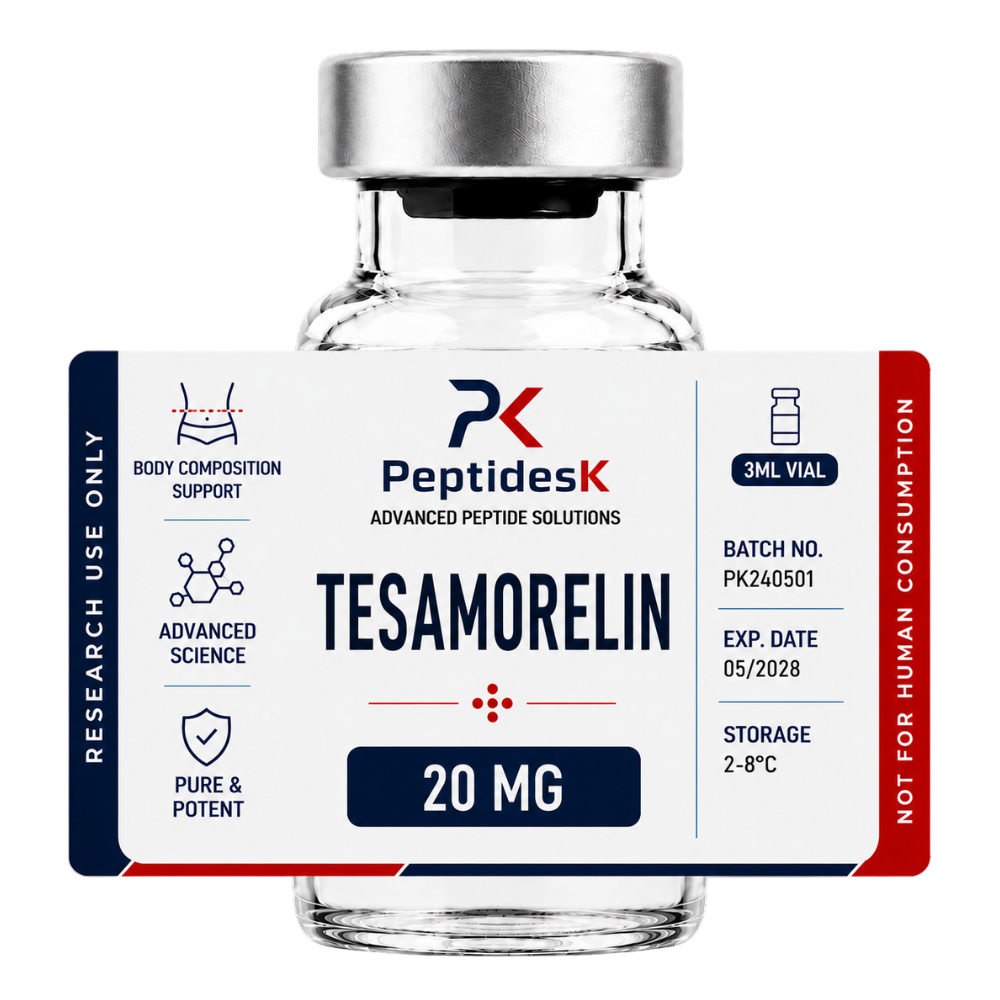
For efficient laboratory evaluation, the matrix below consolidates the core analytical, storage, and cross-reference parameters of Tesamorelin 20mg.
| Core Parameter | Technical Summary & Quick Data | Internal Cross-Reference |
|---|---|---|
| Purity & Grade | ≥ 98% HPLC Certified Sterile filtered, stable lyophilized cake engineered for high-purity assays. | View High-Purity Series → |
| Primary Target Path | GHRH Receptor Agonism: Stimulates endogenous growth hormone secretion; extensively evaluated in lipolysis and metabolic syndrome research. | Metabolic Research Series → |
| Storage Protocol | Lyophilized: -20°C to -80°C (Up to 24 months). Reconstituted: 2°C to 8°C (Must use within 10–14 days). | Buy Reconstitution Diluents → |
| Synergistic Assays | Frequently co-evaluated with other growth hormone secretagogues (GHS) or lipolytic peptides for structural tissue modeling. | Explore Tissue Repair Series → |
What Is Tesamorelin?
What Is Tesamorelin?
Tesamorelin is a stabilized, synthetic peptide analogue of Growth Hormone-Releasing Hormone (GHRH). Composed of 44 amino acids with an added hexenoyl group at its N-terminal anchor, this modification significantly enhances its enzymatic resistance and biological half-life compared to endogenous GHRH. It is extensively utilized in laboratory settings to examine growth hormone regulation axes and lipolytic biological mechanisms.
Tesamorelin 20mg Overview
Our Tesamorelin 20mg formulation provides high-yield analytical purity engineered strictly for in vitro diagnostics and structural laboratory profiling. Each vial contains a highly stable, freeze-dried (lyophilized) cake, preserving the complex peptide sequences against heat-induced degradation paths during research preparations.
| Parameter | Specification |
|---|---|
| Product Format | 20mg Vial (Lyophilized Powder) |
| Sequence | Hexenoyl-Tyr-Ala-Asp-Ala-Ile-Phe-Thr-Asn-Ser-Tyr-Arg-Lys-Val-Leu-Gly-Gln-Leu-Ser-Ala-Arg-Lys-Leu-Leu-Gln-Asp-Ile-Met-Ser-Arg-Gln-Gln-Gly-Glu-Ser-Asn-Gln-Glu-Arg-Gly-Ala-Arg-Ala-Arg-Leu-NH2 |
| Molecular Formula | C221H366N72O67S1 |
| Molecular Weight | 5135.9 g/mol |
| Purity Level | ≥ 98% (HPLC Verified) |
| Physical Appearance | Sterile filtered, white lyophilized cake |
| Core Research Focus | GHRH Receptor Activation, Visceral Adipose Tissue (VAT) Lipolysis, GH Axis Homeostasis |
Regulatory Compliance Notice: This product is synthesized, distributed, and intended solely for laboratory research and development purposes. It is strictly not for human therapeutic use, clinical trials, or agricultural applications. Analytical data sheets (HPLC/MS results) are logged per batch and can be verified upon request.
Research Applications of Tesamorelin Peptide
Research Applications of Tesamorelin Peptide
In scientific literature, Tesamorelin is widely investigated for its direct influence on neuroendocrine axes. Because it retains excellent structural stability, researchers utilize this compound to analyze:
- Visceral Adipose Tissue (VAT) Reduction: Studying targeted lipolytic pathways that specifically reduce visceral fat deposits without altering subcutaneous fat layers.
- Growth Hormone Kinase Feedback Loops: Investigating the structural feedback mechanisms that control endogenous pulsatile Growth Hormone (GH) release.
- Cardiovascular Risk Parameters: Evaluating downstream changes in lipid profiles, triglyceride balances, and inflammatory markers during metabolic lipid accumulation assays.
Tesamorelin Mechanism of Action
Tesamorelin exerts its biological activity by binding highly selectively to **GHRH receptors** located on pituititaries (pituitary somatotroph cells). This interaction initiates a downstream molecular cascade:
- Triggers the synthesis and pulsatile secretion of endogenous Growth Hormone (GH).
- Elevated GH signals the hepatic cells to upregulate **Insulin-Like Growth Factor 1 (IGF-1)** expression.
- The systemic increase in IGF-1 and GH works synergistically to accelerate lipolysis (fat breakdown) via camp pathways in adipose cellular structures.
Potential Areas of Research
Contemporary laboratory studies are continually expanding the experimental footprint of Tesamorelin into alternative biological sectors:
- Cognitive Decline and Neuroprotection: Investigating whether GHRH signaling amplification alters somatotropic support paths in memory or age-associated cognitive decline models.
- NASH and Hepatic Steatosis: Analyzing changes in liver fat content and localized metabolic stress profiles during localized fatty-liver cellular assays.
Research Overview: Benefits vs. Technical Risks
| Observed Research Benefits | Technical Risks & Limitations |
|---|---|
| • Pulsatile GH Release: Unlike direct GH introduction, Tesamorelin preserves normal physiologic negative feedback mechanisms, avoiding pituitary exhaustion. | • Glucose Sensitivity Shifts: Extended exposure in test models can cause minor alterations in baseline glucose levels and insulin sensitivity profiles. |
| • Highly Selective Lipolysis: Demonstrates high affinity for visceral adipose arrays while preserving secondary subcutaneous tissues intact. | • Rapid Enzymatic Cleavage: Though modified with a hexenoyl anchor, the reconstituted liquid is still highly fragile if subjected to room-temperature fluctuations. |
Peptide Comparison Matrix
Peptide Comparison Matrix
| Peptide Compound | Primary Mechanism | Core Research Focus | Target Receptors | Peptide Class |
|---|---|---|---|---|
| AOD 9604 5mg(This Product) | Selective Lipolytic Activity | Accelerating lipid breakdown, triglyceride clearing, and non-glycemic adipocyte metabolic models. | Adipocyte Matrix | hGH C-Terminal Fragment |
| GH Stack 5/5mg | Dual GHRH & GHS Agonism | Tracking pulsatile cellular hormone secretion paths and somatotropic cell cross-talk. | GHS-R / GHRH-R | Co-Lyophilized Blend |
| Cagrilintide 10mg | Non-Selective AMYR Agonism | CTR-RAMP complex co-activation, satiety signaling paths, and gastric transit profiling. | AMYR Complex | Acylated Polypeptide |
| GLP-1 SG 5mg | Selective GLP-1R Agonism | Glucose-dependent insulin transcription tracking, cellular cAMP loops, and incretin calibrations. | GLP-1 Receptor | Linear Incretin Chain |
Storage & Reconstitution Guidelines
Storage & Reconstitution Guidelines
Because Tesamorelin is a long 44-amino acid sequence, its delicate secondary bonds are highly prone to thermal unfolding. Follow these storage safety guidelines closely:
- LONG-TERM
Lyophilized Powder: Must be frozen immediately at -20°C or -80°C to reach full 24-month stability limits. - SHORT-TERM
Transit Resiliency: The freeze-dried state stays secure at room temperatures up to 25°C for 3 weeks max. Refrigerate post-delivery. - POST-RECONSTITUTION
Liquid Form: Must be refrigerated between 2°C and 8°C. Use within 10 to 14 days maximum. Avoid any shaking or refreezing cycles.
Reconstitution Guidelines
- Bring the vial to ambient room balance before introducing any liquid.
- Swab the protective rubber core entry with a high-grade alcohol wipe.
- Slowly slide 1ml or 2ml of bacteriostatic water down the inside glass barrier of the vial.
- Do not shake. Swirl horizontally in small circles until the 20mg powder cake dissolves fully into a perfectly transparent fluid.
There are no reviews yet.