Description
Operational Parameters & Core Metrics
The table below provides analytical benchmark profiles optimized for integrating Cagrilintide 10mg into comparative metabolic research rows.
| Operational Domain | Assay Specification Data | Internal Catalog Link |
|---|---|---|
| Pathway Activation | Non-Selective Amylin Agonism: Binds dualistically to CTR-RAMP complexes to investigate hindbrain satiation signaling loops independent of central hunger structures. | Metabolic Series → |
| Purity Verification | ≥ 98% via SEC-HPLC Vacuum lyophilized to lock the acylated peptide backbone structure against storage mutations. | High-Purity Series → |
| Storage Boundaries | Freeze-Dried Cake: 24 Months (-20°C to -80°C). Solubilized State: Store at 2°C to 8°C. Must completely exhaust within 10 to 14 days maximum. | Get Lab Diluents → |
What Is Cagrilintide 10mg and How Does It Work?
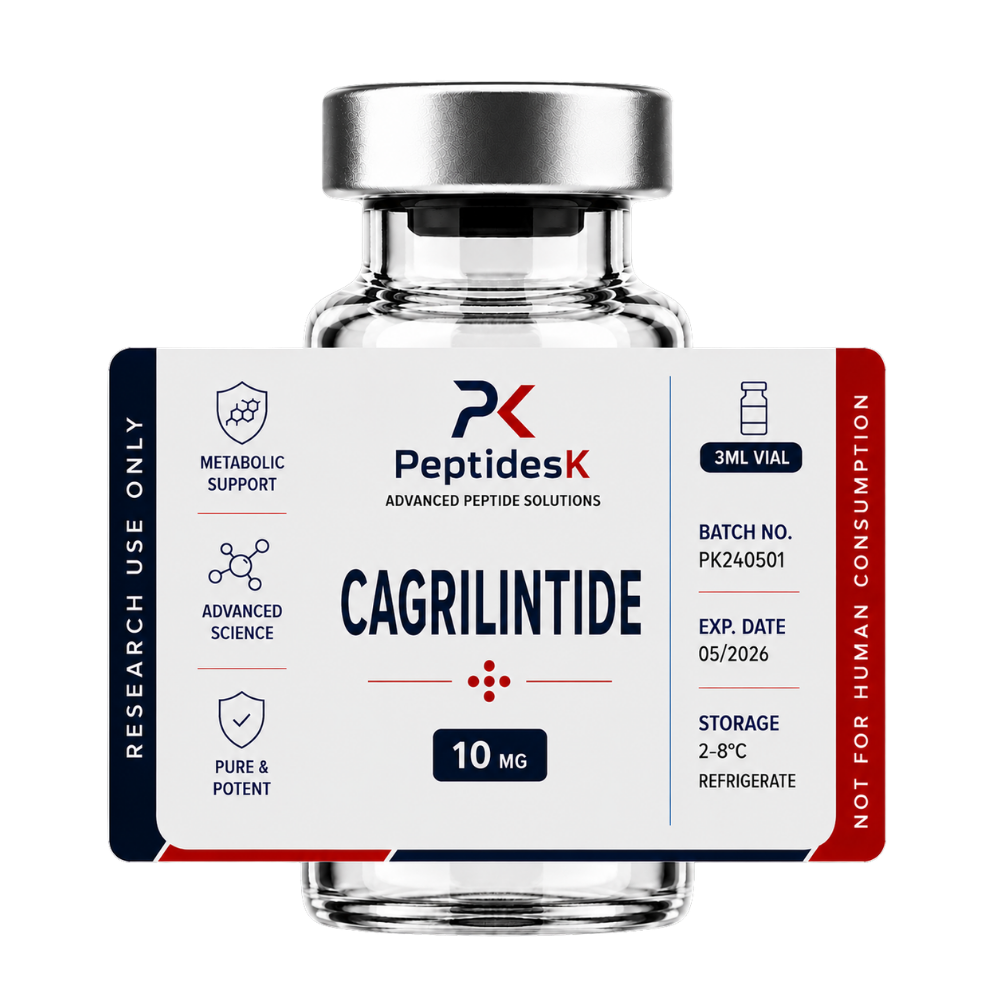
Cagrilintide 10mg is a novel, long-acting dual-acylated analog of the natural human peptide hormone amylin (islet amyloid polypeptide). Designed specifically for advanced metabolic and obesity research, this long-acting amylin analog exhibits modified pharmacokinetic properties, allowing for prolonged receptor activation and sustained metabolic signaling in experimental models.
In analytical endocrinology and metabolic studies, our Cagrilintide research peptide presentation serves as a premier reference standard. Supplying a high-purity 10mg vial provides laboratories with optimal material yield for concentration titration series, receptor binding assays, and metabolic profiling without batch variance. To review batch testing details and third-party lab documentation, visit peptidesk.com.
| Parameter | Specification Standard |
|---|---|
| Product Format | 10mg Purified Lyophilized Powder / Vial (Cagri 10mg) |
| Purity Baseline | ≥ 98.0% Certified Purity via HPLC |
| Compound Class | Acylated Amylin Receptor Agonist |
| Primary Target Node | AMY3 Receptors & Central CNS Satiety Centers |
| Physical Appearance | Sterile filtered, pure white freeze-dried cake |
How Does Cagrilintide Activate Amylin Receptors?
The Cagrilintide peptide exerts its biological activity through high-affinity binding to calcitonin receptor (CTR) coreceptor complexes, specifically targeting the AMY3 subtype receptors located in central nervous system structures.
Upon binding, Cagrilintide initiates intracellular signaling cascades that regulate energy homeostasis, slowing gastric emptying rates and modulating neural pathways involved in energy expenditure without relying on insulin-dependent mechanisms.
How Does Cagrilintide Affect Appetite and Satiety?
In metabolic studies, Cagrilintide is recognized for its powerful ability to suppress hunger signaling and promote early postprandial satiety:
- Central CNS Satiety Integration: Interacts directly with the area postrema and nucleus tractus solitarius (NTS) in the brainstem to signal fullness.
- Gastric Emptying Modulation: Slows down the rate at which food leaves the stomach, prolonging nutrient absorption and extending the duration of satiety signals.
- Reward Circuitry Suppression: Modulates mesolimbic dopamine pathways to decrease food-crawling reward drives in animal feeding models.
What Is Cagrilintide Used for in Metabolic Research?
In contemporary metabolic and obesity research, Cagrilintide is evaluated across several primary investigative areas:
1. Long-Term Weight Management Models
Tracking body composition shifts, fat mass reduction, and caloric intake suppression in diet-induced obesity (DIO) animal models.
2. Glycemic Control & Energy Expenditure
Measuring insulin sensitivity markers and basal metabolic rate adaptations during extended acylated peptide administration.
What Is the Difference Between Cagrilintide and Semaglutide?
While both compounds are leading agents in metabolic research, they target completely distinct neuroendocrine receptor pathways:
| Feature | Semaglutide (GLP-1 Receptor Agonist) | Cagrilintide (Amylin Analog) |
|---|---|---|
| Receptor Target | GLP-1 Receptors (Glucagon-like peptide-1) | Amylin / AMY3 Receptors (Calcitonin receptor complexes) |
| Insulin Secretion | Glucose-dependent insulinotropic stimulation | Suppresses glucagon secretion; acts independently of insulin |
| Primary Action | Enhances insulin release & slows gastric emptying | Targets central satiety centers via non-GLP-1 mechanisms |
What Is CagriSema and How Is It Related to Cagrilintide?
CagriSema is a breakthrough combination regimen that co-formulates Cagrilintide with Semaglutide. Because Cagrilintide works via amylin receptor pathways and Semaglutide operates through GLP-1 receptors, combining them creates a powerful synergistic dual-hormone approach.
In metabolic research trials, the CagriSema combination demonstrates enhanced weight reduction and appetite suppression compared to either compound administered alone, representing the cutting edge of combination peptide therapy.
What Makes PeptidesK Cagrilintide 10mg Different?
PeptidesK Cagrilintide 10mg stands apart through uncompromising manufacturing precision. Each vial is produced utilizing advanced solid-phase peptide synthesis (SPPS) and rigorous dual-acylation chemistry, ensuring high structural integrity and stability during laboratory reconstitution.
How Is PeptidesK Cagrilintide 10mg Tested for Purity and Quality?
Maintaining analytical precision is essential when working with complex acylated peptides. Every batch of our Cagrilintide inventory undergoes rigorous quality control procedures:
Rigorous Testing Protocols
- HPLC Assays: High-Performance Liquid Chromatography confirms sequence identity and guarantees a purity baseline of ≥98.0%.
- Mass Spectrometry (LC-MS): Verifies molecular weight accuracy and ensures the correct acylation structure is intact.
- Lot-Specific COA: Every order is backed by accessible, batch-specific certificate of analysis documentation.
Storage and Handling Instructions
Storage Recommendations
- Freeze-Dried Powder: Keep unopened vials in a laboratory freezer at -20°C to -80°C for long-term stability up to 24 months. Protect from direct light.
- Transit Stability: Lyophilized vials tolerate ambient shipping temperatures up to 25°C for up to 3 weeks without bioactivity loss.
- Reconstituted Liquid Phase: Store under refrigeration between 2°C and 8°C. Use active liquid within 10 to 14 days maximum. Do not refreeze.
Reconstitution Protocol
- Allow the 10mg vial to reach ambient room temperature naturally before opening the cap to eliminate condensation moisture.
- Sanitize the rubber entry stopper thoroughly with a fresh isopropyl alcohol wipe.
- Slowly introduce 1ml to 2ml of sterile bacteriostatic water down the inside glass wall of the vial.
- Do not shake. Gently swirl horizontally in small circles until the cake completely dissolves into a clear liquid.
Where Can I Buy Cagrilintide 10mg for Research?
When searching where to buy Cagrilintide 10mg online or reviewing competitive Cagrilintide 10mg price structures, partnering with a trusted supplier is essential. At PeptidesK, our direct-to-laboratory sales policy ensures that every vial of Cagrilintide 10mg is sourced directly from certified cleanroom laboratories, eliminating middlemen markups and guaranteeing transparent pricing.
Every lot of our Cagrilintide USA inventory undergoes strict HPLC and mass spectrometry testing to guarantee a certified purity baseline of ≥98.0%. To order lot-tested 10mg vials backed by reliable domestic shipping across the USA, check our selection directly on peptidesk.com.
Analytical Verification & Sales Policy: View our latest purity charts, direct lab pricing, and testing documents directly on our PeptidesK Third-Party Lab Testing Page.
Shop by Research Goals
Explore our catalog of analytical-grade compounds grouped by research category:
| Category | Primary Research Focus |
|---|---|
| Fat Loss & Metabolic Peptides → | Incretin mimetics, amylin analogs, and metabolic flexibility profiling. |
| Anti-Aging & Longevity Peptides → | Cellular renewal, telomere maintenance, and anti-senescence research models. |
| Focus & Cognitive Peptides → | Nootropic signaling, neuroprotection, and synaptic plasticity assays. |
| Recovery & Healing Peptides → | Soft tissue repair, tendon-to-bone recovery, and systemic cell migration. |
| Muscle Growth & Building Peptides → | Anabolic signaling, GH secretagogues, and protein synthesis acceleration. |


There are no reviews yet.