
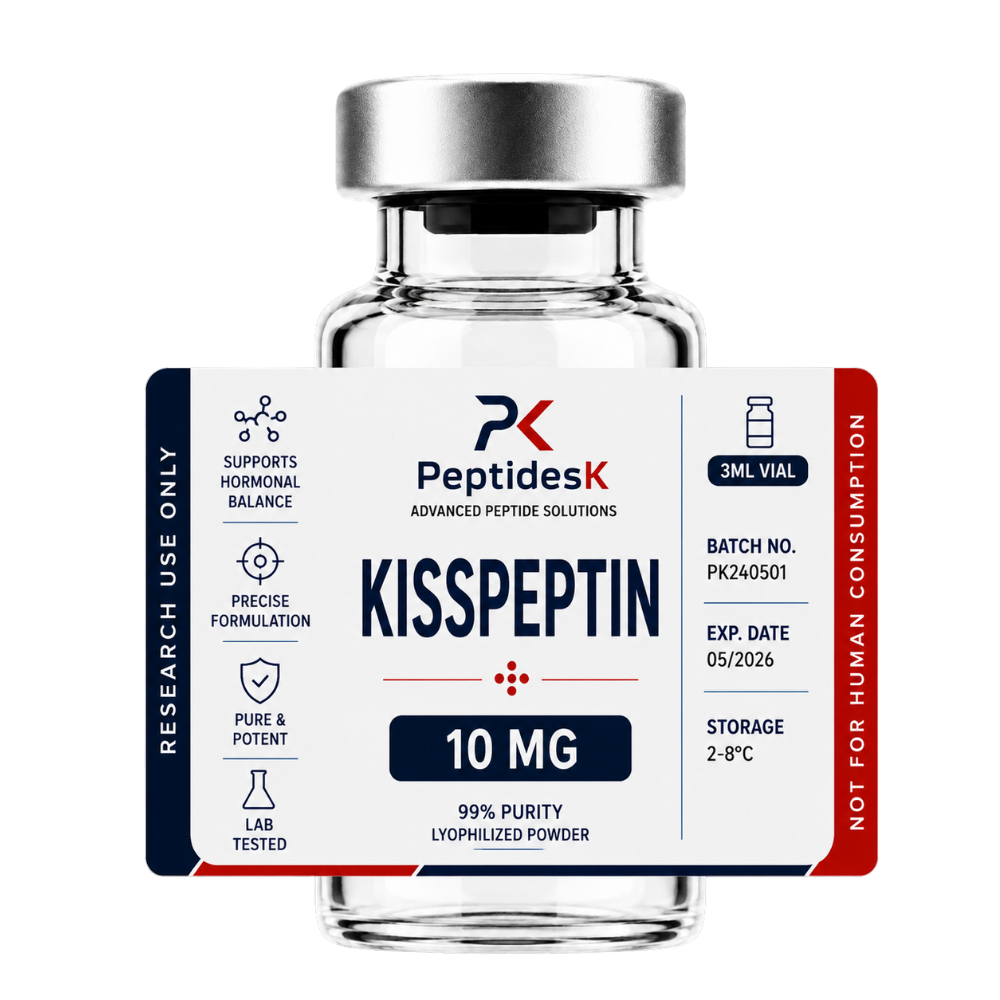
Description
Quick-Reference Overview Matrix
For efficient protocol alignment, the matrix below details the foundational technical and routing criteria of Kisspeptin-10 10mg.
| Core Parameter | Technical Summary & Quick Data | Internal Cross-Reference |
|---|---|---|
| Purity & Grade | ≥ 98% HPLC Certified Sterile filtered, vacuum-desiccated lyophilized cake optimized for targeted neuroendocrine assays. | View High-Purity Series → |
| Storage Protocol | Lyophilized Solid: -20°C to -80°C (Up to 24 months). Reconstituted Fluid: 2°C to 8°C (Must use within 10–14 days). Avoid aggressive mechanical motion. | Buy Reconstitution Diluents → |
| Synergistic Assays | Frequently cross-referenced alongside behavior-modulating central agonists like PT-141 to map complex hypothalamic reward loop configurations. | Pair with PT-141 10mg → |
What Is Kisspeptin-10 and How Does It Work?
Kisspeptin-10 (frequently designated in scientific literature as KP-10 or Kisspeptin 10mg) is a biologically active, 10-amino-acid C-terminal cleavage fragment of the larger Kisspeptin precursor protein (encoded by the KISS1 gene). Functioning as a primary neuroendocrine regulator, Kisspeptin-10 acts as the central gatekeeper of the Hypothalamic-Pituitary-Gonadal (HPG) axis by driving upstream hormonal signaling in central nervous system models.
In analytical endocrinology and reproductive physiology, our Kisspeptin-10 research peptide presentation serves as a premier reference standard. Utilizing a high-purity 10mg lyophilized vial provides laboratories with ample material for concentration titration series, receptor binding assays, and pulse-frequency profiling without batch-to-batch variation. To review batch-specific HPLC purity verification and third-party lab testing reports, visit peptidesk.com.
| Parameter | Specification Standard |
|---|---|
| Product Format | 10mg Purified Lyophilized Powder / Vial |
| Purity Baseline | ≥ 98.0% Certified via HPLC Assays |
| Kisspeptin-10 Peptide Sequence | Tyr-Asn-Trp-Asn-Ser-Phe-Gly-Leu-Arg-Phe-NH2 |
| Kisspeptin-10 Molecular Weight | 1302.4 g/mol |
| Physical Appearance | Sterile filtered, white lyophilized cake |
How Does Kisspeptin-10 Activate the KISS1R Receptor?
The molecular Kisspeptin mechanism relies on high-affinity binding to the KISS1R receptor (formerly known as GPR54), a G-protein-coupled receptor predominantly expressed on Gonadotropin-Releasing Hormone (GnRH) neurons in the hypothalamus.
Upon binding, the Kisspeptin signaling pathway triggers a intracellular signal cascade:
- Gq/11 Protein Coupling: Receptor activation stimulates Phospholipase C (PLC) activity.
- Inositol Triphosphate (IP3) & DAG Generation: Cleaves membrane phospholipids into IP3 and diacylglycerol.
- Intracellular Calcium Release: IP3 induces rapid mobilization of stored intracellular calcium ($Ca^{2+}$), leading to sustained depolarization of GnRH neuronal membranes.
How Does Kisspeptin-10 Affect GnRH Release?
GnRH neurons themselves lack direct receptors for most circulating steroid hormones (such as estrogen and testosterone). Kisspeptin neurons act as the essential intermediate conduit that senses circulating feedback and translates it into direct neural input.
When Kisspeptin-10 binds to KISS1R on GnRH nerve terminals, it induces pulsatile release of Gonadotropin-Releasing Hormone into the hypophyseal portal circulation system, effectively setting the firing pace for the entire reproductive cascade.
Does Kisspeptin-10 Increase LH and FSH Levels?
Yes. By driving pulsatile GnRH secretion from the hypothalamus, Kisspeptin-10 downstream signals directly stimulate the anterior pituitary gland to release Luteinizing Hormone (LH) and Follicle-Stimulating Hormone (FSH):
Luteinizing Hormone (LH) Modulation
Induces immediate, robust spikes in LH secretion, serving as a primary model for evaluating ovulation triggers in female assays and Leydig cell testosterone stimulation in male models.
Follicle-Stimulating Hormone (FSH) Modulation
Promotes moderate, sustained increases in FSH, supporting follicle maturation research and Sertoli cell spermatogenesis tracking.
What Are the Effects of Kisspeptin-10 on Reproductive Hormones?
The downstream regulatory effects of the Kisspeptin-10 peptide extend across the entire endocrine system, influencing secondary steroidogenesis in gonadal tissues:
- Testosterone Upregulation: In male models, LH surges driven by KP-10 stimulate Leydig cells to produce endogenous testosterone natively.
- Estrogen & Progesterone Dynamics: In female models, pulsatile LH/FSH elevation coordinates follicular development and steroidogenesis in ovarian tissue.
- Feedback Loop Homeostasis: Serves as an analytical tool to measure central sensitivity to negative steroid feedback loops.
What Is Kisspeptin-10 Used for in Research? Is It Used in Fertility Studies?
Yes, Kisspeptin-10 is extensively utilized across fertility, reproductive biology, and neuroendocrine publications. Key investigative areas include:
- Hypogonadotropic Hypogonadism Models: Evaluating whether central KISS1R stimulation can restore suppressed gonadotropin release in delayed puberty or stress-induced infertility models.
- Targeted Ovulation Triggering: Investigating KP-10 as a physiological alternative to hCG for inducing oocyte maturation with a lower risk of ovarian hyperstimulation syndrome (OHSS).
- Metabolic Infertility & Energy Balance: Mapping how metabolic stressors (such as low leptin or energy deficit) alter Kisspeptin neuronal firing and impair fertility.
What Is the Difference Between Kisspeptin-10 and Kisspeptin-54?
While both peptides share the identical active 10-amino-acid C-terminal sequence required for KISS1R binding, structural length creates distinct operational differences in laboratory settings:
| Feature | Kisspeptin-10 (KP-10) | Kisspeptin-54 (KP-54) |
|---|---|---|
| Sequence Length | 10 Amino Acids (Minimum active core) | 54 Amino Acids (Full-length endogenous precursor) |
| Half-Life Kinetics | Shorter, rapid-onset biological action | Extended circulation clearance time |
| Laboratory Utility | Ideal for precise, acute pulse-response assays | Used for extended, steady-state endocrine tracking |
Observed Research Benefits & Experimental Limits
Key Research Advantages
- Upstream HPG Activation: Drives physiological GnRH release naturally without overwhelming pituitary receptors.
- Minimal Active Motif: Compact 10-AA structure minimizes synthesis impurities and enhances receptor binding efficiency.
- Precise Pulsatile Modeling: Rapid onset allows exact monitoring of acute LH/FSH secretion spikes.
Potential Handling Limits
- Rapid Plasma Clearance: Solubilized liquid solutions exhibit short enzymatic stability if not handled properly.
- Receptor Desensitization: Continuous, non-pulsatile exposure can induce temporary KISS1R internalization in cell assays.
Laboratory Storage & Handling Instructions
Storage Recommendations
- Freeze-Dried Powder (Unopened): Store unopened vials in a laboratory freezer at -20°C to -80°C for long-term stability up to 24 months. Keep protected from direct light.
- Transport Resilience: Lyophilized powder remains completely stable during ambient transit conditions up to 25°C for up to 3 weeks.
- Reconstituted Liquid Phase: Store under refrigeration between 2°C and 8°C. Exhaust active testing liquid within 10 to 14 days maximum. Do not refreeze liquid solutions.
Step-by-Step Reconstitution Protocol
- Allow the 10mg vial to reach ambient room temperature naturally before opening the cap to eliminate condensation moisture inside the glass.
- Sanitize the rubber entry stopper with a fresh isopropyl alcohol wipe.
- Slowly introduce 1ml to 2ml of sterile bacteriostatic water down the inside glass wall of the vial.
- Do not shake. Gently swirl horizontally in small circles until the cake completely dissolves into a clear liquid.
Where Can I Buy Kisspeptin-10 10mg for Research?
When searching where to buy Kisspeptin-10 10mg online or checking competitive Kisspeptin-10 price rates, verifying third-party analytical quality is essential for accurate endocrine testing. Impurities or sequence truncations can impair KISS1R binding affinity and yield inaccurate laboratory data.
Every lot of our Kisspeptin-10 USA inventory undergoes independent High-Performance Liquid Chromatography (HPLC) and Mass Spectrometry (MS) testing to confirm structural identity and guarantee a certified purity baseline of ≥98.0%. To order high-grade 10mg vials with fast domestic shipping across the USA, check our Kisspeptin-10 for sale selection directly on peptidesk.com.
Analytical Verification & COA Reports: Inspect our latest batch-specific HPLC purity charts, mass spectrometry results, and independent COA documents directly on our PeptidesK Third-Party Lab Testing Page.
Shop by Research Goals
Explore our catalog of analytical-grade compounds grouped by primary experimental targets:
| Category | Primary Research Focus |
|---|---|
| Anti-Aging & Longevity Peptides → | Cellular renewal, telomere maintenance, and anti-senescence research models. |
| Focus & Cognitive Peptides → | Nootropic signaling, neuroprotection, and synaptic plasticity assays. |
| Fat Loss & Metabolic Peptides → | Incretin mimetics, lipolysis acceleration, and metabolic flexibility profiling. |
| Recovery & Healing Peptides → | Soft tissue repair, tendon-to-bone recovery, and systemic cell migration. |
| Muscle Growth & Building Peptides → | Anabolic signaling, GH secretagogues, and protein synthesis acceleration. |
There are no reviews yet.