
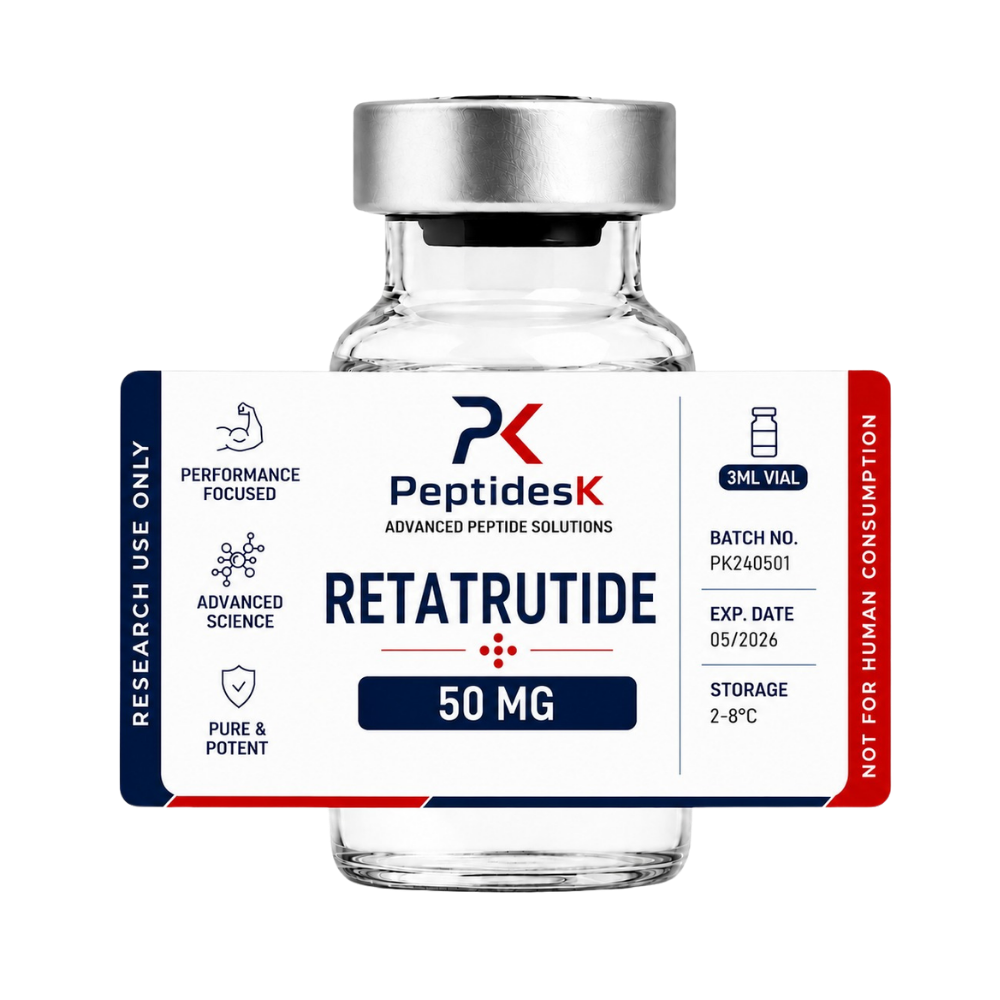
Description
Retatrutide 50mg Core Specifications
Deep technical specification parameters optimized for integrating high-mass Retatrutide into continuous, multi-well laboratory screening protocols.
| Research Parameter | Assay Benchmark Profile | Internal Catalog Link |
|---|---|---|
| Sequence Blueprint | Modified 39 Amino Acid Peptide Complex (GIP / GLP-1 / Glucagon Tri-Agonist Base) | High-Purity Series → |
| Molecular Weight | 4731.4 Da (Stabilized with a customized C20 fatty diacid chain modification) | |
| Purity Baseline | ≥ 98.0% via High-Performance HPLC Testing | Metabolic – Weight Loss Compounds → |
| Assay Target | Concurrent GIPR, GLP-1R, and GCGR Multi-Pathway Saturation Loops |
What Is Retatrutide Peptide & How Does It Work?
Retatrutide (chemically designated as LY3437943) represents a breakthrough synthetic polypeptide architecture explicitly engineered to operate as a potent triple agonist targeting three fundamental metabolic receptors: Glucose-Dependent Insulinotropic Polypeptide (GIP), Glucagon-Like Peptide-1 (GLP-1), and Glucagon (GCG). By integrating these three independent incretin and glucagon signaling pathways into a single, modified 39-amino-acid backbone, Retatrutide yields an unprecedented degree of fat clearing, glycemic control, and cellular energy expenditure management. Its peptide sequence features a distinct C20 lipophilic fatty acid tail modification that significantly extends its active half-life and insulates the molecule against rapid enzymatic breakdown by dipeptidyl peptidase-4 (DPP-4). In modern endocrinology research, this massive 50mg configuration serves as a stable, high-yield reference standard for monitoring deep adipocyte cellular adaptations, lipid oxidation speed, and multi-receptor metabolic flux. To review verified batch documentation, visit peptidesk.com.
Retatrutide 50mg Technical Specifications
| Technical Property | Laboratory Standard Specifications |
|---|---|
| Chemical Structure | Acylated 39-AA Peptide Chain (Triple-Incretin Agonist Base) |
| Active Core Payload | 50mg Purified Crystalline Powder / Vial (High-Yield Core Configuration) |
| Purity Baseline | ≥ 98.0% Pure Certified via HPLC & Mass Spectrometry Assays |
| Primary Target Node | Simultaneous GIPR/GLP-1R/GCGR activation, mitochondrial energy kinetics, and lipid oxidation |
Research Compliance Notice: Materials offered as retatrutide research peptide for sale are supplied strictly for in vitro laboratory profiling, cellular assay design, and scientific research. They are not approved for human therapeutic use, prescription delivery, or self-administration.
Retatrutide Mechanism of Action: GLP-1, GIP & Glucagon Triple Agonism
The core LY3437943 mechanism relies on its unique identity as a retatrutide triple agonist. By engaging three discrete receptor sites simultaneously, the retatrutide GLP-1 GIP glucagon cascade produces synergistic metabolic outcomes that exceed traditional mono- or dual-agonist therapies:
- GIP Receptor Agonism: Enhances glucose-dependent insulin secretion, improves adipose tissue nutrient handling, and buffers against gastrointestinal intolerance.
- GLP-1 Receptor Agonism: Stimulates intracellular cyclic AMP (cAMP) accumulation, suppresses inappropriate postprandial glucagon release, delays gastric emptying, and uregulates central satiety signaling.
- Glucagon Receptor (GCGR) Agonism: Directly stimulates hepatic lipid oxidation, increases basal energy expenditure via non-shivering thermogenesis, and accelerates overall triglyceride clearance from tissue storage.
Retatrutide Core Pathways & Action Matrix
| Target Pathway | Observed Cellular Action | Primary Research Goal |
|---|---|---|
| Triple Receptor Sync | Co-activates GIP, GLP-1, and GCG pathways to maximize downstream internal cyclic AMP flux. | Quantifying multi-receptor incretin and glucagon synergy. |
| Lipid Oxidation | Recruits glucagon pathways to directly accelerate fatty acid breakdown inside adipocyte rows. | Measuring the deceleration speed of new tissue fat accumulation. |
| Energy Kinetics | Forces cells to prioritize burning stored lipid parameters, enhancing baseline cellular metabolic rates. | Mapping high-yield non-shivering heat generation curves natively. |
Retatrutide Weight Loss Results & Clinical Trial Data
In Phase 2 and ongoing trial publications evaluating retatrutide for weight loss, the compound has established unprecedented efficacy benchmarks. Researchers analyzing retatrutide weight loss results document several key parameters across extended study timelines:
- Weight Loss Percentage: Clinical study data revealed an average retatrutide weight loss percentage reaching up to 24.2% of total body mass at 48 weeks in highest-dose cohorts (12mg weekly).
- Continuous Mass Reduction: Unlike earlier incretins that hit an efficacy plateau around 36 to 40 weeks, retatrutide weight loss study trajectories show persistent downward mass curves through week 48.
- Cardiometabolic & Hepatic Improvements: Beyond total weight reduction, trial data demonstrated remarkable drops in liver fat content (over 80% reduction in non-alcoholic fatty liver disease models), alongside improved systolic blood pressure and triglyceride profiles.
- High-Yield 50mg Configuration: Utilizing a 50mg high-mass presentation allows research facilities to manage broad automated screening panels and multi-vial titration models entirely from a uniform batch.
Retatrutide Phase 3 Clinical Trials & Current Research Progress
The global development program for Retatrutide includes the extensive TRIUMPH Phase 3 clinical trials, designed to evaluate safety, tolerability, and efficacy across diverse patient demographics:
- TRIUMPH-1 & TRIUMPH-2: Focus on chronic weight management in subjects with and without type 2 diabetes mellitus.
- TRIUMPH-3 & TRIUMPH-4: Target cardiovascular outcomes, knee osteoarthritis pain reduction, and sleep apnea improvements secondary to weight loss.
- 2026 Research Milestones: Updated retatrutide weight loss results 2026 from late-phase trials continue to confirm superior metabolic flexibility and fat oxidation rates compared to prior-generation single and dual agonists.
Retatrutide FDA Approval Status & Investigational Notice
Regarding retatrutide FDA approval status, Retatrutide is currently an investigational compound and has not received FDA approval for commercial prescription or human clinical use. It remains restricted to controlled clinical trial environments and scientific research protocols. Any material sourced as a retatrutide research compound is intended solely for qualified laboratory experimentation.
Is Retatrutide Safe? Side Effects & Safety Profile
When addressing the question is retatrutide safe, researchers evaluate documented retatrutide side effects and overall tolerability profiles from clinical trial cohorts:
- Gastrointestinal Responses: Like other incretin mimetics, primary retatrutide adverse effects include transient mild-to-moderate nausea, vomiting, diarrhea, constipation, and decreased appetite during titration.
- Heart Rate Elevation: A dose-dependent increase in resting heart rate has been observed, peaking around weeks 24 weeks before declining toward baseline.
- Cutaneous Hyperesthesia: Uniquely reported in a small percentage of trial subjects, mild skin sensitivity or tingling sensations occurred secondary to rapid metabolic or nervous system stimulation.
- Safety Mitigation: Gradual, step-wise dose escalation schedules substantially improve tolerability and reduce acute gastrointestinal distress across test models.
Retatrutide Dosage & Clinical Trial Doses
In Phase 2 and Phase 3 trial designs, retatrutide dosage schedules follow a conservative escalation pattern to build metabolic tolerance:
- Initiation Phase (Weeks 1–4): Started at a low baseline dose of 2mg once weekly via subcutaneous retatrutide injection.
- Escalation Phase (Weeks 5–12+): Increased progressively in 2mg or 4mg steps (moving through 4mg, 8mg, and up to 12mg target maintenance tiers every 4 weeks).
- Top Maintenance Tier (12mg Weekly): The maximum clinical maintenance dose tested in Phase 2 trials was 12mg weekly, driving peak triple-receptor agonism and fat clearance.
Retatrutide vs Tirzepatide: Dual vs. Triple Agonism
Comparing retatrutide vs tirzepatide highlights the structural and functional evolution from dual incretin agonism to triple receptor agonism:
| Comparison Metric | Tirzepatide (Mounjaro / Zepbound) | Retatrutide (LY3437943) |
|---|---|---|
| Target Receptors | Dual GIPR + GLP-1R | Triple GIPR + GLP-1R + GCGR |
| Mean Weight Loss (48 Wks) | ~20.9% to 22.5% | Up to 24.2% (Superior trajectory) |
| Energy Expenditure Mechanism | Incretin-driven glucose & satiety control | Direct glucagon-driven thermogenesis & lipolysis |
Retatrutide vs Semaglutide (Ozempic & Wegovy)
Evaluating retatrutide vs semaglutide (or Ozempic / Wegovy) illustrates the performance gap between first-generation selective GLP-1 mono-agonists and next-generation multi-agonists:
- Efficacy Differential: Semaglutide achieves an average 15% weight reduction over 68 weeks, whereas Retatrutide achieves over 24% weight loss in 48 weeks.
- Mechanism Distinction: Semaglutide acts exclusively on central appetite and gastric delay via GLP-1R, while Retatrutide adds GIP insulinotropic control and Glucagon metabolic expenditure.
Retatrutide vs Orforglipron: Injectable Triple Agonist vs. Oral GLP-1
Comparing retatrutide vs orforglipron contrasts two distinct frontiers in modern metabolic research:
- Delivery Format: Retatrutide is a 39-amino-acid acylated peptide requiring subcutaneous administration, whereas Orforglipron is a non-peptide small molecule designed for once-daily oral delivery.
- Target Scope: Orforglipron selectively targets the GLP-1 receptor, whereas Retatrutide provides multi-receptor triple agonism for maximum energy expenditure.
Retatrutide Half-Life & Pharmacokinetics
Understanding retatrutide half-life parameters is vital for establishing protocol administration intervals. Thanks to its C20 fatty acid chain modification that binds reversibly to endogenous albumin, Retatrutide exhibits an elimination half-life of approximately 6 days (144 hours). This extended pharmacokinetic profile supports convenient once-weekly administration schedules in research models.
When calculating protocol capacity—for example, evaluating how long will 10mg of retatrutide last—a 10mg total quantity provides 5 weeks of material at a baseline 2mg weekly dose. A high-yield 50mg vial offers extended operational longevity for high-volume laboratory screening rows.
Retatrutide Reconstitution & Storage Protocols
Following verified retatrutide reconstitution guidelines ensures structural peptide integrity and prevents early degradation of its 39-amino-acid chain:
- FREEZER (-20°C)
Lyophilized Powder: Store dry powder vials inside a laboratory freezer at -20°C to -80°C for long-term stability up to 24 months. - TRANSIT WINDOW
Unreconstituted Powder: Highly resilient during transport; can endure room temperatures up to 25°C for up to 3 weeks. Freeze upon receipt. - REFRIGERATOR (2°C – 8°C)
Reconstituted Fluid Phase: Keep reconstituted liquid solutions under refrigeration between 2°C and 8°C. Exhaust active liquid within 10 to 14 days maximum. Do not refreeze liquid.
Step-by-Step Reconstitution Protocol
- Allow the 50mg vial to naturally reach room temperature equilibrium before removing the plastic security cap.
- Sanitize the top rubber entry septum using a sterile isopropyl alcohol wipe.
- Slowly inject sterile bacteriostatic water down the internal glass wall to prevent mechanical kinetic shock.
- Do not shake or vortex. Gently roll the vial horizontally between your palms until the crystalline powder cake fully dissolves into a crystal-clear liquid layer.
LY3437943 Research Overview & Sourcing
As a leading retatrutide supplier committed to analytical excellence, PeptidesK provides batch-certified retatrutide 50mg vials verified via high-performance liquid chromatography (HPLC) and mass spectrometry analysis. To inspect third-party testing reports or buy retatrutide peptide for qualified research applications, order directly from peptidesk.com.
Analytical Verification & Lab Reports: Inspect our latest batch-specific HPLC purity charts, mass spectrometry results, and independent Certificates of Analysis (COA) directly on our PeptidesK Third-Party Lab Testing Page.
Shop by Goal Categories
Explore our high-purity research compounds and peptides categorized by primary experimental targets and research goals:
| Goal Category | Primary Research Focus |
|---|---|
| Anti-Aging & Longevity Peptides → | Cellular renewal, telomere maintenance, and anti-senescence research models. |
| Fat Loss & Metabolic Peptides → | Incretin mimetics, lipolysis acceleration, and metabolic flexibility profiling. |
| Muscle Growth & Building Peptides → | Anabolic signaling, GH secretagogues, and protein synthesis acceleration. |
| Recovery & Healing Peptides → | Soft tissue repair, tendon-to-bone recovery, and systemic cell migration. |
| Focus & Cognitive Peptides → | Nootropic signaling, neuroprotection, and synaptic plasticity assays. |

There are no reviews yet.