
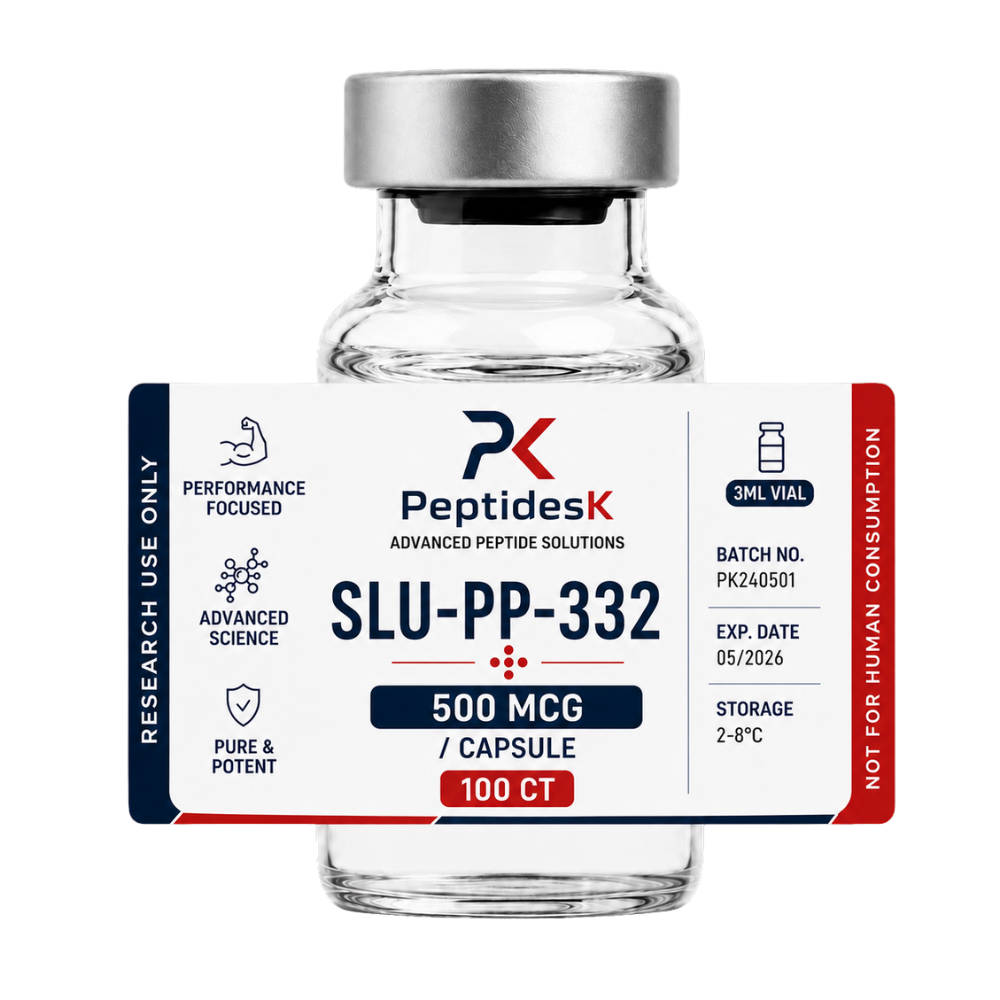
Description
SLU-PP-332 500mcg Core Metrics
Technical specification parameters optimized for integrating high-purity SLU-PP-332 capsules into focused cellular endurance rows.
| Research Parameter | Assay Benchmark Profile | Internal Catalog Link |
|---|---|---|
| Molecular Engine | ERR Pan-Agonist (Exercise Mimetic Model) | High-Purity Series → |
| Purity Baseline | ≤ 98.0% via High-Resolution SEC-HPLC | Metabolic Series → |
What is SLU-PP-332 & How Does it Work?
What is SLU-PP-332 & How Does it Work?
SLU-PP-332 is a highly specialized synthetic small molecule designed to act as a potent nuclear receptor pan-agonist targeting Estrogen-Related Receptors (ERR alpha, beta, and gamma). In contemporary metabolic literature, this non-peptide compound is heavily studied as an exercise mimetic. It triggers key genetic pathways typically turned on during intense endurance exercise without requiring physical activity. By avoiding the typical degradation challenges seen with sensitive peptide sequences, its oral capsule format provides researchers with a highly stable tool to observe sustained energy expenditure and mitochondrial changes inside laboratory research models.
SLU-PP-332 500mcg Quick Specifications
| Technical Property | Laboratory Standard Specifications |
|---|---|
| Chemical Structure | ERR alpha/beta/gamma Pan-Agonist Small Molecule |
| Active Core Payload | 500mcg per Capsule (100 Active Capsules / Bottle) |
| Purity Threshold | ≥ 98.0% Pure Certified via HPLC Assays |
| Primary Research Node | Mitochondrial biogenesis, skeletal muscle remodeling, and fatty acid oxidation curves |
How Does SLU-PP-332 Work in Laboratory Assays?
SLU-PP-332 functions by directly crossing cell membranes to activate the ERR alpha/beta/gamma transcriptional network core. This binding action turns on genes responsible for building fresh mitochondria and scaling up cell respiration speed. Unlike traditional metabolic agents that force raw central nervous stress, SLU-PP-332 alters fuel preference inside cell matrices toward active fatty acid oxidation. This allows investigators to observe continuous non-shivering heat generation and lipid breakdown natively, completely free from unguided cellular proliferation data noise.
SLU-PP-332 Research Applications
SLU-PP-332 Research Applications
In analytical metabolic endocrinology and muscular transcriptomic profiling publications, SLU-PP-332 is evaluated extensively for its ability to increase oxidative muscle fiber percentages in test models. Investigators utilize this 500mcg capsule format to track glucose clearance rates and monitor total body fat tissue deceleration under controlled diets. The 100ct presentation provides an ideal, pre-calculated material footprint required for extended concentration screening curves without running into early lot-to-lot baseline titration errors.
SLU-PP-332 Core Pathways & Action Matrix
The table below consolidates the primary cellular pathways, biological markers, and research objectives tracked during SLU-PP-332 laboratory testing lines:
| Target Pathway | Observed Cellular Action | Primary Research Goal |
|---|---|---|
| Mitochondrial Expansion | Upregulates key genes to increase active mitochondrial density inside muscle tissue matrices. | Quantifying cell respiration and ATP generation speed. |
| Fatty Acid Oxidation | Forces cells to prioritize burning stored lipid parameters for cellular fuel requirements. | Studying fat accumulation deceleration and lean tissue markers. |
| Fiber Architecture Shift | Promotes structural remodeling toward oxidative (fatigue-resistant) fiber types. | Mapping endurance mimetic data curves natively. |
Step-by-Step Mechanism of Action
When SLU-PP-332 is introduced to the target sample research media, it coordinates deep energy adaptations through a highly standardized sequence path:
- Nuclear Penetration: The small molecule structure smoothly crosses internal lipid boundaries to reach the cell’s nuclear core directly.
- ERR Pan-Agonism: Docks selectively across active ERR alpha, beta, and gamma receptor backbones simultaneously.
- Co-Activator Recruitment: Prompts immediate structural changes that recruit key gene controllers, turning on mitochondrial biogenesis networks.
- Metabolic Shift: The cell lines demonstrate an intense spike in baseline oxygen consumption, accelerating active fat breakdown while keeping muscle tissue preservation stable.
How Does SLU-PP-332 Compare to Other Research Peptides?
How Does SLU-PP-332 Compare to Other Research Peptides?
To assist in protocol coordination, it is essential to differentiate the muscle-focused energy expenditure and exercise mimetic focus of SLU-PP-332 500mcg from alternative metabolic tracks available in our collection. While alternative compounds target appetite signaling networks or adipose cell tissue pathways explicitly, SLU-PP-332 focuses entirely on turning on mitochondrial transcription. Understanding these core catalog differences allows for more precise laboratory assay designs.
Peptide Quick Comparison Matrix
The comparative table below outlines the core differences in research focus, mechanism of action, and primary target nodes across our active high-purity laboratory collection:
| Research Peptide | Mechanism of Action | Primary Laboratory Focus | Target Nodes | Peptide Structure |
|---|---|---|---|---|
| SLU-PP-332 500mcg(This Product) | ERR alpha/beta/gamma Agonism | Exercise mimetic pathways, mitochondrial биогенез, and muscle lipid breakdown. | ERR Core Network | Small Molecule |
| MOTS-c 10mg | Mito-Signaling Loop | Mitochondrial energy output tracking, non-insulin glucose clearings, and exercise mimetic assays. | AMPK Pathways | Linear 16-AA Peptide |
| AOD 9604 5mg | Selective Adrenergic Activity | Accelerating lipid breakdown, triglyceride clearing, and non-glycemic metabolic models. | Adipocyte Matrix | 16-AA C-Term Fragment |
Synergistic Research Application Notice
In broad metabolic research projects, investigators frequently study ERR pan-agonists alongside mitochondrial-derived peptides like MOTS-c to observe cellular stamina adaptations. The 500mcg oral configuration provides the exact material control required to establish baseline low-dose parameters without liquid reconstitution errors. While our standard peptide series look into rapid AMPK pathways or selective lipolysis, standalone SLU-PP-332 offers a pristine reference loop for deep nuclear-directed cell energy research.
Storage & Reconstitution Guidelines
Storage & Reconstitution Guidelines
How to Store SLU-PP-332 Oral Capsules
To keep your high-purity SLU-PP-332 capsules fully stable and prevent the small molecule layout from losing transcriptional strength over time, you must follow strict environment rules. This stable chemical structure resists standard solution breakdown paths but remains sensitive to high heat, moisture infiltration, and direct sunlight exposure loops.
- COOL & DRY (15°C – 25°C) Long-Term Bottle Storage: Store the original tightly sealed capsule bottle inside a cool, dark laboratory cabinet between 15°C and 25°C. Keeping the environment dry fully protects shell integrity for up to 24 months.
- HUMIDITY CONTROLS Desiccant Integrity: Keep the moisture-absorbing pack inside the bottle at all times. Ambient humidity changes can degrade the active shell structure, creating data distortion parameters during cell testing lines.
- ZERO RECONSTITUTION Ready-to-Test Configuration: SLU-PP-332 500mcg is pre-calibrated inside dry oral capsules (100ct). Do not attempt to dissolve the capsules or mix the internal powder with bacteriostatic water. Introduce it intact to maintain precise research benchmarks.
There are no reviews yet.