
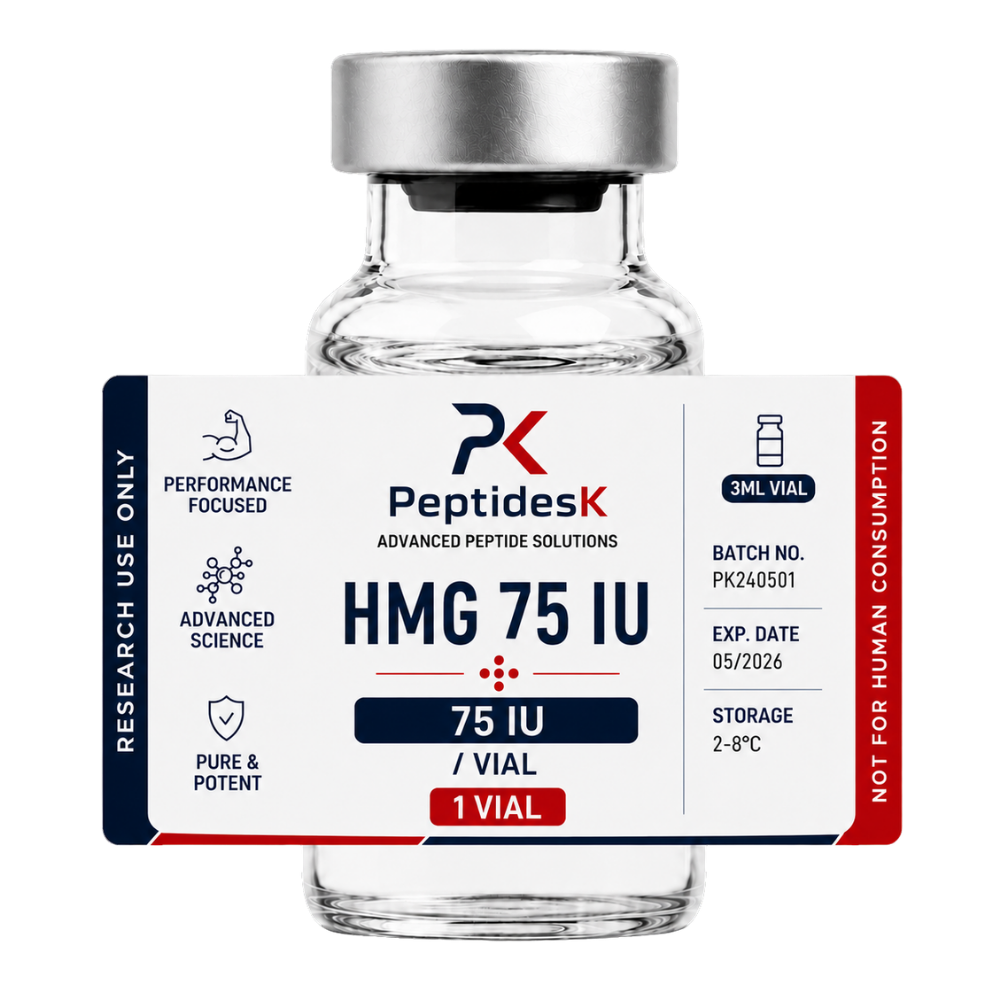
Description
HMG 75 IU Core Specifications
Deep technical specification parameters optimized for integrating 75 IU HMG into focused, multi-well laboratory screening protocols.
| Research Parameter | Assay Benchmark Profile | Internal Catalog Link |
|---|---|---|
| Active Complex Class | Purified Heterodimeric Glycoprotein Complex (FSH and LH Active Strands) | High-Purity Series → |
| Total Active Yield | 75 IU Follicle-Stimulating Hormone + 75 IU Luteinizing Hormone activity / vial | |
| Purity Baseline | ≥ 98.0% via High-Performance SEC-HPLC | Anti-Aging Compounds → |
| Assay Target | Simultaneous FSHR and LHCGR Dual Pathway Induction Loops |
What Is HMG 75 IU & How Does It Work?
HMG 75 IU (Human Menopausal Gonadotropin, also commonly documented as Menotropins) is a biologically active glycoprotein complex purified for endocrine and reproductive research. Unlike single-chain recombinant proteins, HMG naturally contains a balanced 1:1 bio-activity ratio of both Follicle-Stimulating Hormone (FSH) and Luteinizing Hormone (LH). This dual-action structure allows the compound to engage two distinct cell surface receptor lines at the same time, offering a comprehensive model for laboratory study.
When asking what is HMG 75 IU used for in scientific settings, researchers utilize this standardized 75 IU payload to study cellular steroidogenesis, germ cell development speed, and gonadal hormone loop adjustments. The combination of active FSH (75 IU) and active LH (75 IU) in a single vial provides a clean reference standard for observing complete reproductive feedback mechanisms without needing to combine separate hormone preparations. To view verified third-party lab testing for this product, visit peptidesk.com.
HMG 75 IU Quick Specifications
| Technical Property | Laboratory Standard Specifications |
|---|---|
| Complex Type | Purified Heterodimeric Glycoprotein Architecture |
| Active Core Payload | 75 IU Active FSH + 75 IU Active LH Bio-Potency / Vial |
| Purity Baseline | ≥ 98.0% Pure Certified via High-Grade HPLC Testing |
| Primary Research Focus | Simultaneous FSHR and LHCGR activation, cellular steroidogenesis, and maturation tracking |
Research Compliance Notice: Products supplied as hmg 75 iu lyophilized are provided strictly for in vitro laboratory profiling, cellular research, and scientific testing. They are strictly not approved for clinical human administration, prescription delivery, or personal self-medication.
How Does HMG Work in Laboratory Assays?
Understanding how does HMG work requires tracking its dual interaction with cell surface receptors. HMG operates by binding concurrently to two distinct receptor frameworks on target cells: follicle-stimulating hormone receptors (FSHR) and luteinizing hormone/choriogonadotropin receptors (LHCGR).
This dual activation triggers a series of downstream biochemical events inside the cell matrix:
- FSHR Activation: The FSH component binds to FSH receptors, driving the upregulation of aromatase enzymes. This increases the conversion of androgens into estrogens within target cell lines.
- LHCGR Activation: At the same time, the LH component binds to LH/hCG receptors, stimulating intracellular cyclic AMP (cAMP) accumulation. This cAMP wave promotes cholesterol transport into mitochondria, driving raw steroid synthesis.
- Synergistic Response: By activating both pathways together, researchers can observe natural cellular maturation speeds and complete endocrine feedback loops in a controlled environment.
HMG Core Pathways & Action Matrix
| Target Pathway | Observed Cellular Action | Primary Research Goal |
|---|---|---|
| Dual Gonadotropin Sync | Co-activates FSHR and LHCGR pathways to maximize downstream internal cyclic AMP flux. | Quantifying multi-receptor glycoprotein synergy. |
| Steroidogenesis | Triggers cellular lipid conversion engines to optimize raw steroid synthesis output speeds natively. | Measuring hormone production drop curves. |
| Cellular Maturation | Recruits local transcription networks to facilitate tissue structure development inside target culture lines. | Tracking cellular adaptation speeds under endocrine balance. |
HMG vs HCG: What is the Key Difference?
When setting up endocrine protocols, researchers frequently evaluate HMG vs HCG to determine which compound fits their specific laboratory goals. While both are purified biological glycoproteins used in hormone research, their active ingredients and receptor target profiles differ significantly:
- Active Composition: HCG (Human Chorionic Gonadotropin) contains almost exclusively LH-like activity, targeting LHCGR receptors. HMG (Human Menopausal Gonadotropin) contains an equal 1:1 mixture of both active FSH and active LH.
- Receptor Scope: HCG acts primarily on Leydig cells or luteal cells to stimulate testosterone or progesterone output. HMG acts on both Leydig/luteal cells (via LH) and Sertoli/granulosa cells (via FSH) simultaneously.
- Research Focus: HCG is used to study isolated LH pathway stimulation, whereas HMG is required when researchers need to analyze complete germ cell maturation and dual-gonadotropin signaling.
Menotropins vs HMG: Are They the Same?
If you are reviewing scientific literature comparing menotropins vs HMG, they refer to the exact same biological compound. “Menotropins” is the official pharmacological and medical name assigned to purified Human Menopausal Gonadotropin.
Both names describe a natural extract containing equal parts follicle-stimulating hormone (FSH) and luteinizing hormone (LH). While clinical pharmaceuticals utilize menotropins in reproductive medicine, the freeze-dried HMG 75 IU vial provided for research is an unformulated laboratory standard used to calibrate assays, measure cell receptor occupancy, and track steroid production across tissue cultures.
How Does HMG Compare to Other Research Compounds?
To assist in protocol design, it is helpful to compare the dual-action glycoprotein focus of HMG 75 IU against alternative single-receptor hormones, metabolic peptides, and tissue repair tripeptides available in our laboratory catalog:
| Research Compound | Mechanism of Action | Primary Laboratory Focus | Target Nodes | Compound Class |
|---|---|---|---|---|
| HMG 75 IU(This Product) | Dual FSHR & LHCGR Agonism | Follicular development curves, natural cellular steroidogenesis, and gonadotropin receptor mapping. | FSHR / LHCGR | Purified Glycoprotein |
| HCG 5000 IU | Selective LHCGR Agonism | Isolated LH pathway tracking, Leydig cell steroid production models, and luteal baseline assessments. | LH Receptor Node | Glycoprotein Base |
| KPV 10mg | Intracellular NF-kB Inhibition | Epithelial barrier repair mapping, non-hormonal anti-inflammatory cell loops, and tight junction preservation. | Intracellular Cytoplasm | Tripeptide (3-AA) |
| Retatrutide 10mg | Triple Receptor Agonism | GCGR, GIPR, and GLP-1R sync profiling, intensive lipids oxidation, and high energy expenditure tracking. | GIP/GLP-1/GCG | Modified Peptide |
Storage & Reconstitution Guidelines for HMG 75 IU
Because HMG is a complex heterodimeric glycoprotein, its structure is sensitive to temperature shifts and mechanical friction. Following strict laboratory storage and mixing guidelines ensures that active FSH and LH potencies remain fully stable without loss of bio-activity over time:
- FREEZER (-20°C)
Unopened Lyophilized Powder: Store dry powder vials inside a laboratory freezer at -20°C to -80°C for long-term storage up to 24 months. Protect from direct light. - TRANSIT RESILIENCE
Unmixed Powder: Highly stable during transit; can handle ambient shipping temperatures up to 25°C for up to 3 weeks. Freeze upon arrival. - REFRIGERATOR (2°C – 8°C)
Reconstituted Liquid: Store mixed liquid solutions strictly under refrigeration between 2°C and 8°C. Exhaust active liquid within 7 to 10 days maximum. Do not refreeze liquid.
Step-by-Step Reconstitution Protocol
- Temperature Adaptation: Allow the 75 IU vial to reach room temperature naturally before opening the flip-off seal to prevent moisture condensation.
- Septum Sanitization: Wipe the upper rubber entry stopper with a fresh, sterile isopropyl alcohol swab.
- Controlled Liquid Cascade: Draw your diluent (such as sterile bacteriostatic water or sterile saline) and slowly inject 1ml down the internal glass wall. Let the liquid stream down gently rather than spraying directly onto the powder cake.
- Gentle Dissolution: Do not shake or vortex the vial. Mechanical friction easily disrupts complex glycoprotein bonds. Roll the vial horizontally between your palms until the white powder fully dissolves into a clear liquid.
HMG 75 IU Price, Purity & Where to Buy Online
When evaluating HMG 75 IU price options or preparing to source research compounds, verifying batch quality and laboratory testing is essential. Low-purity glycoproteins can contain degraded subunits or uncalibrated activity levels, leading to inconsistent assay data.
Every batch of our HMG 75 IU USA stock undergoes strict High-Performance Liquid Chromatography (HPLC) testing to confirm a purity threshold of ≥98.0%. To check current batch reports, Certificate of Analysis (COA) records, or to human menopausal gonadotropin 75 iu buy for your laboratory, place your order directly through peptidesk.com.
Analytical Verification & Lab Reports: Inspect our latest batch-specific HPLC purity charts, mass spectrometry results, and independent COA documents directly on our PeptidesK Third-Party Lab Testing Page.
Shop by Goal Categories
Explore our high-purity research compounds and peptides categorized by primary experimental targets and research goals:
| Goal Category | Primary Research Focus |
|---|---|
| Anti-Aging & Longevity Peptides → | Cellular renewal, telomere maintenance, and anti-senescence research models. |
| Fat Loss & Metabolic Peptides → | Incretin mimetics, lipolysis acceleration, and metabolic flexibility profiling. |
| Muscle Growth & Building Peptides → | Anabolic signaling, GH secretagogues, and protein synthesis acceleration. |
| Recovery & Healing Peptides → | Soft tissue repair, tendon-to-bone recovery, and systemic cell migration. |
| Focus & Cognitive Peptides → | Nootropic signaling, neuroprotection, and synaptic plasticity assays. |
There are no reviews yet.