
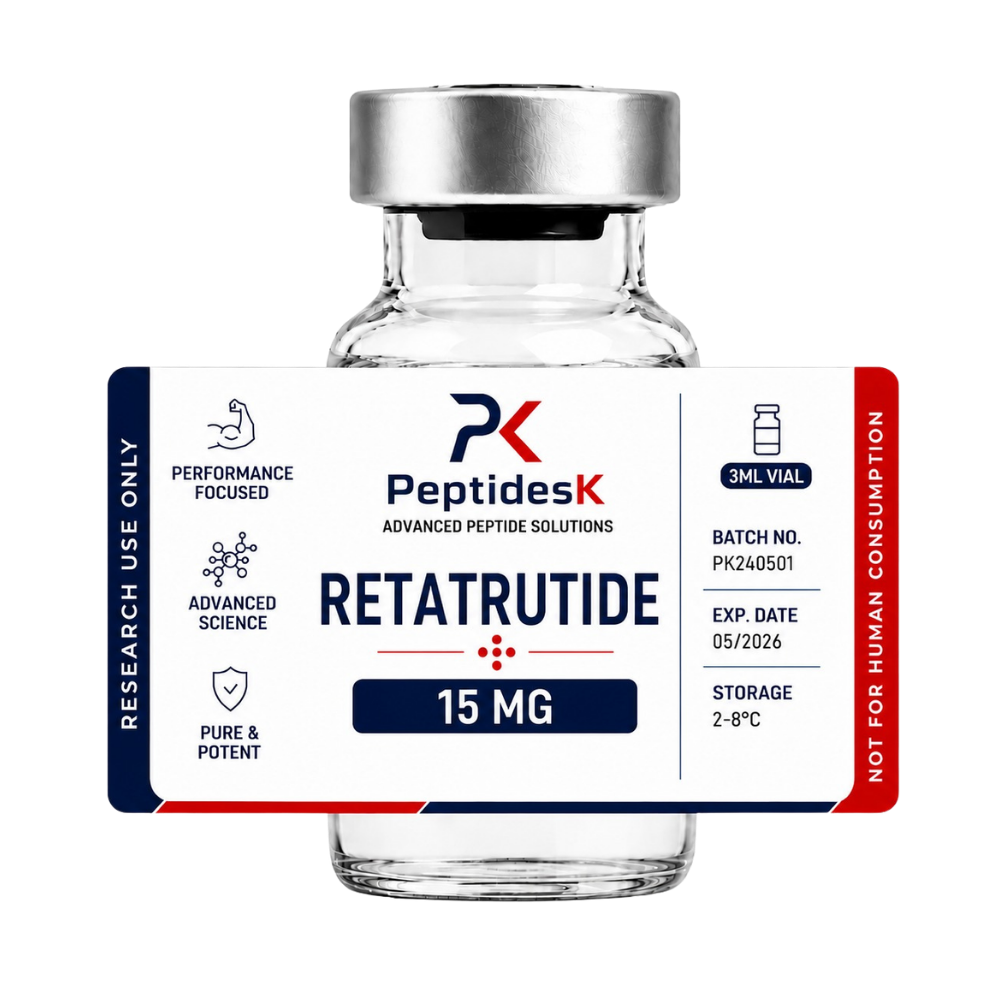
Description
Retatrutide 15mg Core Specifications
Deep technical specification parameters optimized for integrating 15mg Retatrutide into focused, multi-well laboratory screening protocols.
| Research Parameter | Assay Benchmark Profile | Internal Catalog Link |
|---|---|---|
| Sequence Blueprint | Modified 39 Amino Acid Peptide Complex (GIP / GLP-1 / Glucagon Tri-Agonist Base) | High-Purity Series → |
| Molecular Weight | 4731.4 Da (Stabilized with a customized C20 fatty diacid chain modification) | |
| Purity Baseline | ≥ 98.0% via High-Performance HPLC Testing | Metabolic – Weight Loss Peptides → |
| Assay Target | Concurrent GIPR, GLP-1R, and GCGR Multi-Pathway Saturation Loops |
What Is Retatrutide 15mg & How Does It Work?
Retatrutide 15mg (developmental code LY3437943) is an advanced multi-receptor bio-peptide engineered to function as a potent triple agonist targeting Glucose-Dependent Insulinotropic Polypeptide (GIP), Glucagon-Like Peptide-1 (GLP-1), and Glucagon (GCG) receptors. Synthesized as a modified 39-amino-acid acylated sequence, this compound incorporates a C20 lipophilic fatty acid tail that extends its active metabolic tracking window and protects the molecule against early degradation by dipeptidyl peptidase-4 (DPP-4). In contemporary endocrinology research, this specialized 15mg vial configuration offers a balanced, highly controlled payload for intermediate trial rows, preliminary titration profiling, and cell-line metabolic flux assays without the risk of reconstituted material waste. To inspect verified analytical documentation, visit peptidesk.com.
Retatrutide 15mg Quick Specifications
| Technical Property | Laboratory Standard Specifications |
|---|---|
| Chemical Structure | Acylated 39-AA Peptide Chain (Triple-Incretin Agonist Base) |
| Active Core Payload | 15mg Purified Crystalline Powder / Vial (Mid-Tier Setup) |
| Purity Baseline | ≥ 98.0% Pure Certified via HPLC & Mass Spectrometry Assays |
| Primary Target Node | Simultaneous GIPR/GLP-1R/GCGR activation & direct fatty acid oxidation |
Research Compliance Notice: Materials offered as buy retatrutide 15mg are supplied strictly for in vitro laboratory profiling, metabolic research, and cellular assays. They are strictly not approved for human clinical administration, prescription delivery, or self-medication.
Retatrutide Mechanism of Action: Triple Agonism Dynamics
Understanding the cellular retatrutide mechanism of action requires analyzing its selective binding mechanics across three independent endocrine pathways. Upon entering target cell media, the compound docks concurrently into GIP, GLP-1, and Glucagon surface receptors, initiating a synchronized downstream signaling sequence:
- GIP Pathway Activation: Enhances glucose-dependent insulin secretion and improves adipocyte lipid buffer handling while reducing gastrointestinal sensitivity.
- GLP-1 Pathway Activation: Drives cyclic AMP (cAMP) accumulation, suppressing postprandial glucagon spikes and slowing gastric motility to regulate satiety.
- Glucagon (GCG) Pathway Activation: Uniquely stimulates hepatic lipid oxidation, forcing cells to burn stored lipids and raising basal thermogenic energy expenditure.
Retatrutide Core Pathways & Action Matrix
| Target Pathway | Observed Cellular Action | Primary Research Goal |
|---|---|---|
| Triple Receptor Sync | Co-activates GIP, GLP-1, and GCG pathways to maximize downstream internal cyclic AMP flux. | Quantifying multi-receptor incretin and glucagon synergy. |
| Lipid Oxidation | Recruits glucagon pathways to directly accelerate fatty acid breakdown inside adipocyte rows. | Measuring the deceleration speed of new tissue fat accumulation. |
| Energy Kinetics | Forces cells to prioritize burning stored lipid parameters, enhancing baseline cellular metabolic rates. | Mapping high-yield non-shivering heat generation curves natively. |
Retatrutide Weight Loss Results & Clinical Data
In clinical research evaluating retatrutide for weight loss, scientists track substantial body mass reductions and metabolic rate improvements across standardized trial benchmarks:
- Mean Loss Trajectory: Trial data reveals that high-dose test cohorts achieve an average body mass loss exceeding 24% over 48-week trial schedules.
- Hepatic Fat Clearance: Studies document over 80% reduction in liver fat content, indicating rapid clearance of ectopic fat deposits in non-alcoholic fatty liver disease models.
- Sustained Mass Reduction: Unlike single-receptor incretins that hit an early efficacy plateau, Retatrutide maintains a steady downward weight curve through week 48.
- Practical 15mg Format: The 15mg vial offers an economical quantity for medium-term research projects, balancing active compound yield with liquid shelf-life limits.
Retatrutide Phase 3 Clinical Trials Update
The global research trajectory for Retatrutide centers on the ongoing TRIUMPH Phase 3 clinical trial series. These multi-center studies examine long-term metabolic outcome parameters, cardiovascular health markers, and obstructive sleep apnea resolutions secondary to weight loss. Published findings continue to confirm its distinct competitive advantage over dual GIP/GLP-1 and single GLP-1 agonists.
Retatrutide FDA Approval Status
Regarding retatrutide FDA approval status, Retatrutide remains an investigational compound currently undergoing Phase 3 clinical trials. It is not approved by the FDA for commercial prescription or therapeutic human use. Products supplied as a retatrutide research compound are strictly intended for controlled laboratory assays and scientific research protocols.
Retatrutide Side Effects & Tolerability Profile
Evaluating is retatrutide safe requires analyzing recorded adverse effects in clinical trial logging. The most frequent secondary observations include transient mild-to-moderate gastrointestinal responses (nausea, vomiting, diarrhea, and constipation) during early dose-escalation steps. Additionally, a temporary increase in resting heart rate and localized skin sensitivity (hyperesthesia) have been reported. Implementing gradual step-wise dose escalation schedules significantly improves overall gastrointestinal tolerability across test models.
Retatrutide Clinical Dosing Protocols
In experimental protocols, retatrutide dosage parameters follow a conservative step-wise titration schedule. Research models initiate testing at a baseline dose of 2mg once weekly via subcutaneous retatrutide injection, escalating every 4 weeks through 4mg, 8mg, and up to a top maintenance tier of 12mg weekly to optimize tissue receptor tolerance.
Retatrutide vs. Tirzepatide: Dual vs. Triple Agonism
Comparing retatrutide vs tirzepatide highlights the major structural and clinical evolution from dual incretin agonism to triple receptor agonism. Tirzepatide functions as a dual GIP and GLP-1 receptor agonist, leveraging dual-incretin signaling to enhance insulin sensitivity, delay gastric emptying, and suppress appetite, achieving an average weight loss of up to 22.5% in Phase 3 trials. In contrast, Retatrutide introduces a third active mechanism by incorporating direct Glucagon Receptor (GCGR) agonism alongside GIP and GLP-1 activation.
This addition of the glucagon pathway alters cellular bioenergetics. While GIP and GLP-1 primarily manage nutrient absorption, insulin release, and central satiety signals, glucagon directly stimulates hepatic lipid oxidation and increases resting metabolic rate via non-shivering thermogenesis. As a result of this synergistic triple action, clinical trial data demonstrates that Retatrutide exceeds a 24% mean body mass reduction within 48-week observation windows, making it a powerful tool for investigating deep fat clearance and severe metabolic adaptation.
Retatrutide vs. Semaglutide (Ozempic & Wegovy)
Evaluating retatrutide vs semaglutide (found in prescription brands such as Ozempic and Wegovy) illustrates a substantial performance gap between first-generation single GLP-1 mono-agonists and next-generation triple agonists. Semaglutide acts selectively on the GLP-1 receptor, relying heavily on gastric motility deceleration and central nervous system appetite suppression to yield an average weight loss of 15% over 68-week trial durations. While highly effective as a standalone incretin mimetic, its single-receptor mechanism is bounded by natural physiological adaptation and early weight loss plateaus.
Retatrutide bypasses these single-receptor limitations by engaging three independent metabolic nodes simultaneously. By co-activating GIP and Glucagon receptors alongside GLP-1, Retatrutide not only reduces caloric intake but also actively accelerates baseline energy expenditure. Clinical research shows that Retatrutide delivers faster, deeper weight reduction and significantly superior liver fat clearance (achieving over 80% reduction in hepatic steatosis models) in shorter 48-week trial windows, establishing a new baseline for high-potency metabolic research.
Retatrutide vs. Orforglipron: Injectable Triple Agonist vs. Oral GLP-1
Comparing retatrutide vs orforglipron contrasts two distinct engineering approaches in modern endocrinology research: a multi-receptor injectable 39-amino-acid peptide versus a non-peptide, small-molecule oral GLP-1 receptor agonist. Orforglipron represents a breakthrough in oral delivery design, offering a non-invasive daily capsule that bypasses digestive enzyme degradation to selectively stimulate GLP-1 surface receptors, making it an ideal candidate for evaluating non-injectable baseline glycemic control and patient compliance metrics.
Conversely, Retatrutide is designed for maximum metabolic force via weekly subcutaneous injection. While Orforglipron targets a single receptor pathway through oral bioavailability, Retatrutide’s acylated peptide backbone delivers high-potency triple agonism (GIP/GLP-1/Glucagon). This allows researchers to study complex metabolic interactions—such as direct adipocyte lipolysis, thermogenic heat generation, and dramatic systemic fat mobilization—that single oral GLP-1 mimetics cannot replicate. Understanding these structural and route-specific differences enables laboratories to select the exact compound required for their specific metabolic assay goals.
Retatrutide Half-Life & Pharmacokinetics
Thanks to its C20 fatty acid modification that binds to endogenous plasma proteins, the retatrutide half-life is approximately 6 days (144 hours). This extended biological half-life supports convenient once-weekly administration schedules in experimental models.
Retatrutide Reconstitution & Storage Protocols
- FREEZER (-20°C)
Lyophilized Powder: Store dry powder vials inside a laboratory freezer at -20°C to -80°C for long-term stability up to 24 months. - TRANSIT RESILIENCE
Unreconstituted Powder: Highly stable during transit; can endure ambient temperatures up to 25°C for up to 3 weeks. Freeze upon arrival. - REFRIGERATOR (2°C – 8°C)
Reconstituted Solution: Store liquid solutions under refrigeration between 2°C and 8°C. Exhaust active liquid within 10 to 14 days maximum. Do not refreeze.
Step-by-Step Reconstitution Protocol for Retatrutide 15mg
- Allow the 15mg vial to naturally reach room temperature equilibrium before removing the flip-off cap.
- Sanitize the upper rubber stopper using a sterile isopropyl alcohol wipe.
- Slowly inject sterile bacteriostatic water down the internal glass envelope wall to avoid mechanical impact.
- Do not shake or vortex. Gently roll the vial horizontally between your palms until the white cake completely dissolves into a crystal-clear liquid.
LY3437943 Research Sourcing
As a trusted retatrutide supplier committed to quality, PeptidesK provides batch-certified retatrutide 15mg vials verified via high-performance liquid chromatography (HPLC) and mass spectrometry analysis. To inspect third-party testing reports or buy retatrutide peptide for laboratory research applications, order directly from peptidesk.com.
Analytical Verification & Lab Reports: Inspect our latest batch-specific HPLC purity charts, mass spectrometry results, and independent Certificates of Analysis (COA) directly on our PeptidesK Third-Party Lab Testing Page.
Shop by Goal Categories
Explore our high-purity research compounds and peptides categorized by primary experimental targets and research goals:
| Goal Category | Primary Research Focus |
|---|---|
| Anti-Aging & Longevity Peptides → | Cellular renewal, telomere maintenance, and anti-senescence research models. |
| Fat Loss & Metabolic Peptides → | Incretin mimetics, lipolysis acceleration, and metabolic flexibility profiling. |
| Muscle Growth & Building Peptides → | Anabolic signaling, GH secretagogues, and protein synthesis acceleration. |
| Recovery & Healing Peptides → | Soft tissue repair, tendon-to-bone recovery, and systemic cell migration. |
| Focus & Cognitive Peptides → | Nootropic signaling, neuroprotection, and synaptic plasticity assays. |



There are no reviews yet.