
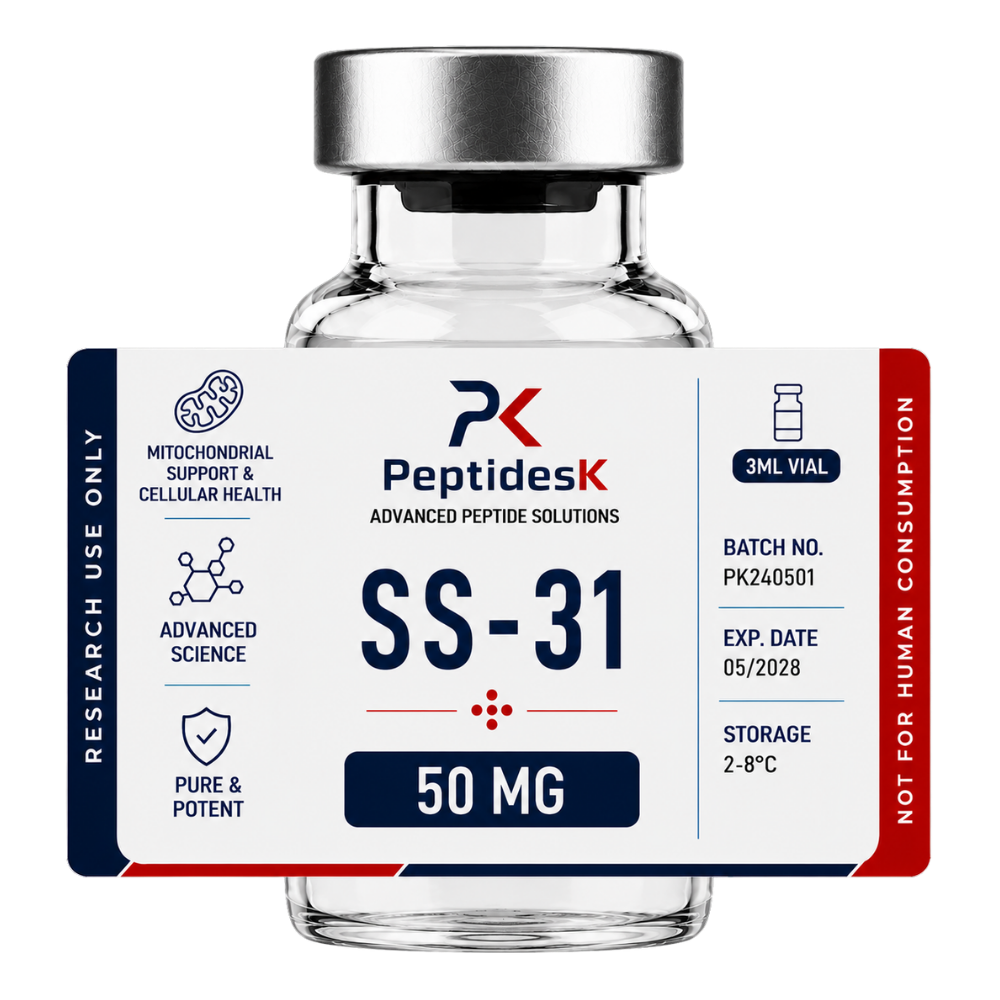
Description
Quick-Reference Overview Matrix
For efficient laboratory evaluation, the matrix below consolidates the core analytical, storage, and cross-reference parameters of SS-31 50mg.
| Core Parameter | Technical Summary & Quick Data | Internal Cross-Reference |
|---|---|---|
| Purity & Grade | ≥ 98% HPLC Certified Sterile filtered, vacuum-sealed lyophilized cake optimized for bioenergetic assays. | View High-Purity Series → |
| Primary Target Path | Cardiolipin Binding: Selectively targets the inner mitochondrial membrane, optimizing electron transport chain efficiency and preventing ROS generation. | Cellular Longevity Series → |
| Storage Protocol | Lyophilized: -20°C to -80°C (Up to 24 months). Reconstituted: 2°C to 8°C (Must use within 10–14 days). | Buy Reconstitution Diluents → |
| Synergistic Assays | Frequently evaluated alongside epigenetic DNA regulators like Epitalon or cellular recovery chains for longevity and aging models. | Pair with Epitalon 10mg → |
What Is SS-31 & How Does It Work?
SS-31 (widely documented in scientific literature as Elamipretide or Bendavia) is a synthetic, cell-permeable tetrapeptide designed with a unique structural motif that specifically targets mitochondria. Composed of alternating aromatic and basic amino acids (featuring the exact SS-31 amino acid sequence D-Arg-2′,6′-Dmt-Lys-Phe-NH2), this low-molecular-weight compound crosses plasma membranes independent of receptor-mediated pathways and concentrates selectively at the inner mitochondrial membrane.
In analytical laboratories, biological aging models, and cellular bioenergetics research, our high-purity SS-31 50mg vial serves as a premier reference standard. Having a high-yield 50mg lyophilized vial allows researchers to conduct long-term assay timelines, microfluidic cell tracking, and high-throughput screening without baseline data noise caused by batch variance. To review verified batch documentation and third-party testing for this product, visit peptidesk.com.
SS-31 50mg Quick Specifications
| Technical Property | Specification Standard |
|---|---|
| Product Format | 50mg Purified Lyophilized Powder / Vial |
| Sequence | D-Arg-2′,6′-Dmt-Lys-Phe-NH2 |
| Molecular Formula | C32H49N9O5 |
| Molecular Weight | 639.8 g/mol |
| Purity Baseline | ≥ 98.0% Certified via HPLC Assays |
| Physical Appearance | Sterile filtered, white lyophilized crystalline cake |
| Core Target Nodes | Inner Mitochondrial Membrane, Cardiolipin Lipids, Electron Transport Chain |
Research Compliance Notice: Products supplied as an SS-31 research peptide USA standard are provided strictly for in vitro laboratory profiling, cellular assays, and scientific research. They are strictly not approved for human clinical use, therapy, or personal consumption.
How Does SS-31 Work in Laboratory Assays?
Inquiries into how does SS-31 work at the sub-cellular level focus on its high affinity for cardiolipin, an essential polyunsaturated phospholipid found exclusively within the inner mitochondrial wall. By electrostatic and hydrophobic interactions, SS-31 inserts itself directly into cardiolipin-rich membrane domains.
This targeted binding mechanism drives several protective biological pathways:
- Mitigation of SS-31 Oxidative Stress: Anchoring cardiolipin prevents lipid peroxidation when exposed to free radicals, significantly curbing mitochondrial Reactive Oxygen Species (ROS) generation.
- Optimization of SS-31 Mitochondrial Bioenergetics: Stabilizing cristae architecture optimizes electron transfer across Electron Transport Chain complexes (Complex I-IV), dramatically enhancing ATP synthesis rates.
- Ischemia & Cellular Protection: Prevents mitochondrial permeability transition pore (mPTP) opening, protecting cells against apoptotic pathways during oxygen deprivation and reperfusion assays.
Core Pathways & Action Matrix
| Target Pathway | Observed Cellular Action | Primary Research Goal |
|---|---|---|
| Cardiolipin Binding | Selectively anchors inner mitochondrial membrane lipids to preserve cristae structure. | Quantifying mitochondrial structural integrity under stress. |
| ROS Suppression | Limits electron leakage along the transport chain to decrease harmful reactive oxygen output. | Measuring oxidative damage in ischemic cell models. |
| ATP Yield Upregulation | Restores electron transport chain efficiency to elevate cellular energy production natively. | Tracking bioenergetic recovery in aging cell lines. |
SS-31 Research Applications & Cellular Bioenergetics
In modern biochemistry, renal disease models, and age-related metabolic publications, SS-31 elamipretide is evaluated for its capacity to restore cellular energy kinetics during metabolic stress. Scientists utilize this 50mg format to build high-yield titration curves and observe cellular recovery across stressed tissue matrices.
Primary areas of scientific evaluation include:
- Renal & Myocardial Ischemia Models: Assessing organ preservation parameters and tissue survival rates following acute oxygen deprivation.
- Age-Associated Mitochondrial Decline: Investigating how cardiolipin stabilization restores youthful ATP generation capacity in aging muscle and neural cell lines.
- Neuroprotective Assays: Evaluating reductions in oxidative stress markers across neuronal cultures exposed to neurotoxic stressors.
Research Overview: Benefits vs. Technical Limitations
| Observed Research Benefits | Technical Risks & Limitations |
|---|---|
| • Rapid Membrane Penetration: Low molecular weight and alternating basic/aromatic architecture allow the compound to cross outer cell envelopes instantly without active transport. | • Concentration Saturation: Extremely high assay doses can oversaturate cardiolipin sheets, occasionally masking structural baseline data during transport tracking. |
| • High Stability in Powder Form: The presence of a D-amino acid (D-Arg) at its starting anchor provides superior peptide-chain resistance against ambient storage degradation. | • Solubilized Sensitivity: Once reconstituted into liquid form, the compound remains vulnerable to structural denaturing if exposed to light or temperature spikes. |
How Does SS-31 Compare to Other Research Peptides?
To assist in experimental protocol coordination, the table below provides a comparative analysis of SS-31 50mg against alternative mitochondrial, anti-aging, and longevity compounds in our catalog:
| Research Peptide | Mechanism of Action | Primary Laboratory Focus | Target Nodes | Peptide Structure |
|---|---|---|---|---|
| SS-31 50mg(This Product) | Cardiolipin Targeting | Inner mitochondrial wall stabilization, ATP yield upregulation, and ROS suppression. | Cardiolipin Lipids | Tetrapeptide (4-AA) |
| Epitalon 10mg | TERT Gene Promoter | Telomerase enzyme activation, telomere elongation, and lifespan expansion. | Nuclear DNA / TERT | Tetrapeptide (4-AA) |
| MOTS-c 10mg | AMPK Pathway Activation | Mitochondrial-derived metabolic regulation, glucose uptake tracking, and cellular homeostasis. | AMPK Pathway | Polypeptide (16-AA) |
Storage & Reconstitution Guidelines for SS-31 50mg
To preserve the tetrapeptide structure and protect your batch yield from hydrolysis pathways, proper temperature management and gentle handling are required:
- FREEZER (-20°C)
Unopened SS-31 Lyophilized Powder: Store dry freeze-dried powder vials in a laboratory freezer at -20°C to -80°C for long-term stability up to 24 months. Protect from light. - TRANSIT RESILIENCE
Unmixed Powder: Highly resilient during transit; can withstand ambient shipping temperatures up to 25°C for up to 3 weeks. Place in freezer storage upon arrival. - REFRIGERATOR (2°C – 8°C)
Reconstituted Liquid Phase: Store mixed liquid solutions under strict refrigeration between 2°C and 8°C. Exhaust active liquid within 10 to 14 days maximum. Do not refreeze liquid solutions.
Step-by-Step Reconstitution Protocol
- Temperature Adaptation: Allow the 50mg vial to reach room temperature naturally before opening the cap to prevent condensation moisture from forming inside the glass.
- Septum Sanitization: Wipe the upper rubber entry stopper thoroughly using a fresh, sterile isopropyl alcohol swab.
- Controlled Diluent Addition: Using a sterile syringe, slowly inject 1ml to 3ml of sterile bacteriostatic water down the inside glass wall of the vial rather than spraying directly onto the powder cake.
- Gentle Dissolution: Do not shake or vortex the vial. Gently roll the vial horizontally between your palms until the dense 50mg cake completely dissolves into a clear liquid.
SS-31 Purity, Price & Buying Online in the USA
When preparing to buy SS-31 peptide online or researching competitive elamipretide 50mg price points, verifying third-party analytical quality is critical. Low-grade peptides containing truncated fragments or chemical residues can impair cardiolipin binding assays and produce inaccurate lab data.
Every lot of our SS-31 peptide USA inventory is verified using High-Performance Liquid Chromatography (HPLC) and Mass Spectrometry (MS) to guarantee an ultra-high SS-31 99% purity baseline (≥98.0% certified). Whether you need an established SS-31 peptide supplier or wish to buy elamipretide in bulk, place your order directly through peptidesk.com.
Analytical Verification & Lab Reports: Inspect our latest batch-specific HPLC purity charts, mass spectrometry results, and independent COA documents directly on our PeptidesK Third-Party Lab Testing Page.
Order certified SS-31 50mg for sale USA Stock with fast domestic shipping, visit peptidesk.com.
Shop by Goal Categories
Explore our high-purity research compounds and peptides categorized by primary experimental targets and research goals:
| Goal Category | Primary Research Focus |
|---|---|
| Anti-Aging & Longevity Peptides → | Cellular renewal, telomere maintenance, and anti-senescence research models. |
| Fat Loss & Metabolic Peptides → | Incretin mimetics, lipolysis acceleration, and metabolic flexibility profiling. |
| Muscle Growth & Building Peptides → | Anabolic signaling, GH secretagogues, and protein synthesis acceleration. |
| Recovery & Healing Peptides → | Soft tissue repair, tendon-to-bone recovery, and systemic cell migration. |
| Focus & Cognitive Peptides → | Nootropic signaling, neuroprotection, and synaptic plasticity assays. |

There are no reviews yet.