
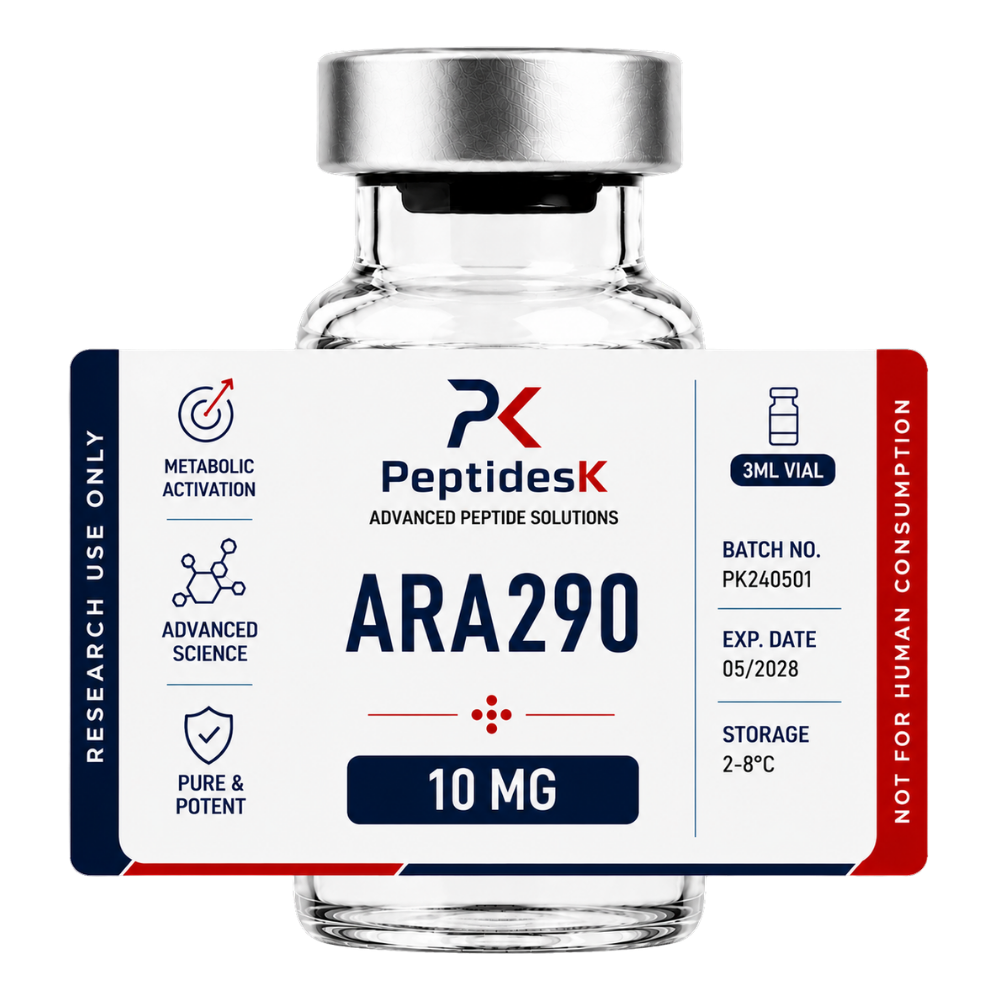
Description
ARA-290 10mg Core Specifications
Deep technical specification parameters optimized for integrating 10mg ARA-290 into focused, multi-well laboratory screening protocols.
| Research Parameter | Assay Benchmark Profile | Internal Catalog Link |
|---|---|---|
| Sequence Blueprint | Pyr-Glu-Gln-Leu-Glu-Arg-Ala-Leu-Asn-Ser-Ser (11-AA Helix B Derived Peptide) | High-Purity Series → |
| Molecular Weight | 1257.4 Da (Stabilized, short linear peptide architecture) | |
| Purity Baseline | ≤ 98.0% via High-Performance SEC-HPLC | Anti-Aging Compounds → |
| Assay Target | Selective Innate Repair Receptor (IRR) Heterodimer Activation |
What Is ARA-290 Peptide & How Does It Work?
ARA-290 peptide (also widely documented in scientific literature as Cibinetide) is an 11-amino-acid synthetic peptide derived from the detailed 3D structure of erythropoietin (EPO). Specifically, it mimics the non-hematopoietic Helix B loop section of the parent EPO molecule. While natural erythropoietin is well known for stimulating red blood cell production, ARA-290 possesses a distinct molecular layout that prevents it from binding to classic homodimeric EPO receptors. As a result, this specialized ARA-290 tissue protective peptide promotes localized cell survival without altering hematocrit levels, red blood cell counts, or blood viscosity parameters.
In modern biological research, this high-purity ARA-290 peptide 10mg vial serves as a premier reference standard for investigating peripheral nerve repair, cellular survival under stress, and small nerve fiber protection. By isolating tissue-protective mechanisms from red blood cell production, researchers can analyze long-term tissue adaptation without facing background cardiovascular or hematological noise. To review verified batch testing documents for this product, visit peptidesk.com.
ARA-290 10mg Quick Specifications
| Technical Property | Laboratory Standard Specifications |
|---|---|
| Chemical Structure | Linear 11-Amino-Acid Peptide Sequence (Erythropoietin Helix B Fragment) |
| Active Core Payload | 10mg Purified Crystalline Powder / Vial (Focused Titration Setup) |
| Purity Baseline | ≥ 98.0% Pure Certified via High-Grade HPLC Assays |
| Primary Research Focus | Selective Innate Repair Receptor (IRR) binding, nerve survival, and cytokine suppression |
Research Compliance Notice: Products supplied as cibinetide research peptide are provided strictly for in vitro laboratory profiling, cellular research, and scientific testing. They are strictly not approved for human clinical administration, medical diagnosis, or personal self-medication.
How Does ARA-290 Work in Laboratory Assays?
Understanding how ARA 290 cibinetide operates requires examining its selective interaction with the Innate Repair Receptor (IRR). The IRR is a unique heterodimeric receptor complex composed of erythropoietin receptor subunits paired with beta-common receptor subunits. Unlike standard EPO receptors expressed on red blood cell precursors, cells display the IRR complex primarily during periods of physical trauma, hypoxia, or severe tissue stress.
When ARA-290 binds to the Innate Repair Receptor, it initiates a series of protective intracellular signals:
- Inhibition of Inflammatory Cascades: Selective IRR engagement shuts down major pro-inflammatory signaling loops, blocking the overproduction of tissue-destroying cytokines such as TNF-alpha, IL-6, and IL-1 beta.
- Anti-Apoptotic Signaling: The peptide activates survival pathways that prevent programmed cell death in threatened or damaged tissue arrays.
- Nerve & Boundary Defense: By stabilizing endothelial tight junctions and protecting small unmyelinated nerve fibers, ARA-290 provides robust ARA-290 cellular protection and accelerates axonal recovery.
ARA-290 Core Pathways & Action Matrix
| Target Pathway | Observed Cellular Action | Primary Research Goal |
|---|---|---|
| IRR Heterodimer Agonism | Binds exclusively to active tissue-protective receptor sites to prompt immediate repair cascades. | Quantifying localized nerve fiber recovery speeds. |
| Neuropathic Defense | Protects peripheral axon boundaries, decreasing cell death rates in damaged nerve rows. | Measuring the survival of small-diameter unmyelinated fibers. |
| Non-Erythropoietic Loop | Bypasses classic red blood cell production channels completely, avoiding hematocrit changes. | Isolating tissue protection from cardiovascular parameter changes. |
ARA-290 Research Applications in Tissue & Nerve Recovery
In analytical neurology, immunology, and regenerative biology, cibinetide peptide research focuses heavily on peripheral nerve repair and microvascular stabilization. Small fiber neuropathy is characterized by the gradual loss or damage of small, unmyelinated nerve fibers responsible for pain and temperature sensation. Research demonstrates that ARA-290 encourages small nerve fiber regeneration, helping restore structural axonal density in damaged nerve models.
Additionally, studies investigating ARA-290 tissue repair and ARA-290 anti-inflammatory activity explore its protective effects in wound healing, renal ischemia, and autoimmune tissue inflammation models. Because this ARA-290 11 amino acid peptide acts specifically on damaged tissues expressing the Innate Repair Receptor, it offers scientists a targeted tool to study localized tissue rescue without disrupting baseline systemic physiology.
How Does ARA-290 Compare to Other Catalog Peptides?
To assist in experimental design, it is helpful to compare the non-hematopoietic, nerve-protective action of ARA-290 against alternative short anti-inflammatory peptides, secretagogues, and cellular coenzymes available in our catalog:
| Research Peptide | Mechanism of Action | Primary Laboratory Focus | Target Nodes | Peptide Structure |
|---|---|---|---|---|
| ARA-290 10mg(This Product) | Selective IRR Heterodimer Agonism | Peripheral small nerve protective mapping, localized tissue repair, and erythropoiesis-free lines. | IRR Complex (Helix B) | Linear Core (11-AA) |
| KPV 10mg | Intracellular NF-kB Inhibition | Epithelial barrier repair mapping, non-hormonal anti-inflammatory cell loops, and tight junction preservation. | Intracellular Cytoplasm | Tripeptide (3-AA) |
| Ipamorelin 5mg | Selective GHSR Agonism | Isolated growth hormone pulse tracking, lipolytic speed mapping, and cellular mass accumulation tracking. | Ghrelin Receptor | Pentapeptide (5-AA) |
| NAD+ 1000mg | Sirtuin Enzyme Substrate | Mitochondrial respiration mapping, sirtuin deacetylation, and global cellular energy restoration. | SIRT1-7 / Mitochondria | Purified Coenzyme |
Storage & Reconstitution Guidelines for ARA-290
Maintaining proper storage conditions is essential to protect the 11-amino-acid linear structure of ARA-290 from premature enzymatic or thermal degradation. Following these handling guidelines ensures consistent assay baselines throughout your testing protocols:
- FREEZER (-20°C)
Unopened Lyophilized Powder: Store dry crystalline powder vials in a laboratory freezer at -20°C to -80°C for long-term stability up to 24 months. Protect from direct light. - TRANSIT RESILIENCE
Unmixed Powder: Highly resilient during shipping; can endure ambient transit temperatures up to 25°C for up to 3 weeks. Place in freezer storage upon receipt. - REFRIGERATOR (2°C – 8°C)
Reconstituted Liquid Phase: Store mixed liquid solutions under strict refrigeration between 2°C and 8°C. Exhaust active liquid within 10 to 14 days maximum. Do not refreeze liquid.
Step-by-Step Reconstitution Protocol
- Temperature Adaptation: Allow the 10mg vial to naturally reach room temperature equilibrium before removing the plastic cap to prevent condensation inside the glass.
- Septum Sanitization: Wipe the upper rubber entry stopper thoroughly using a fresh, sterile isopropyl alcohol wipe.
- Controlled Liquid Cascade: Draw your laboratory diluent (such as sterile bacteriostatic water) and slowly inject 1ml down the internal glass envelope wall. Let the fluid stream down gently rather than spraying directly onto the freeze-dried cake.
- Gentle Dissolution: Do not shake, vibrate, or vortex the vial. Mechanical agitation can shear linear peptide bonds. Gently roll the vial horizontally between your palms until the white powder dissolves into a crystal-clear liquid.
ARA-290 Purity, Price & Buying Online in the USA
When looking to order ARA-290 online or comparing competitive ARA-290 10mg price points, verifying third-party analytical quality is critical. Low-grade peptides containing truncated sequence errors or residual solvents can compromise nerve cell assays and yield unreliable scientific data.
Every lot of our cibinetide peptide USA stock undergoes strict High-Performance Liquid Chromatography (HPLC) testing to confirm an ARA-290 purity baseline of ≥98.0%. Whether you need to source certified cibinetide for sale for academic or clinical laboratory research, place your order directly through peptidesk.com.
Analytical Verification & Lab Reports: Inspect our latest batch-specific HPLC purity charts, mass spectrometry results, and independent COA documents directly on our PeptidesK Third-Party Lab Testing Page.
To buy ARA-290 10mg vials backed by independent batch testing and fast USA domestic delivery, visit peptidesk.com.
Shop by Goal Categories
Explore our high-purity research compounds and peptides categorized by primary experimental targets and research goals:
| Goal Category | Primary Research Focus |
|---|---|
| Anti-Aging & Longevity Peptides → | Cellular renewal, telomere maintenance, and anti-senescence research models. |
| Fat Loss & Metabolic Peptides → | Incretin mimetics, lipolysis acceleration, and metabolic flexibility profiling. |
| Muscle Growth & Building Peptides → | Anabolic signaling, GH secretagogues, and protein synthesis acceleration. |
| Recovery & Healing Peptides → | Soft tissue repair, tendon-to-bone recovery, and systemic cell migration. |
| Focus & Cognitive Peptides → | Nootropic signaling, neuroprotection, and synaptic plasticity assays. |


There are no reviews yet.