
Description
Quick-Reference Overview Matrix
For efficient laboratory evaluation, the matrix below consolidates the core analytical, storage, and cross-reference parameters of Thymosin Alpha-1 10mg.
| Core Parameter | Technical Summary & Quick Data | Internal Cross-Reference |
|---|---|---|
| Purity & Grade | ≥ 98% HPLC Certified Sterile filtered, lyophilized white powder free from structural degradation. | View High-Purity Series → |
| Primary Target Path | Immune System Regulation: Acts as an agonist on TLR2/TLR9 receptors; accelerates cellular defense paths and Th1 cytokine expression. | View All Metabolic Peptides → |
| Storage Protocol | Lyophilized: -20°C to -80°C (Up to 24 months). Reconstituted: 2°C to 8°C (Strictly use within 10–14 days). | Buy Reconstitution Diluents → |
| Synergistic Assays | Frequently co-evaluated alongside cellular recovery and tissue repair compounds for comprehensive multi-pathway research. | Explore Tissue Repair Series → |
*Directions: Use the links in the “Internal Cross-Reference” column to navigate between targeted chemical classes and accessory laboratory items. Detailed molecular structures and mixing steps are available in the dedicated sections below.
Peptide Comparison Matrix
Peptide Comparison Matrix
| Peptide Compound | Primary Mechanism | Core Research Focus | Target Receptors | Molecular Weight |
|---|---|---|---|---|
| Thymosin Alpha-1 (This Product) | Immune Modulation | T-Cell maturation, antiviral paths, and cytokine balance. | TLR2 / TLR9 | 3108.3 g/mol |
| BPC-157 10mg | Angiogenesis & Healing | Tissue regeneration, tendon repair, and gut lining integrity. | VEGFR2 / EGR-1 | 1419.5 g/mol |
| TB-500 10mg | Actin Sequestration | Cell migration, wound healing, and muscle recovery models. | Actin-Binding | 4963.5 g/mol |
| Epitalon 10mg | Telomerase Activation | Cellular longevity, telomere elongation, and circadian rhythms. | Epigenetic DNA | 390.4 g/mol |
Product Details & Specifications
Product Details & Specifications
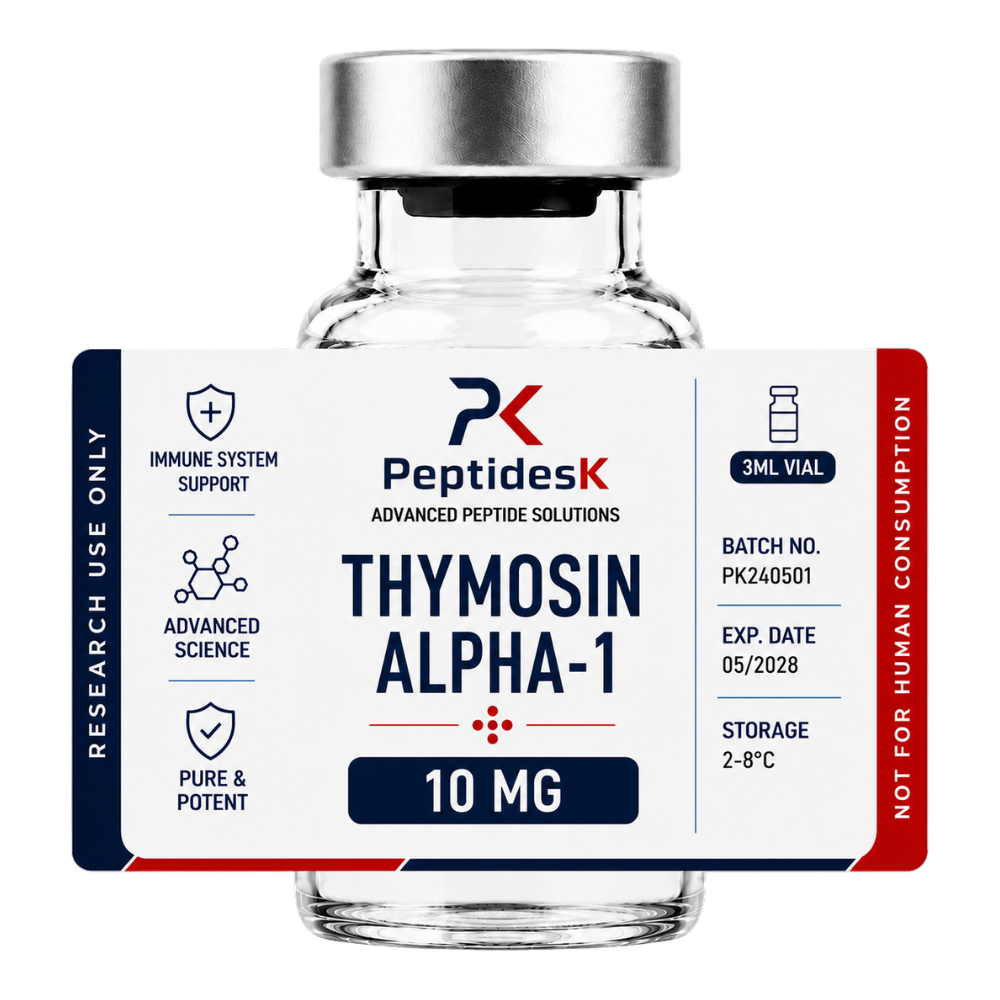
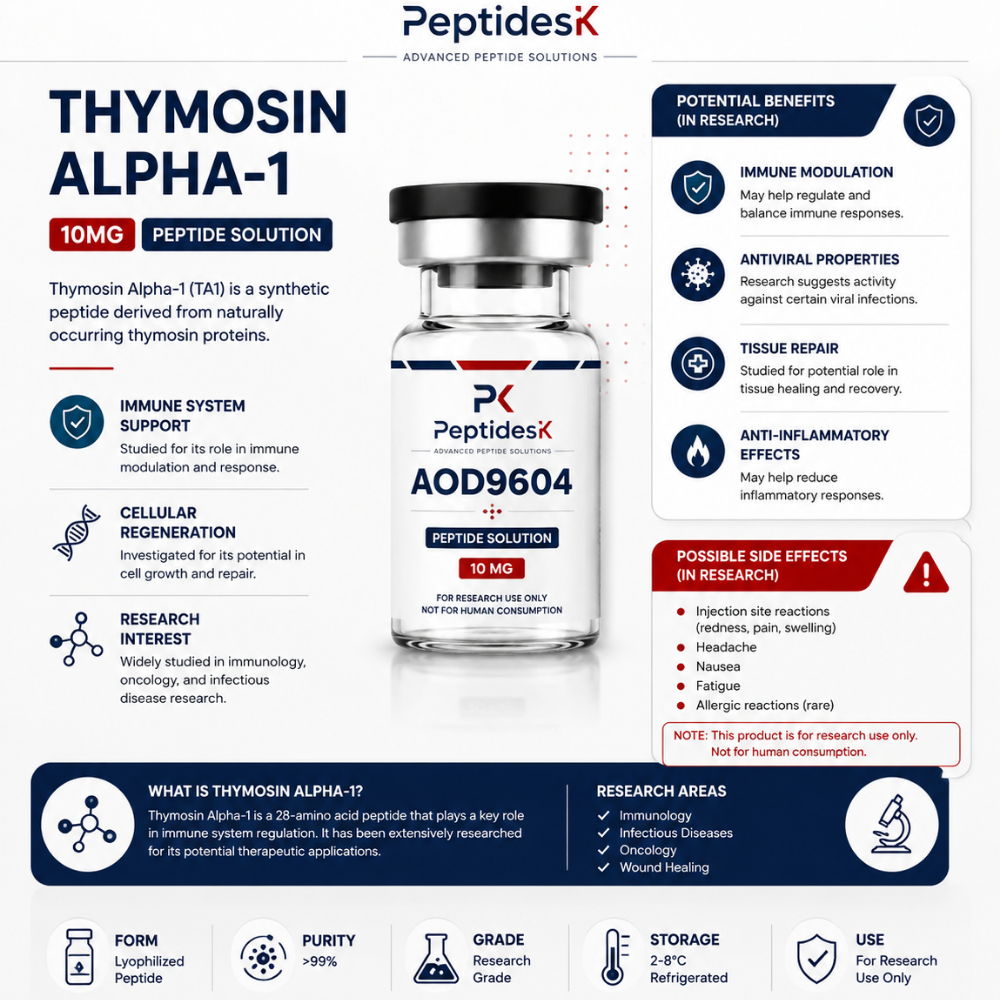
Thymosin Alpha-1 (TA1) is a premium-grade, synthetic peptide fragment comprising 28 amino acids. Originally identified as an endogenous compound isolated from thymus gland tissue, this variant is synthesized to match the natural peptide responsible for modulating cellular immune responses. Our formulation is engineered to the highest analytical standards, explicitly tailored for laboratory research, in vitro diagnostics, and in vivo evaluation.
Thymosin Alpha-1 10mg Overview
| Parameter | Specification |
|---|---|
| Product Format | 10mg Vial (Lyophilized Powder) |
| Sequence | Ac-Ser-Asp-Ala-Ala-Val-Asp-Thr-Ser-Ser-Glu-Ile-Thr-Thr-Lys-Asp-Leu-Lys-Glu-Lys-Lys-Glu-Val-Val-Glu-Glu-Ala-Glu-Asn-OH |
| Molecular Formula | C129H215N33O55 |
| Molecular Weight | 3108.3 g/mol |
| Purity Level | ≥ 98% (HPLC Monitored) |
| Physical Appearance | Sterile filtered, white lyophilized cake/powder |
| Core Research Focus | T-Cell Maturation, TLR2/TLR9 Signaling, Cellular Immunity |
Regulatory Compliance Notice: This product is synthesized, distributed, and intended solely for laboratory research and development purposes. It is strictly not for human therapeutic use, clinical trials, or agricultural applications. Analytical data sheets (HPLC/MS results) are systematically logged per batch and can be verified upon institutional request.
Research & Mechanism of Action
Research & Mechanism of Action
In scientific literature, Thymosin Alpha-1 is widely investigated for its diverse biological effects. Primary research applications focus on how this 28-amino acid peptide impacts cellular response paths. Researchers currently utilize this compound to analyze:
- Immune System Regulation: Investigating its exact role in T-cell differentiation, maturation, and functional balance.
- Antiviral Pathways: Analyzing its regulatory impact on viral replication rates and host cellular defense responses.
- Oncology Research: Studying its potential synergistic mechanisms when combined with other experimental therapeutic agents in cancer research models.
Thymosin Alpha-1 Mechanism of Action
Thymosin Alpha-1 exerts its biological activity primarily by targeting Toll-like receptors (TLRs), specifically acting as an agonist for TLR2 and TLR9 in myeloid dendritic cells. This interaction triggers a downstream signaling cascade that results in the following biological processes:
- Promotes the dynamic production and secretion of Th1 cytokines (such as Interferon-gamma and Interleukin-2).
- Increases Natural Killer (NK) cell population activity and cytotoxicity levels.
- Enhances macrophage-mediated phagocytosis, thereby orchestrating a targeted, coordinated cellular immune response.
Potential Areas of Research
Beyond its classic immunomodulatory profiles, contemporary laboratory studies are expanding the scope of TA1 investigations into broader biomedical fields:
- Chronic Inflammatory Diseases: Evaluating how the peptide balances pro-inflammatory and anti-inflammatory pathways to mitigate tissue stress.
- Vaccine Adjuvant Studies: Exploring its ability to enhance and accelerate specific antibody responses to co-administered antigens.
- Tissue Repair & Regeneration: Investigating potential secondary biological benefits in cellular migration and wound healing models.
Research Overview: Benefits vs. Technical Risks
For laboratory evaluation and experimental design optimization, researchers should weigh the documented biological advantages against the inherent technical risks and limitations of the compound:
| Observed Research Benefits | Technical Risks & Limitations |
|---|---|
| • Potent Immune Modulation: Highly effective in accelerating T-cell maturation and restoring Th1/Th2 balance in compromised cell cultures. | • High Degradation Risk: Highly susceptible to rapid enzymatic degradation if exposed to room temperature beyond transit limits. |
| • High Selectivity: Specific binding to TLR2 and TLR9 reduces non-targeted receptor background noise during assays. | • Narrow Dosage Window: Biphasic dose-responses can obscure data; over-saturation may lead to receptor down-regulation in vitro. |
| • Synergistic Potential: Demonstrates excellent structural stability when combined with antiviral or secondary signaling compounds. | • Reconstitution Sensitivity: Aggressive mechanical shaking breaks peptide chains, rendering the laboratory solution completely inactive. |
Storage & Reconstitution Guidelines
Storage & Reconstitution Guidelines
To prevent premature degradation and maintain the peak structural integrity of the Thymosin Alpha-1 peptide chain, strict adherence to temperature-controlled storage protocols is mandatory:
- LONG-TERM
Lyophilized Powder: Store the freeze-dried powder strictly at -20°C or -80°C. Under these conditions, the compound remains stable for up to 24 months. - SHORT-TERM
Transit Stability: The lyophilized vial can withstand ambient room temperatures (up to 25°C) for up to 3 weeks during logistics without structural loss. Refrigerate immediately upon arrival. - POST-RECONSTITUTION
Liquid Solution: Once reconstituted, store the solution strictly between 2°C and 8°C. Utilize the compound within 10 to 14 days. Do not re-freeze dissolved liquid.
Reconstitution Guidelines
Reconstitution must be executed with extreme care in an aseptic laboratory environment to avoid shearing the delicate 28-amino acid structural backbone:
- Temperature Equilibrium: Remove the Thymosin Alpha-1 vial from storage and allow it to naturally reach room temperature before initiating the reconstitution process.
- Aseptic Preparation: Thoroughly swab the sterile rubber stopper of the vial using a fresh isopropyl alcohol wipe to ensure contaminant-free needle entry.
- Diluent Introduction: Using a sterile syringe, slowly introduce a bacteriostatic or sterile water diluent (recommended volume: 1ml to 2ml). Aim the needle directly against the interior glass wall of the vial rather than forcing liquid directly onto the powder cake.
- Gentle Dissolution (Do Not Shake): Aggressive mechanical agitation will destroy the chemical bonds. Instead, gently swirl the vial in a slow, circular horizontal motion until the lyophilized cake is completely dissolved into a clear, colorless liquid.

There are no reviews yet.